
Review · PRIVATE PALACE TOURS
Beirut to Beiteddine: Private Journey Through Palaces & Villages
The most striking part of this day is the mix of grand palace rooms, a handmade hilltop castle, and a small town where mosque and churches sit close together. Beiteddine Palace gives you Lebanon’s royal and political past in one setting, while Deir al-Qamar feels more intimate and lived-in.
I like the private vehicle and hotel pickup, since the route is much easier without arranging mountain transport yourself. I also like the unusual Moussa Castle stop, a personal project built over decades by Moussa Al Maamari. The main consideration is that admission fees and lunch are not included, so your final cost will be higher than the advertised $70 per person.
Key points at a glance
- Beiteddine Palace takes the largest share of the day, with about 90 minutes to see its public rooms and fountains.
- Moussa Castle is a very personal attraction, built by Moussa Al Maamari from a dream he first had at age 14.
- Deir al-Qamar packs several faiths and centuries into a short walk, including a mosque, churches, and the memory of a synagogue.
- The tour is private, so only your group participates and the vehicle is reserved for you.
- Hotel pickup and drop-off from Beirut simplify a mountain day, especially if you do not want to plan local connections.
- The $70 price is a starting point, since palace and castle entrance tickets, plus lunch, are extra.
From Beirut to the Chouf in a private vehicle
The day begins at 9:00 a.m. with pickup from your Beirut hotel. You travel in a private, air-conditioned vehicle with a driver, accompanied by a tour leader. Since the activity is private, your party does not share the vehicle or schedule with another group.
That private setup matters on a day built around several short stops. You are not tied to a large coach timetable, and you can focus on the places rather than sorting out transport between them. The route heads toward the Chouf District and the mountain town of Beiteddine, with Deir al-Qamar about five kilometers away.
The tour is listed at about eight hours, which gives you a full day outside Beirut without requiring an overnight stay. You should still treat that timing as an estimate. Palace visits, road conditions, and the pace of your own group can affect the day.
The agency also makes a useful impression before the tour begins. Communication by email is available, and arrangements can be discussed in advance. That is worth using if you have questions about pickup, the order of stops, or what you want to see most.
More Private Palace Tours in Beirut:
- Guided Private Full Day Tour to Baalbek, Anjar and Chateau Ksara
★ 5.0 · 60 reviews - Guided Full-Day Private Trip to Cedars, Baalbek and Chateau Ksara
★ 5.0 · 10 reviews - Half-Day Private Tour to Baalbek & Chateau Ksara
★ 5.0 · 8 reviews
Beiteddine Palace, Lebanon’s grand centerpiece
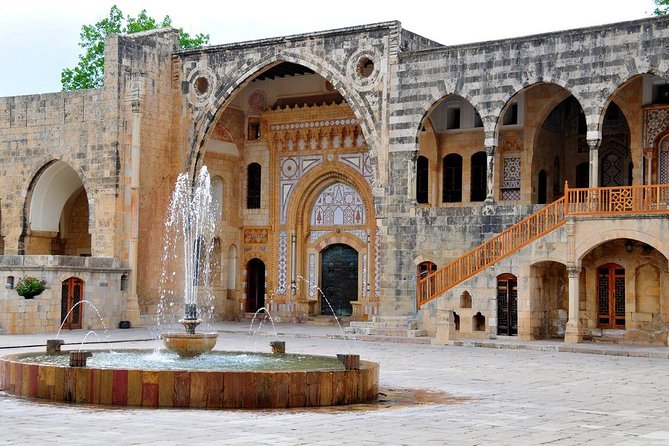
Beiteddine Palace is the main attraction, and the schedule allows about 90 minutes here. Its name means House of Faith, and Emir Bashir Chehab II built it between 1788 and 1818 after becoming ruler of the Mount Lebanon Emirate.
You will see the public parts of a palace that has served several very different roles. After 1840, the Ottomans used it as a government building. During the French Mandate, it became a local administrative office. In 1943, it was declared the official summer residence of the president of Lebanon.
That changing use gives the palace more meaning than a simple old residence. It is tied to the emirate, Ottoman administration, the French Mandate, and modern Lebanese government. I find that context useful because it helps you read the rooms as political spaces, not just decorated interiors.
The palace is known for elaborate rooms and fountains. The water features are an important part of the visit, giving the complex a sense of movement and ceremony. You will also see the effects of its troubled recent past. The building suffered heavy damage during the Lebanese Civil War, and only part of the palace is open to the public today. The rest remains the president’s summer residence.
That restricted access is both a limit and a reminder that this is still more than a museum. You will not wander through every room, so do not expect a completely open palace complex. The 90-minute stop should be enough for the public areas, but it will feel short if you like to examine architecture slowly or take many photographs.
Admission is not included in the tour price. I would check the current fee before departure and keep some flexibility in your budget. The palace is the stop that most justifies the day, so an entrance charge is worth factoring into the total rather than treating the advertised $70 as the final amount.
Moussa Castle and one man’s lifelong project
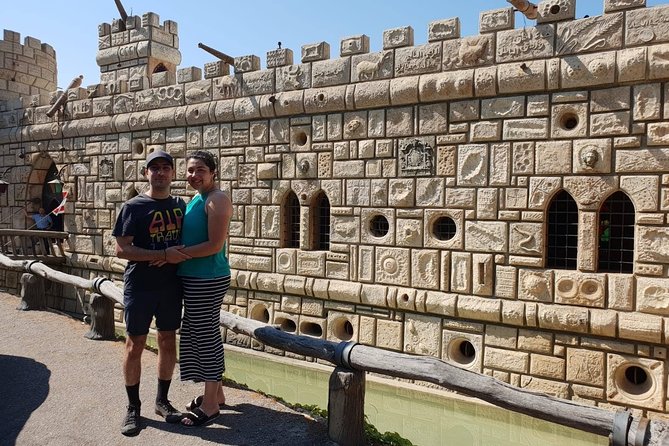
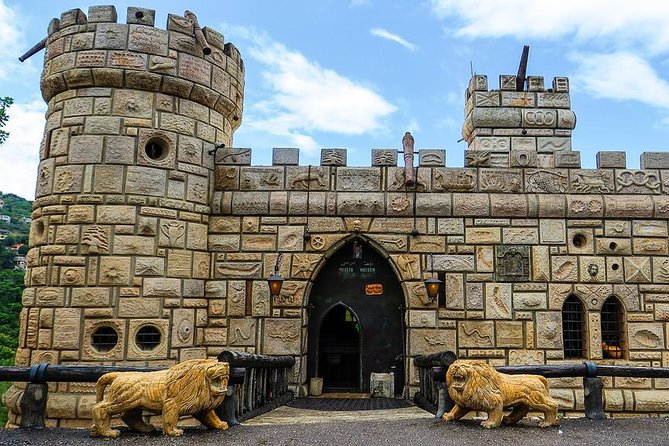
The stop at Moussa Castle lasts about 30 minutes. That is brief, but the site is unlike the formal palace at Beiteddine. Qasr Moussa tells the story of Moussa Al Maamari, who was born on July 27, 1931, and spent years pursuing the idea of building his own castle.
The story begins when he was 14. He wanted to impress a local girl he loved, and the dream of a castle stayed with him. The result is a handmade fortress on the hill between Deir al-Qamar and Beiteddine, with Moussa’s beliefs and ideas engraved into its stones.
I like this stop because it changes the tone of the day. Beiteddine represents rulers, governments, and public power. Moussa Castle is more personal, driven by one person’s imagination and determination. It gives you something to think about beyond the usual royal rooms and official monuments.
The 30-minute visit is enough for an introduction, but not a long study of every detail. If you are traveling with children or teenagers, this may be the most immediately engaging stop because the story is easy to grasp and the building itself is unusual. It also has appeal for adults who enjoy handmade places with a strong backstory.
Admission is extra here as well. Since the tour includes two paid attractions, ask about the combined entrance cost when planning your budget. The short visit may be less appealing if you prefer to spend all your time at major historic monuments, but it adds variety and keeps the day from feeling like one palace after another.
Deir al-Qamar, a town shaped by many faiths
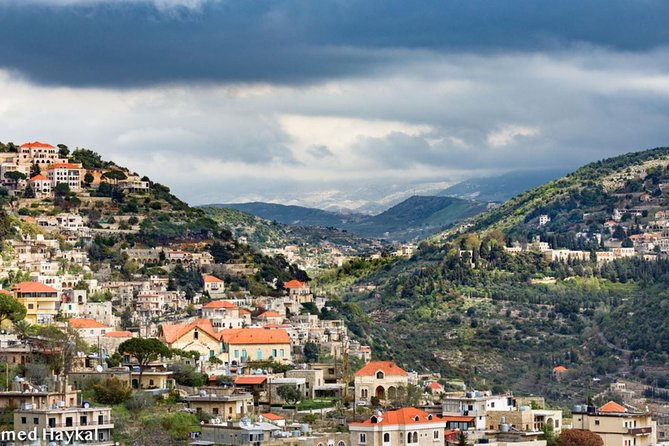
Deir al-Qamar means Monastery of the Moon. The town lies in the Chouf District, southeast of Beirut and close to Beiteddine Palace. The scheduled visit includes the municipal area, Fakhreddine’s Mosque, and Saydet El Talle Church.
The town has an important civic distinction. It was the first village in Lebanon to have a municipality, established in 1864. It is also associated with artists, writers, and politicians. That combination gives Deir al-Qamar a civic character as well as a religious one.
The town’s past has not been peaceful. In 1860, Deir al-Qamar was destroyed during fighting between Druze and Christians, and much of it was set ablaze. Napoleon III sent a French contingent to help rebuild it. As you walk through the town, that history helps explain why the buildings and religious sites carry such weight.
What I find especially valuable is the record of different communities living in the same town. Deir al-Qamar had a mosque, a synagogue, and Christian churches, reflecting a more varied local society than a quick visit might suggest. The tour does not treat the town as a single-story Christian or Muslim site. It gives you several points from which to understand its past.
The municipal stop is listed at about 30 minutes and does not require an admission ticket. That is enough to get your bearings and see the main features, but it is not a long walking tour. You will want to stay aware of the schedule, especially if you stop for photographs or pause to study the architecture.
More Palaces to Tour in Beirut:
- Deir el Qamar – Beiteddine Palace – Chouf Cedars From Beirut
★ 5.0 · 7 reviews - Deir Al-Qamar, Beiteddine Palace and Barouk Cedars Tour
★ 4.5 · 6 reviews - DeirElkamar, Beitdeen, Moussa Palace, EinwZien Grotto,Full-Day Trip PRIVATE-CAR
★ 5.0 · 5 reviews - Palace of Dreams – Oyoun El Samak – Zahlan Grotto – Jabal El Arbaaine
★ 4.5 · 5 reviews
Fakhreddine’s Mosque and its octagonal minaret
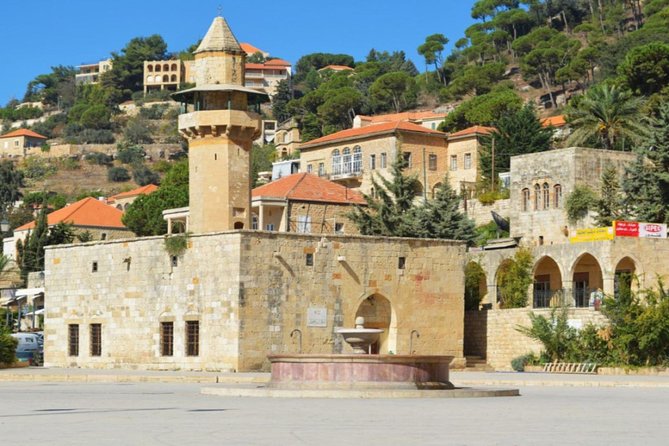
Fakhreddine’s Mosque takes about 15 minutes. Built in 1493 and restored in the 16th century by Fakhreddine I, it is described as the oldest mosque in Mount Lebanon.
The octagonal minaret is the key detail to watch for. In a short stop, a single architectural feature can help you remember the site, and this minaret gives the mosque a clear visual identity. The building also provides another layer to Deir al-Qamar’s shared religious past.
There is no admission fee listed for the mosque. The visit is concise, so you should not expect an extended interior tour or a long period for independent exploration. Still, it is a worthwhile pause because it places Islamic history directly alongside the Christian sites that follow.
I would listen closely to the tour leader here. With only 15 minutes, the explanation matters more than simply looking at the exterior. The site is easy to pass quickly, but its age and place in Mount Lebanon’s history make it more than a photo stop.
Saydet El Talle Church and the hill legend
The Church of Saidet et Tallé, also called Our Lady of the Hill, is another 15-minute stop in Deir al-Qamar. It dates to the 15th century and is regarded as one of the town’s major religious and historic sites.
The church was built by Monk Nicolas Smisaati over the remains of an older Phoenician temple dedicated to Astarte. That earlier structure was later destroyed by an earthquake in 859. The site therefore brings together several layers of belief, from the ancient Phoenician period to Christian worship today.
A local legend adds another memorable detail. A Druze emir in Baakline is said to have seen a light coming from the hill of Deir al-Qamar. He ordered his soldiers to dig there, with instructions to build either a mosque or a church depending on which religious symbol they found. The story connects the hill to the town’s wider pattern of shared religious space.
Like the mosque, the church visit is short and admission is free. You should see it as part of a compact historical walk rather than a full religious tour. The value comes from the connection between the church, the ancient site beneath it, the earthquake, and the local legend.
What the $70 price really covers
At $70 per person, this tour is priced as a private transport and guiding day rather than as a bundle of every expense. The price includes hotel pickup and drop-off, a tour leader, comfortable private transportation, and an air-conditioned vehicle.
It does not include lunch or admission tickets. That distinction is important because Beiteddine Palace and Moussa Castle both charge separately. Your total cost will depend on the current entrance fees and whatever you spend on food.
I see the value most clearly if you are traveling with family, friends, or a small group that wants its own vehicle. The price buys convenience and a full route from Beirut to several sites that would be awkward to link together independently. Group discounts are also offered, though the exact terms are not provided, so ask about them before booking.
For a solo visitor, $70 may feel less like a bargain once admissions and lunch are added. For several people sharing a private day, the calculation can look better. You are paying for door-to-door transport, a planned route, and a guide rather than only buying entry to one monument.
Who will get the most from this day
I would recommend this experience to you if you want a broad introduction to the Chouf area in one outing. It suits first-time visitors who want major historic sites without arranging several separate transfers.
Families may especially enjoy the range of stops. Children and teenagers can respond to the story behind Moussa Castle, while adults may prefer the palace and the religious architecture in Deir al-Qamar. The schedule also keeps each stop focused, which can help younger visitors avoid a long, repetitive museum day.
The tour works well for anyone who values privacy. You travel only with your own group, and hotel pickup removes the need to find an early meeting point in Beirut. The air-conditioned vehicle is another practical benefit for a long day that includes several road segments.
I would be more cautious if your main goal is slow photography, extended time inside Beiteddine Palace, or a long lunch in Deir al-Qamar. The day covers a lot, but the town stops are short and the palace visit is limited to about 90 minutes. This is a survey of several important places, not a leisurely stay in one village.
Useful planning details before you book
Confirmation is provided at the time of booking, and most people can take part. Since the tour is private, you do not have to match another group’s pace.
The start time is 9:00 a.m. Hotel pickup and return are included, but you should make sure your hotel details are correct when arranging the booking. If you have specific priorities, such as spending more time at the palace or making the most of Deir al-Qamar, raise them before the day begins.
Free cancellation is available if you cancel at least 24 hours before the local start time. Cancellations or changes made inside that 24-hour window are not accepted for a refund.
The provider is Beirut Daily Tours. Communication before arrival can be useful, especially if you want to confirm what has been arranged. The service has been described as reliable in carrying out agreed plans, so clear email communication should help you set expectations before pickup.
Should you book the Beirut to Beiteddine day?
I would book this tour if you want an easy, private route from Beirut to the Chouf’s best-known palace, an unusual handmade castle, and the historic town of Deir al-Qamar. The combination is stronger than a palace-only outing, and the private transport makes the day practical.
I would skip it only if you want a slow, highly detailed visit to one site or if you dislike paying entrance fees separately. For most people, the $70 starting price offers fair value once you consider the driver, vehicle, tour leader, and hotel service. Just budget extra for lunch and both paid attractions.
FAQ
What time does the tour start?
The tour starts at 9:00 a.m.
Is hotel pickup included?
Yes. Hotel pickup and drop-off from Beirut are included.
Is this a private tour?
Yes. Only your group participates in the activity.
Is lunch included?
No. Lunch is not included in the tour price.
Are entrance tickets included?
No. Admission tickets for Beiteddine Palace and Moussa Castle are not included. The listed stops in Deir al-Qamar have free admission.
How long does the tour last?
The experience lasts approximately eight hours.
Newly added in Beirut
- Full-Day Private Tour to Beiteddine, Deir El Qamar, Mousa Palace★ 5.0 · 2 reviews
- Exclusive Excursion: Discover Baalbek, Anjar, and Chateau Ksara★ 5.0 · 6 reviews
- DeirElkamar, Beitdeen, Moussa Palace, EinwZien Grotto,Full-Day Trip PRIVATE-CAR★ 5.0 · 5 reviews
- Palace of Dreams – Oyoun El Samak – Zahlan Grotto – Jabal El Arbaaine★ 4.5 · 5 reviews
- Half-Day Private Tour to Baalbek & Chateau Ksara★ 5.0 · 8 reviews
- Baalback , Anjar & Chateau Ksara★ 5.0 · 7 reviews
- Deir el Qamar – Beiteddine Palace – Chouf Cedars From Beirut★ 5.0 · 7 reviews
- Guided Half-Day Private Trip to Beiteddine Palace and Deir el Qamar★ 5.0 · 2 reviews
Private Palace Tours, compared.
Alhambra Private/Small Group Tour & Nasrid Palaces Skip the Line
Read our review →
Mutianyu Great Wall&Summer Palace Excursion:Group/Private Options
Read our review →
Private Tour of Sintra, Cabo da Roca and Cascais with 2 Palaces
Read our review →
Private 4hrs Venice Tour: Doge’s Palace, Grand Canal & St Mark’s
Read our review →
Knossos Palace Skip-the-Line Ticket & Private Guided Tour
Read our review →
Private Tour Sintra from Lisbon Palaces of Pena and Regaleira
Read our review →
Browse the lists this tour appears in