
Review · GERMANY PALACE TOURS
Potsdam Tour from Berlin With Guided Sanssouci Palace Visit
Potsdam packs royal palaces, Cold War drama, Russian village cottages, and grand squares into a short trip from Berlin. The centerpiece is Sanssouci Palace, Frederick the Great’s relaxed summer retreat, where skip-the-line entry saves precious time on a four-hour outing.
I like the comfortable coach ride and the way the guide fills in the story between stops. I also like the mix of royal Potsdam and Cold War history, from Frederick’s palace to the Bridge of Spies. The main drawback is time: Potsdam deserves a full day, and this tour gives you only a brisk introduction.
Key points to know before booking
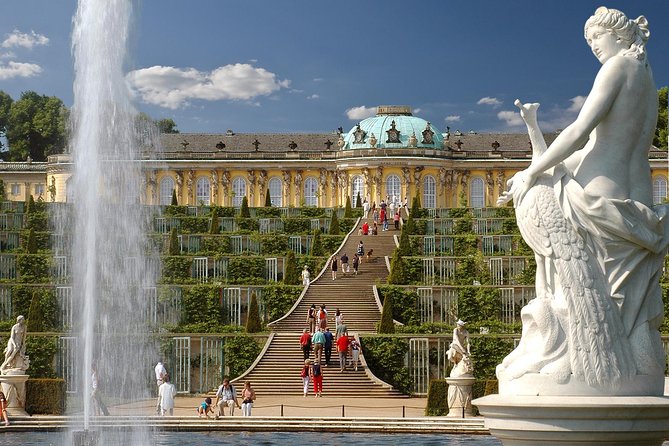
- Sanssouci Palace is the main event: Allow about two hours for the palace and its grounds, with admission included.
- The Bridge of Spies adds modern history: Glienicke Bridge connects Berlin and Potsdam and once served as a crossing point for exchanged spies.
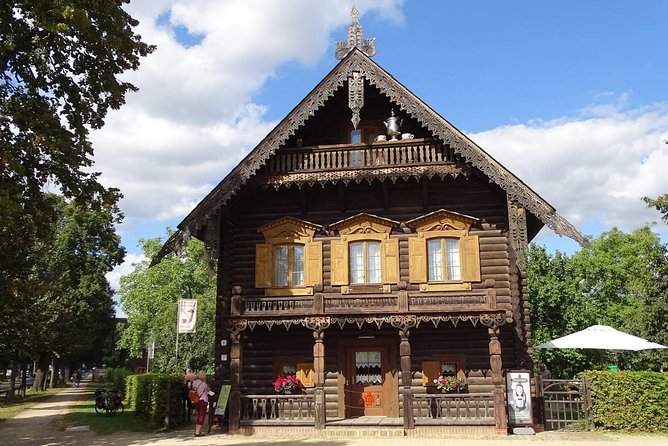
- You see several Potsdam districts from the coach: The Dutch Quarter, Alexandrovka, Old Market Square, and St. Nicholas Church add variety without requiring a long walk between each sight.
- Guides make or break the experience: Susan, Karin, Jasmin, Bridget, Stefanie, and others have received strong praise for clear history talks and friendly handling of questions.
- This is a tightly timed half-day: You get an efficient overview, not long, independent visits at every stop.
- The price is about $77 per person: That is reasonable if you value transport, palace entry, and a guide, but less attractive if you want plenty of free time.
Why Potsdam makes a smart half-day from Berlin
Potsdam is close enough to Berlin for an easy excursion, yet it feels like a different chapter of German history. The city was shaped by Prussian kings, Russian connections, grand rebuilding projects, and the Cold War border.
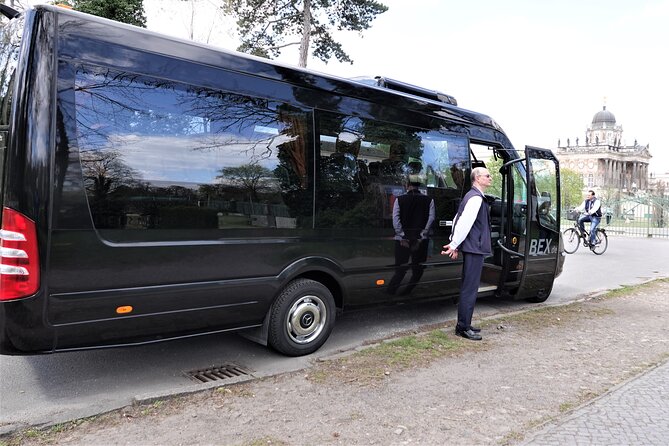
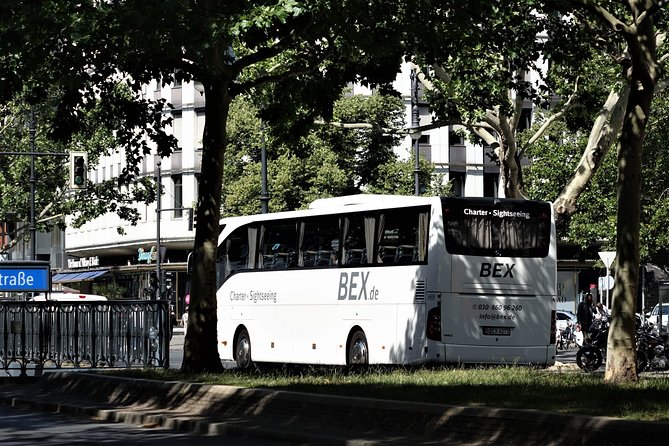
I like this tour because you do not spend the whole morning trying to work out local transport or palace entry times. The coach leaves from Kurfürstendamm 216 at 10 a.m., takes you toward Potsdam, and gives you context along the way. That matters here because the sights are spread across the city.
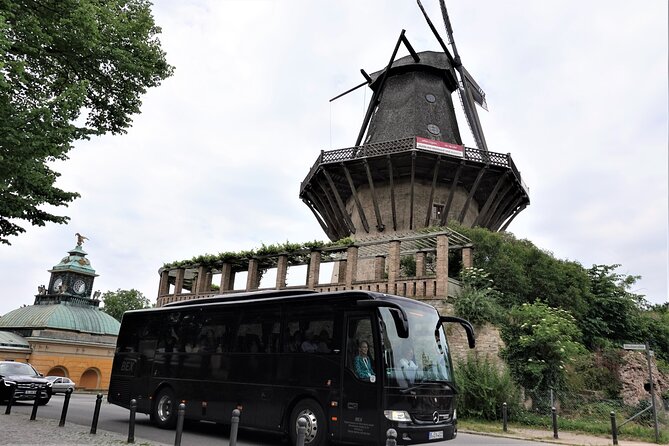
The group can include up to 30 people. That is large enough to keep the price under control, but small enough for a guide to manage without turning the day into a sea of people. The coach has been described as clean, quiet, and comfortable, with drivers praised for punctual, smooth driving.
The English and German format is worth noting. The guide may speak in both languages, and most comments describe the delivery as clear and lively. Still, one poor experience reported that the English commentary was much shorter than the German. If you need every detail in English, listen carefully at the meeting point and make sure you are comfortable with the language balance before setting off.
More Palaces to Tour in Germany:
- Neuschwanstein & Linderhof Castle-Fairytale Day Tour from Munich
★ 4.5 · 7,275 reviews - Potsdam: Palace Tour by Boat
★ 4.5 · 2,369 reviews - Potsdam: Sanssouci Palace and Prussian Palaces Entry Ticket
★ 4.5 · 2,101 reviews
Riding from Kurfürstendamm into Prussian history
The tour begins at Kurfürstendamm 216, a central Berlin address with public transport nearby. Confirmation is sent when you book, and the scheduled departure is 10 a.m. Arrive early enough to find the exact meeting point without rushing.
The drive is part of the sightseeing. Guides have used the journey to explain Berlin and Potsdam, pointing out historical details along the way. One especially interesting return-drive subject is AVUS, Berlin’s former motor-racing and highway circuit, including its grandstand.
That kind of commentary is one of the tour’s best features. You are not simply handed from one attraction to the next. The ride helps connect the city you have just left with the Prussian capital you are about to explore.
There is no food or drink included, so bring water and anything you need for the morning. Bathroom access is worth planning too. A practical stop near the entrance has been recommended, with a small fee and a need for change. The coach bathroom may not be available, so do not count on using it during the ride.
Sanssouci Palace: Frederick the Great’s private retreat
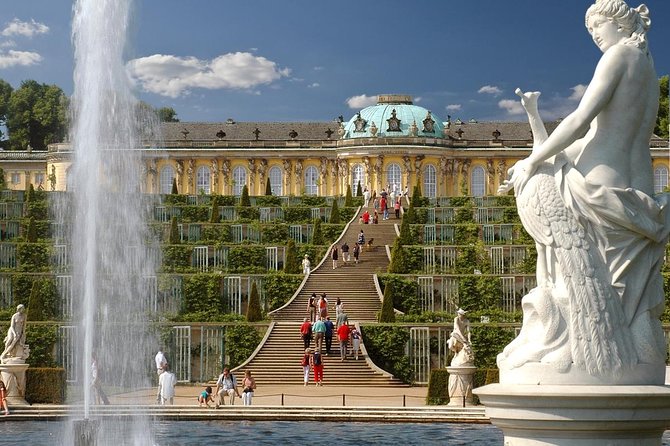
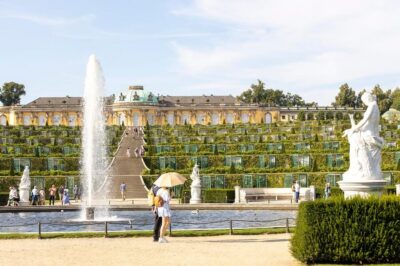
Sanssouci is the heart of the excursion. Frederick the Great, King of Prussia, had the summer palace built between 1745 and 1747 as a place to escape the formality of the Berlin court.
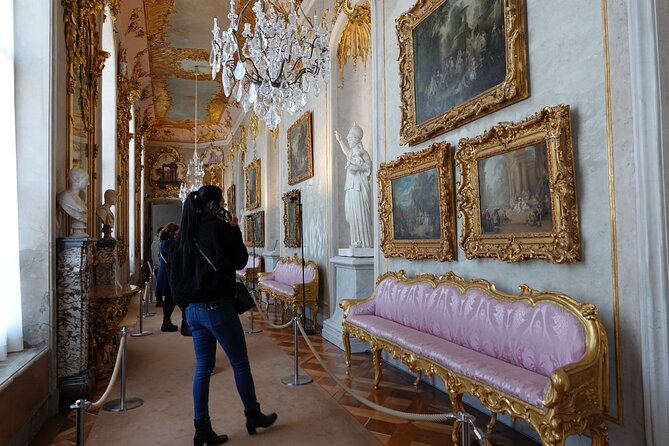
The name suggests freedom from worry, and the setting fits that purpose. This was not designed as a giant ceremonial palace meant to overwhelm every visitor. It was Frederick’s private residence, a place where he could relax away from court rituals.
That is useful context because Sanssouci can seem modest beside Europe’s largest royal residences. One helpful way to set your expectations is to think of it as an intimate retreat with elaborate surroundings, not another Versailles.
The palace was designed by Georg Wenzeslaus von Knobelsdorff. The park is filled with temples and decorative structures, giving the visit more to see than the palace rooms alone. You get roughly two hours assigned to Sanssouci, including the included admission.
The guided visit may use a handheld audio device inside the palace. This gives you a steady stream of information in a short period, although it is different from having a guide speak beside you in every room. The information comes quickly, so stay focused if you want to remember details about Frederick’s life and the building.
The skip-the-line arrangement is especially useful here. Palace entry can consume time on a short outing, and guaranteed access through the long lines lets you spend more of the visit inside the grounds and rooms.
You should expect some walking. The tour is not described as strenuous, but a moderate level of fitness is requested. Comfortable shoes are sensible, especially since the palace visit includes time outdoors in the park.
The Bridge of Spies and Potsdam’s Cold War edge
Glienicke Bridge gives the tour a sharp change of mood. It crosses the Havel River between Berlin’s Wannsee district and Potsdam, and the current bridge was completed in 1907 after earlier versions occupied the site.
Its fame comes from the Cold War. Because the river marked the border between West Berlin and East Germany, the bridge became a place where captured spies were exchanged. That is why it earned the name Bridge of Spies.
You may not spend a long time here, but the stop carries real weight. It turns an ordinary-looking crossing into a physical reminder of the divided city and country. I find this kind of short photo stop valuable because it adds recent political history to a tour otherwise focused on kings, churches, and old neighborhoods.
The bridge also helps you understand Potsdam’s position beside Berlin. This was never an isolated palace town. Its location made it important to Prussia, Germany, and the Cold War border.
Same city, another grand address:
- Berlin: Charlottenburg Palace Entry Ticket
★ 4.4 · 2,076 reviews - Koblenz: Rhine Valley Castles and Palaces Boat Tour
★ 4.4 · 1,824 reviews - Neuschwanstein Castle and Linderhof Palace Day Trip from Munich
★ 4.5 · 1,756 reviews - From Berlin: Potsdam and Sanssouci Palace Tour with Entry
★ 4.7 · 1,219 reviews
The Dutch Quarter: Potsdam’s brick-built character
The Dutch Quarter, or Holländisches Viertel, is one of the city’s most recognizable neighborhoods. It contains 134 red-brick buildings, nearly all restored, built between 1733 and 1740.
Frederick William I ordered the quarter, and Jan Bouman designed it. The goal was linked to Dutch craftsmen and settlers, whose skills were useful to the growing Prussian city.
The district gives Potsdam a different feel from the palace grounds. Instead of royal gardens and grand façades, you see a compact urban quarter with rows of red brick. Depending on the timing, you may view it from the coach or stop briefly to look around.
Do not expect a long café break or an extended independent walk here. The tour has several sights to cover, so this is part of a city overview rather than a neighborhood tour. Still, it is a good inclusion because it shows how Potsdam developed beyond the royal compounds.
Alexandrovka and the Russian connection
North of central Potsdam, the Russian colony Alexandrovka adds another unexpected layer. Frederick William III had it built in 1826 and 1827 for the last twelve Russian singers from a former choir of 62 soldiers.
The colony was named as a memorial to Tsar Alexander I, who died in 1825. The background reflects the family and friendly ties between the Hohenzollern and Romanov dynasties.
Alexandrovka is now part of Potsdam’s UNESCO cultural property. Its inclusion helps explain why Potsdam is not simply a collection of Prussian palaces. The city’s identity also comes from international relationships, royal diplomacy, and carefully planned communities.
This stop is usually best appreciated as a short visit or guided view rather than a long exploration. If you are fascinated by architecture and royal connections, you will wish for more time. On a four-hour tour, the benefit is seeing the colony as part of the wider story.
Old Market Square and St. Nicholas Church
The Old Market Square forms the historic center of Potsdam. At its core is St. Nicholas Church, a Lutheran church with a classicist central plan designed by Karl Friedrich Schinkel and built between 1830 and 1837.
The church’s 77-metre tambour rises above the city roofs. Ludwig Persius and, from 1845, Friedrich August Stüler continued the work on the upper structure.
St. Nicholas also carries the scars of the Second World War. It was hit during a British air raid and later badly damaged by Soviet artillery. After years of rebuilding, it was reconsecrated in 1981 and remains open for worship, visits, and concerts.
This is a useful stop for understanding how much of Potsdam had to be repaired or rebuilt. The square is not just a pretty urban setting. It shows the city’s layered past, from classicist design to wartime destruction and postwar recovery.
Time here is likely limited. You may see the square and church as part of the coach route or a short walking section, rather than receive a full architectural tour. That is enough for a first visit, but anyone interested in Schinkel should plan a separate return.
The guides are the strongest part of the experience
The best guides bring the city together. Susan has been praised for her strong English, broad command of Berlin and Potsdam’s past, and willingness to answer questions. Karin is noted for explaining both the sights and the places passed on the drive.
Jasmin has also been singled out for energy, useful detail, and an engaging style. Stefanie is described as friendly and entertaining, while Bridget is credited with making the trip informative without making it feel heavy.
These names matter because the guide’s role is not limited to pointing at buildings. A good guide explains why Frederick built Sanssouci, how Potsdam relates to Berlin, and why a bridge became a Cold War symbol.
The German and English format can work well when the guide keeps both languages balanced. You should be prepared for some repetition as information is delivered in two languages. That is the trade-off for a bilingual tour, and one experience indicates that the balance may not always be equal.
Is $77 a fair price for four hours?
At about $77.23 per person, this is not the cheapest way to reach Potsdam. You are paying for the coach, driver, guide, palace admission, and the convenience of a planned route that covers several scattered sights.
I think the price is fair if you have limited time in Berlin and want a clear introduction without arranging transport or palace tickets yourself. Skip-the-line access carries extra value on a short schedule, since waiting in line would cut directly into your visit.
The value is weaker if you want to linger. Potsdam has enough museums, gardens, churches, and neighborhoods for a full day, and this tour cannot give each place the attention it deserves.
Food and drinks are not included, and there is no promise of refreshments on the coach. Bring your own water and a snack. Also keep some small change for a bathroom stop.
Who should book this Potsdam tour?
I would choose this outing if you are staying in Berlin for a few days and want a guided first look at Potsdam. It suits people who enjoy history, prefer organized transport, and want both royal and twentieth-century stories in one morning.
It is also a good fit if Sanssouci is your priority. The palace admission and line-skipping arrangement remove two common planning problems.
I would think twice if you have already spent time in Potsdam or want to explore at your own pace. The schedule is efficient, but it leaves little room to sit in the gardens, browse the Dutch Quarter, or study the church and Old Market Square.
The tour ends back at Kurfürstendamm 216. Free cancellation is available until 24 hours before the start time, but changes or cancellations inside that window are not accepted for a refund. The experience also requires a minimum number of participants, so a cancellation by the operator can result in another date or a full refund.
Should you book it?
Book it if you want the major Potsdam highlights in one well-organized half-day, especially Sanssouci, the Bridge of Spies, and the Dutch Quarter. The combination of coach transport, palace entry, and a strong guide makes the outing practical for a first visit.
Skip it if you want a relaxed full-day exploration or dislike bilingual commentary. For most Berlin visitors with limited time, though, it is a solid introduction, with enough history and variety to make Potsdam feel like more than a quick palace stop.
FAQ
Where does the Potsdam tour begin and end?
The tour begins and ends at Kurfürstendamm 216, 10719 Berlin, Germany.
What time does the tour depart?
The scheduled departure time is 10 a.m.
How long does the tour last?
The tour lasts approximately four hours.
Is admission to Sanssouci Palace included?
Yes. Admission to Sanssouci Palace is included, along with guaranteed access past long lines.
Is food included?
No. Food and drinks are not included, so you should bring anything you need for the morning.
Is the tour offered in English?
Yes. The tour is offered in English, and the local guide may provide commentary in both English and German.
Newly added in Germany
- Munich Nymphenburg Palace & Carriage Museum Fast-Track Tour★ 4.9 · 57 reviews
- Munich: Residenz Palace and Hofgarten Skip-the-Line Tour★ 4.8 · 148 reviews
- Munich Nymphenburg Palace & Carriage Museum Fast-Track Tour★ 4.5 · 32 reviews
- Munich: Residenz Palace, Museum and Treasury Private Tour★ 4.9 · 15 reviews
- Munich: Nymphenburg Palace Skip-the-Line Private Guided Tour★ 4.8 · 10 reviews
- Munich Residenz Palace, Museum and Treasury Private Tour★ 4.5 · 12 reviews
- Private Tour of Nymphenburg Palace and Gardens★ 5.0 · 26 reviews
- Dresden: Semperoper und Residenzschloss★ 4.5 · 241 reviews
Germany Palace Tours, compared.
Sanssouci Palace and Prussian Palaces Entry Ticket
Read our review →
Koblenz: Rhine Valley Castles and Palaces Boat Tour
Read our review →
Neuschwanstein Castle and Linderhof Palace Day Trip from Munich
Read our review →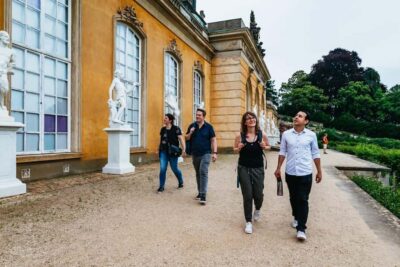
Koblenz:Rhine Valley boat tour along the castles and palaces
Read our review →
Browse the lists this tour appears in