
Review · CHATEAU AND WINE ESTATE TOURS
Full-Day Private Trip to Jeita Grotto, Baalbek and Chateau Ksara
Jeita Grotto’s underground river, Baalbek’s huge Roman stones, and Chateau Ksara’s Lebanese wines make an unusually varied day. You move from cool limestone caves to open-air ruins, then finish among vineyards and old wine cellars. It is a lot of Lebanon in about nine hours.
I like the private door-to-door transport, especially for a day that crosses busy Beirut roads and reaches the Bekaa Valley. I also like the mix of independent time at Jeita with a local guide at Baalbek, where the size and purpose of the ruins make historical context especially useful.
The main drawback is the pace. Jeita, Baalbek, and Ksara are all worthwhile, but the drive between them leaves little room for a long lunch or a slow visit. Entrance fees are also excluded, and the published details about Baalbek admission are not fully consistent, so ask for the current cost before you go.
Key points to know before booking
- Three major sights in one day: You visit Jeita Grotto, the Baalbek temple complex, and Chateau Ksara.
- A private vehicle keeps the day practical: Hotel pickup and drop-off are included, with an air-conditioned vehicle and driver.
- Baalbek gets the strongest historical focus: A local guide explains the Roman sanctuary and its temples.
- The wine stop is short but distinctive: Chateau Ksara was founded by Jesuit priests in 1857 and includes wine tasting.
- Budget beyond the advertised price: The $69.45 fare excludes lunch and entrance fees.
- The schedule is full: The planned stops add up to a long day, with several Baalbek descriptions covering the same complex.
One day, three very different sides of Lebanon
This trip works because the stops do not feel like variations of the same sightseeing experience. Jeita is a natural attraction below ground. Baalbek is an immense archaeological site shaped by Phoenician, Hellenistic, and Roman worship. Chateau Ksara brings you into modern Lebanese wine production, with a French-style wine tradition that began under Jesuit care.
You start at about 8:30 am in Beirut. The company provides hotel pickup, so you do not need to find a meeting point in the city. Your group has its own vehicle and tour leader, rather than sharing the day with a large coach party.
The price is $69.45 per person, which is appealing for a private nine-hour outing with transportation, a driver, a tour leader, and a local Baalbek guide. The value depends on group size. For two people, it is still a convenient way to cover distant sights. For a small group, the private format becomes more attractive because the transport cost is spread across several people.
You should not read the price as an all-in ticket. Lunch is not included, and admission charges are separate. Since the supplied details list some Baalbek entries as free and others as not included, I would confirm exactly which tickets you will pay for at booking.
More Chateau and Wine Estate Tours in the world:
- Versailles Château and Gardens Walking Tour
★ 4.5 · 727 reviews - Versailles Château and Gardens Walking Tour from Paris by Train
★ 4.5 · 714 reviews - Loire Valley: Château Royal d’Amboise Entrance Ticket
★ 4.6 · 476 reviews
Jeita Grotto: a cool start underground
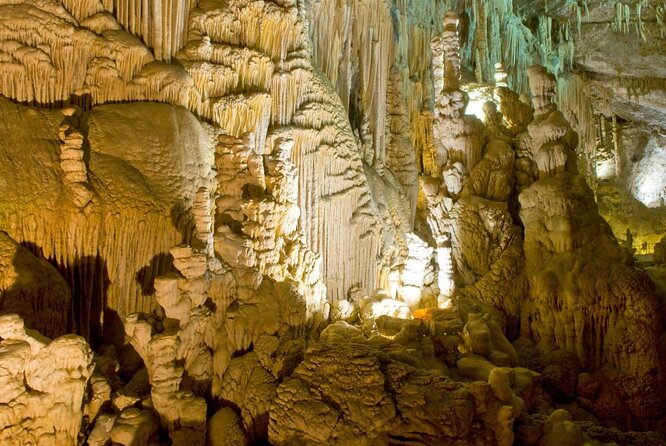
Jeita Grotto is a system of two connected limestone caves about 300 metres above sea level. The caves formed over millions of years, and the complex is described as the longest cave system in the Middle East.
Your visit lasts about 1 hour and 30 minutes. The upper cave is the main showpiece, with stalactites, stalagmites, columns, curtains, draperies, ponds, and mushroom-shaped formations. These names matter because the cave is not just a dark passage. It is a series of large chambers filled with mineral shapes that developed slowly over time.
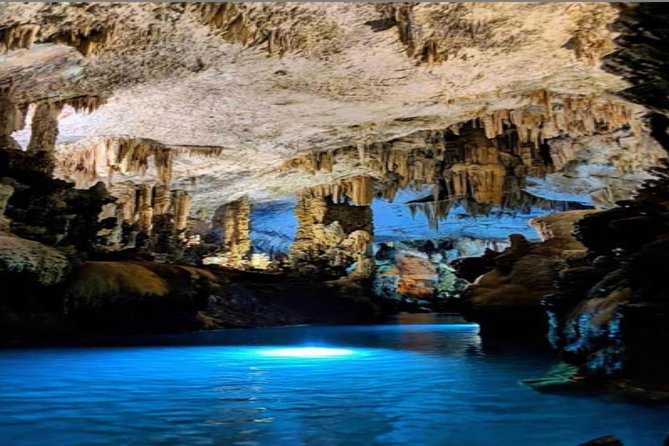
The lower gallery lies about 60 metres below the upper cave. An underground river and lake run through it, and the visit includes a boat ride as well as time on foot. That change of pace gives Jeita a strong opening: you first see the cave formations, then move across the water in a setting far removed from Beirut’s streets.
Jeita is explored independently rather than with the Baalbek-style local guide. That gives you freedom, but it also means the quality of your visit depends more on how you use the allotted time. Keep an eye on the schedule. The cave is only the first major stop, and Baalbek is still a long way ahead.
The admission ticket is not included. The information provided does not give the current ticket price, so include it in your day-trip budget. Photography rules, boat arrangements, and the exact route through the galleries can change, so follow the instructions given at the site.
Baalbek: where the day reaches its peak
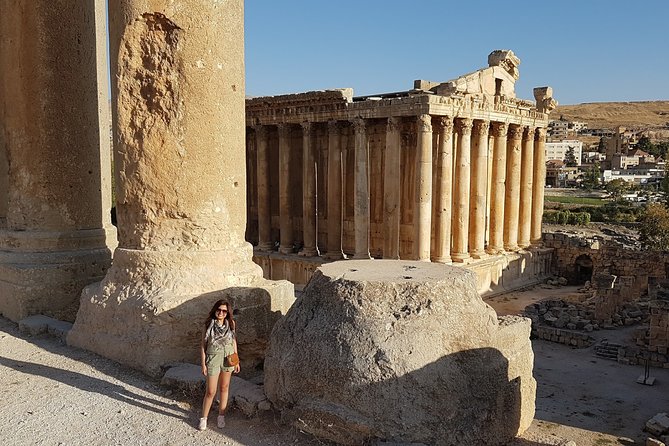
Baalbek is the reason many people will choose this tour. The ruins sit at about 1,150 metres at the foot of the Anti-Lebanon range, near the fertile Bekaa Valley. In the Hellenistic period, the city was known as Heliopolis, or City of the Sun. During Roman rule, it became a major sanctuary dedicated to a Romanized version of a Phoenician religious triad: Jupiter, Venus, and Bacchus.
The scale is difficult to grasp from photographs. The complex contains the Temple of Jupiter and the Temple of Bacchus, two of the grandest Roman ruins in the region. Baalbek became a UNESCO World Heritage Site in 1984, and the site is valued not only for its age but also for the engineering behind its enormous platforms and columns.
The tour allows about 1 hour and 30 minutes for the Baalbek visit, with a local guide included. That guide matters here. A walk among giant columns can become a blur of stones without an explanation of how the sanctuary developed, which gods were worshipped, and why the Romans built such a vast religious center in this location.
The supplied schedule lists several separate Baalbek entries, each with its own 30-minute or 1 hour and 30-minute estimate. They describe the same general temple complex rather than clearly separate full visits. In practice, think of Baalbek as one substantial archaeological stop with several highlights inside it, not four unrelated attractions.
Temple of Jupiter and the Great Court
The Temple of Jupiter was the largest temple in the Roman world dedicated to Jupiter Heliopolitanus. Construction likely began around 16 BC and was nearly complete by about AD 60, though the exact designer and dates are not known.
The temple stood at the western end of the Great Court on a platform raised above massive foundation blocks. Three of those stones are among the heaviest ever used in construction. This is the point where a local guide can help you notice what your eyes might otherwise miss: the relationship between the platform, the court, and the huge blocks beneath it.
Do not expect a complete temple with its roof and interior intact. The power of the site comes from the surviving scale, the raised foundations, and the remaining columns and architectural pieces. Give yourself time to look upward and outward, not only at the decorative fragments close to the path.
More Private Palace Tours in the world:
- Alhambra Private/Small Group Tour & Nasrid Palaces Skip the Line
★ 4.5 · 921 reviews - Bangkok: Grand Palace, Wat Pho, and Wat Arun Private Tour
★ 4.8 · 855 reviews - Mutianyu Great Wall&Summer Palace Excursion:Group/Private Options
★ 5.0 · 816 reviews - Private Tour of Sintra, Cabo da Roca and Cascais with 2 Palaces
★ 5.0 · 770 reviews
Temple of Bacchus and Temple of Venus
The Temple of Bacchus is among the best-preserved and grandest Roman temple ruins at Baalbek. Its ornament dates mainly from the second century AD, although its exact age is not stated. Compared with Jupiter’s temple, Bacchus can feel more complete and easier to read as a building.
The temple belonged to the same sanctuary complex and honored Bacchus, the Roman god associated with wine. That makes it a fitting historical bridge to the final stop at Chateau Ksara, although the connection should not be overstated. Baalbek is an ancient religious site; Ksara is a working wine producer.
The smaller Temple of Venus was built in the third century. Its unusual horseshoe-shaped platform and circular shrine set it apart from the larger rectangular temples. Five niches on the outer façade hold forms linked with doves and shells, clues that led to its association with Venus.
Depending on the exact route and time available, you may also see the Mosque of Sayeda Khawla in Baalbek. It is associated with Sayyida Khawla, believed by local people to have been buried there. This adds a later religious layer to a place already shaped by Phoenician, Hellenistic, Roman, and Islamic traditions.
The Stone of the Pregnant Woman
The Stone of the Pregnant Woman is a short stop, listed at about 15 minutes, near the Roman complex. It is a worked monolith, one of two enormous ancient blocks in the area. The stones were likely intended for the nearby temple construction but were never placed there.
This stop is useful because it makes the scale of Baalbek’s building project easier to understand. A column or decorated wall can look large, but a single abandoned block shows the raw material and labor behind the finished sanctuary.
Do not expect a long guided visit here. It is a brief look and photo stop, best treated as an addition to the main Baalbek experience rather than a separate attraction.
Chateau Ksara: Lebanese wine in the Bekaa Valley
The final scheduled stop is Chateau Ksara, a Lebanese wine producer founded by Jesuit priests in 1857. The winery developed Lebanon’s first dry wine and now produces about three million bottles a year, with exports to more than 40 countries.
The visit lasts about 45 minutes and includes a wine tasting. That is enough time for an introduction to the winery and several samples, but not a long wine-country afternoon. You should see this as a useful first taste of Lebanese wine rather than a full cellar tour and leisurely meal.
The French influence is part of the appeal. Lebanon’s wine tradition is not simply an imported European idea, and Ksara gives you a concrete place to learn how that tradition developed in the Bekaa Valley. The stop also changes the mood after the solemn scale of Baalbek.
Wine tasting and driving require a little common sense. Your private driver handles the road, so you do not need to manage navigation after the tasting. The tasting is included, but the tour description does not say how many wines are poured or whether food is paired with them.
Transport, timing, and the private format
The private setup is one of the strongest practical reasons to book. You receive hotel pickup and drop-off, an air-conditioned vehicle, and a tour leader. You are not tied to the pace of a large group, though the day still has a fixed structure because of the distance and number of stops.
Past company tours have used guides and drivers named Hassan, Makram, Kaleeb, Ahmad, and Kimal. The booking information does not promise one of these people for your departure, so treat the names as examples of the company’s guide team, not a guaranteed assignment.
The company has also been willing to confirm pickup details and accommodate schedule changes in some cases. Still, the formal cancellation terms are strict close to departure: cancel at least 24 hours before the start time for a full refund. Changes made within 24 hours are not accepted, and the payment is not refunded.
The nine-hour estimate is realistic only if the stops remain fairly focused. Jeita takes 90 minutes, Baalbek is planned as the main block of the day, and Ksara adds another 45 minutes. Road time between Beirut, Jeita, Baalbek, and the Bekaa Valley uses much of the remaining schedule.
Lunch is not included. I would ask the driver or operator how much time is reserved for food and where that break fits. If you want a relaxed meal, extended shopping, or extra time at each temple, this itinerary may feel compressed.
Who will get the most from this tour
I would choose this trip if you have limited time in Lebanon and want three major experiences without arranging several separate transfers. It suits first-time visitors who want nature, ancient history, and wine in one day.
It is also a good match for couples, families, and small groups who value a private vehicle. The format lets your group travel together and avoid the uncertainty of public transport between distant sites.
You may want a different plan if your main interest is archaeology. Baalbek deserves more than a quick pass, and a dedicated day could give you longer with the temples and nearby sites. Likewise, serious wine fans may prefer more time at Ksara than a 45-minute tasting allows.
The trip also suits anyone who wants help with the logistics but does not need a guide speaking continuously at every stop. Jeita is independent, while Baalbek has local guidance. That balance gives you freedom without leaving the most important historical site unexplained.
Should you book this Beirut day trip?
Book it if you want an efficient private day that combines Jeita’s caves, Baalbek’s Roman grandeur, and Chateau Ksara’s wine. The transport, hotel pickup, and local Baalbek guide make $69.45 a strong starting price, especially for a small group.
Before paying, confirm the entrance fees, the exact Baalbek route, the lunch plan, and the guide assignment. If you accept a full schedule and budget for extras, this is a practical way to cover three very different Lebanese sights in one day. If you prefer slow meals, long archaeological visits, or a relaxed winery afternoon, split the attractions across separate days.
FAQ
What is included in the tour price?
The price includes private transportation, hotel pickup and drop-off, an air-conditioned vehicle, a tour leader, and a local guide at Baalbek. Wine tasting at Chateau Ksara is also included.
Are entrance fees included?
No. Entrance fees are excluded. The supplied details describe one Baalbek entry as free and several other entries as not included, so confirm the current ticket arrangements before the tour.
Is lunch included?
No. Lunch is not included in the price.
What time does the tour start?
The scheduled start time is 8:30 am.
How long does the tour last?
The experience lasts approximately nine hours.
Is the tour private?
Yes. Only your group participates in the private activity.
How long is the visit to Jeita Grotto?
The planned time at Jeita Grotto is about 1 hour and 30 minutes.
Is wine tasting included at Chateau Ksara?
Yes. The package includes wine tasting at Chateau Ksara. The winery stop is scheduled for about 45 minutes.
What is the cancellation policy?
You can receive a full refund if you cancel at least 24 hours before the experience starts. Cancellations or changes made within 24 hours are not accepted and are not refunded.
More Full-Day Visits in the world
- Versailles Full Day Bike Tour with Palace, Gardens, & Picnic
★ 5.0 · 2,217 reviews - Beijing Classic Full-Day Tour including the Forbidden City, Tiananmen Square, Summer Palace and Temple of Heaven
★ 4.0 · 610 reviews - Versailles: Full Day Tour & Shuttle from Paris
★ 3.5 · 356 reviews - Full-Day; Castle, Palace, Cathedral & Viking ships Tour
★ 5.0 · 326 reviews
Newly added in the world
- Avignon: Around The Palace Tour★ 4.5 · 13 reviews
- Ayutthaya Full-Day Tour with Bang Pa In (Summer Palace)★ 5.0 · 2 reviews
- Bali: Gate Of Heaven and Water Palace Tirta Gangga Package★ 4.7 · 3 reviews
- Aranjuez: Royal Palace Guided Tour★ 4.5 · 93 reviews
- Asia Continent & Topkapı Palace & Harem. Guided, Small group★ 4.9 · 3 reviews
- Kornik Castle and Rogalin Palace Half-Day Private Tour★ 5.0 · 2 reviews
- Antananarivo: Guided Tour and sunset in queen’s palace★ 3.9 · 13 reviews
- Royal Palace of Aranjuez Small-Group Tour with Entry Ticket★ 5.0 · 2 reviews
Chateau and Wine Estate Tours, compared.

Medoc or Saint Emilion Wine Tasting and Chateau from Bordeaux
Read our review →
Guided Tour of the Fairmont Le Chateau Frontenac in Quebec City
Read our review →
Versailles Château and Gardens Walking Tour from Paris by Train
Read our review →

Loire Valley: Château Royal d’Amboise Entrance Ticket
Read our review →
Fontainebleau & Vaux-le-Vicomte Châteaux Day Tour from Paris
Read our review →Browse the lists this tour appears in