
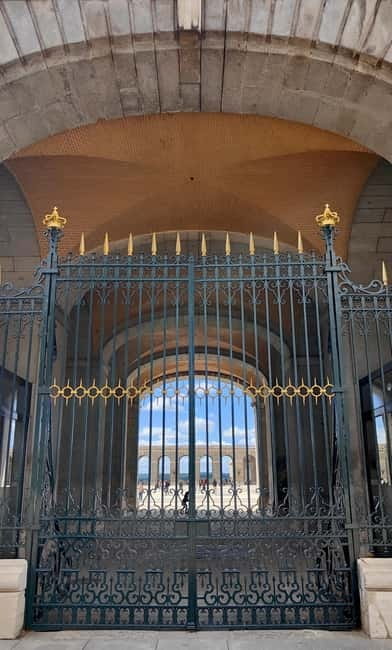
Review · ROYAL PALACE TOURS
Madrid: Guided tour of the Royal Palace in French
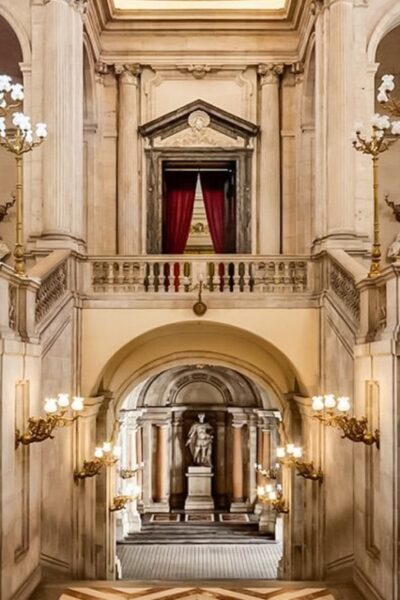
The Royal Palace is not a dusty old shell. It remains the official residence of Spain’s king for state events, and its rooms still carry the polished grandeur of a working royal institution. In two hours, this French-language tour takes you through the Throne Room, Royal Chapel, gala dining room, former smoking room, and other major rooms.
I like the small group of up to eight because a French-speaking guide can explain details without shouting across a crowd. I also like that tickets and headphones are included, so you spend less time sorting out entry and more time looking at the ceiling, furniture, and royal collections. The main drawback is the fixed two-hour format: the palace is huge, and you will see its major rooms rather than every corner.
Key points
- The palace covers 135,000 square meters, making it the largest royal palace in Western Europe.
- The tour is conducted in French by an official guide, with headphones provided.
- Groups are limited to eight participants, a useful size for questions and clear explanations.
- The Throne Room, Royal Chapel, gala dining room, and former smoking room are among the featured interiors.
- The collection of Stradivarius violins is one of the palace’s most unusual highlights.
- Entry tickets and skip-the-line access are included, with cancellation available up to 24 hours before the tour.
Entering Madrid’s Royal Palace with a French-speaking guide
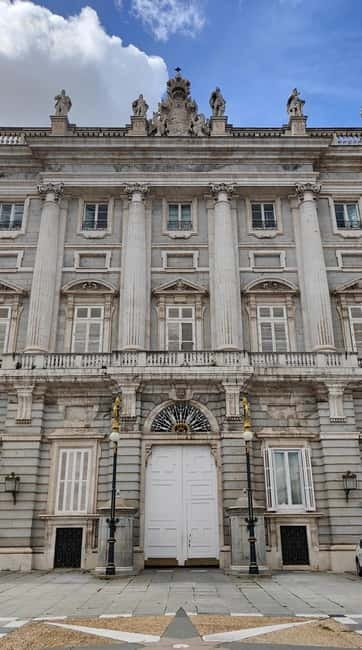
You meet beside the tourist information kiosk, where the guide carries a Recorridos Históricos Madrid sign. That detail matters in a busy central area. Look for the sign rather than relying on a vague meeting point, and arrive ready to join the group promptly.
The experience lasts about two hours. That is long enough to get a solid look at the palace’s main ceremonial rooms without turning the visit into an all-day march. You will use headphones, which should make the guide easier to follow in large interiors where sound can bounce off stone and polished surfaces.
The tour is offered in French. That is the main reason to choose it over a general palace visit. You get the building’s political and artistic story in a language you can follow easily, rather than trying to read every label or piece together the meaning of each room on your own.
The group is limited to eight participants. I consider that a real advantage here. Royal palaces can feel formal and distant, but a small group gives the guide room to point out a ceiling detail, explain a royal custom, or answer a question without holding up a large crowd.
More Royal Palace Tours in Madrid
- Madrid: Royal Palace Expert Guided Tour with Skip-the-Line
★ 4.7 · 8,407 reviews - Madrid Essential: Historic Center, Plaza Mayor & Royal Palace
★ 5.0 · 6,416 reviews - Madrid: Royal Palace Skip-the-line Guided Tour
★ 4.9 · 3,146 reviews
The palace’s scale and changing role
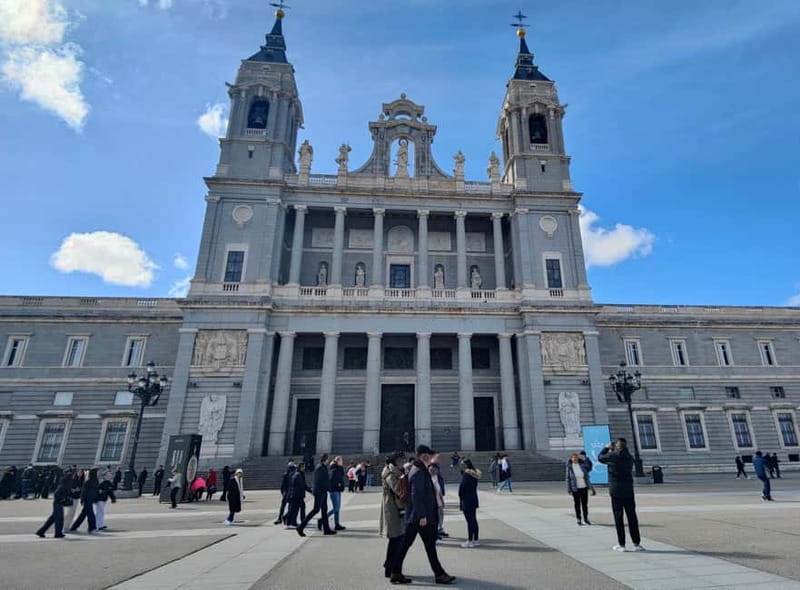
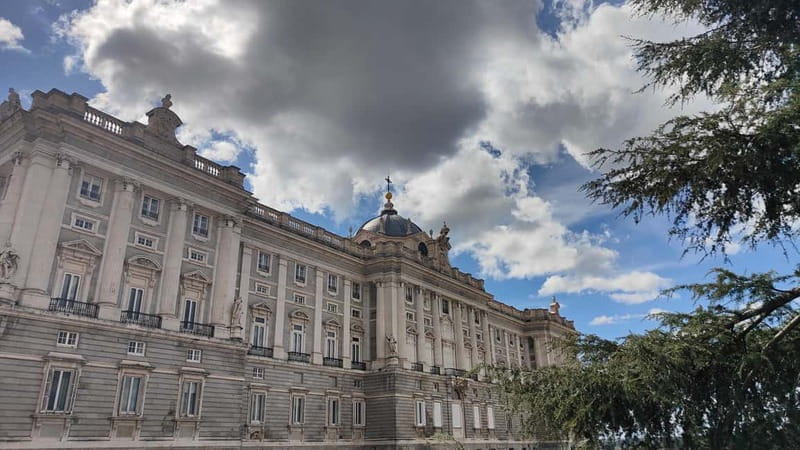
The Royal Palace is enormous, with an area of 135,000 square meters. It is described as the largest royal palace in Western Europe, and that scale becomes easier to understand once you move through its ceremonial interiors.
The palace is also classified as a BIC, or site of cultural interest in Spain. You are not simply touring an attractive government building. You are seeing a protected part of Spain’s national heritage that continues to be used for official events.
That active role gives the visit a useful point of focus. The palace is not presented only as a monument to past kings. Its rooms still have a formal purpose, especially the grand spaces used for state occasions, official meals, and royal ceremonies.
I appreciate that the guide connects architecture with Spanish history. The strongest part of a palace tour is rarely a list of dates. It is understanding why the rooms were designed to impress, how court life worked, and what the objects reveal about power and taste.
The Throne Room and royal ceremony
The Throne Room is one of the major stops, and it is likely to be the room where the palace’s theatrical side feels most obvious. This was designed for ceremony, display, and rank. The scale tells you that the room was built to make an impression before anyone explained a single detail.
Your guide can help you look beyond the obvious shine. Pay attention to the arrangement of the space, the furniture, and the way the room directs attention toward the royal seats. Details that seem decorative at first often had a role in communicating order and authority.
This is also where a French-language explanation earns its keep. A good guide can place the room within Spain’s political story and explain how royal ceremony changed over time. Cristina, one of the guides associated with this experience, has been praised for explaining Spanish history through clear anecdotes and architectural details.
The Throne Room is a high point for many visitors, but it is not the entire palace. If you prefer quiet art museums or small historic homes, the formal scale may feel overwhelming. I would treat that grandeur as part of the point, while remembering that the visit gives priority to public ceremonial rooms.
The Royal Chapel and private devotion

The Royal Chapel offers a different mood. After the display of the Throne Room, a religious interior shifts the focus toward ceremony, belief, and the private side of court life.
The chapel is included among the spaces shown on the tour, but the available information does not promise a detailed list of every object or artwork inside. Your experience will depend on the guide’s route and the time available that day.
Still, I would not rush this stop. A palace is easier to understand when you see more than its grand reception rooms. The chapel shows how royal life mixed public duty with religious practice, and it gives the tour a welcome change of pace.
More Royal Palace Tours in Spain
- Madrid: Royal Palace Skip-the-Line Guided Tour
★ 4.5 · 2,140 reviews - Madrid Old Town & Royal Palace Walking Tour Skip the Line Ticket
★ 4.5 · 1,829 reviews - Madrid: Royal Palace Guided Tour with Skip the Line Ticket
★ 4.5 · 1,583 reviews - Royal Palace & Prado Museum Skip the Line Guided Tour
★ 4.5 · 1,347 reviews
The gala dining room and a table for 144
The gala dining room is one of the palace’s most memorable spaces because of its huge table, built to seat 144 guests. That single figure gives you a clear idea of how different a formal royal meal was from an ordinary dinner.
The room is about ceremony as much as food. A table of that size required careful planning, a strict order of seating, and an army of staff behind the scenes. Your guide can turn what might look like a grand room into a picture of how royal banquets operated.
I like stops such as this because they make palace life easier to imagine. The room is not only a pretty interior. It shows how architecture, etiquette, service, and politics worked together during official events.
The practical limitation is that you will not be attending a banquet, of course. The room is viewed as part of a guided cultural visit, and the tour moves on after the explanation. If you want long stretches for photography or close study, two hours may feel brisk.
The former smoking room and less formal royal spaces
The former smoking room adds a more personal note to the itinerary. It is less immediately grand than the Throne Room or gala dining room, but that is exactly why it helps round out the visit.
A room like this can offer a glimpse of social habits inside the palace. It suggests how court life included informal spaces as well as formal halls. The name itself points to a past custom that may feel distant today, and a guide can explain that change in a way a label rarely can.
This is one of the places where anecdotes matter. The available feedback praises explanations that make Spanish history accessible and add architectural observations along the way. That approach should help you connect the palace’s smaller rooms with its larger story.
Stradivarius violins, porcelain, carpets, and furniture
The Royal Palace is not only about rooms. It also contains major collections, including the world’s largest collection of Stradivarius violins.
That is an unusual highlight. Many grand European palaces have paintings, tapestries, and furniture, but a collection of famous violins gives this tour another angle. You are looking at objects tied to music, craftsmanship, royal patronage, and court entertainment.
The palace also contains collections of carpets, porcelain, and furniture. These objects help fill in the practical side of royal life. A carpet can show wealth and design taste. Porcelain points to dining and presentation. Furniture reveals how rooms were arranged for ceremony, conversation, or work.
Do not judge the palace only by its biggest room. I find that the smaller objects often explain how people actually used these interiors. Ask the guide about the pieces that catch your eye, especially if you want more than a quick parade of grand spaces.
Some content may be presented in its original language. That can be useful when an object, inscription, or historical phrase is best understood in its original form, though it may require a little patience if you want every detail translated.
Why the $64 price can make sense
At $64 per person, this is not the cheapest way to enter the Royal Palace. You are paying for more than admission, though. The price includes the entry ticket, an official French-speaking guide, a small group, headphones, and skip-the-ticket-line access.
The value depends on how you like to visit major sights. If you are comfortable reading signs and moving through the palace alone, a self-guided visit may cost less. If you want clear explanations in French and prefer not to manage the ticket process yourself, the added cost is easier to justify.
The group limit is important here. Eight people is small enough for the guide to maintain contact with everyone, and it reduces the chance that the commentary will become a distant voice in a crowd. You are also more likely to ask a question without feeling that you are interrupting a large tour.
I would consider this a good value for someone who cares about context. It is less compelling for a visitor who mainly wants to enter, take a few photographs, and leave at their own speed.
What the two-hour pace feels like
Two hours is a sensible length for the palace’s principal rooms. You get a structured visit rather than an unfocused wander, and the guide keeps the story moving from royal ceremony to religion, dining, social customs, art, and collections.
The tradeoff is depth. With a building this large, you cannot see everything in two hours. The tour focuses on the principal highlights, so you should not expect a full examination of every gallery or collection.
I suggest thinking of this as an introduction with substance. You will leave knowing how the palace works as a symbol of monarchy and as a cultural site, but you may still want extra time if you are passionate about architecture, decorative arts, or royal history.
The route may also feel more formal than a walking tour through Madrid’s streets. You are inside a carefully preserved palace, following rules designed to protect its contents. That setting rewards attention, but it does not offer the freedom of stopping anywhere for as long as you wish.
The guide’s role and the strongest part of the experience
The most praised feature of this experience is the quality of the explanations. The guide is expected to combine Spanish and Madrid history with architectural observations and memorable anecdotes.
Cristina is specifically named as an exceptional guide, and her two-hour visits have been associated with a large number of useful stories about Spain’s past. Another guide has been praised for making Madrid and Spanish history easy to understand while adding interesting architectural points.
That matters because a royal palace can otherwise become a blur of gold, velvet, chandeliers, and long names. I would choose this tour for the guide’s storytelling as much as for the rooms themselves.
The best approach is to listen for connections. Ask how a room served the court, why a collection belongs in a royal palace, or what changed as Spain’s monarchy changed. Those questions can turn a beautiful building into a more readable place.
Who should book this French-language palace visit
I would recommend this tour to:
- French-speaking visitors who want a live explanation rather than a self-guided route
- First-time visitors to Madrid who want a clear introduction to the palace
- Anyone interested in royal ceremony, architecture, decorative arts, or Spanish history
- Couples and families who prefer a small group rather than a large scheduled tour
- Visitors who value included entry and skip-the-ticket-line access
You may want another format if you need a very slow visit, extensive photography time, or the freedom to explore every room alone. The two-hour structure is useful, but it does not leave unlimited time for lingering.
The tour is wheelchair accessible, and the listed cancellation policy allows a full refund when you cancel at least 24 hours ahead. You can also reserve now and pay later, which helps if your Madrid schedule is still changing.
Should you book the Royal Palace tour in French?
Book it if you want the Royal Palace explained in French, value a small group, and prefer a guide who adds historical anecdotes to the major rooms. The Stradivarius violins, enormous gala dining table, Throne Room, and Royal Chapel give the visit plenty of variety.
At $64, it is a guided-visit price rather than a bargain admission ticket. Still, included entry, headphones, skip-the-line access, and a group capped at eight make the cost reasonable for visitors who want context and an organized route.
I would make this a strong choice for a French-speaking first visit to the palace. Go in expecting a focused look at the highlights, not a complete examination of a 135,000-square-meter complex.
FAQ
Where does the Royal Palace tour meet?
The meeting point is beside the tourist information kiosk. Look for the guide holding a Recorridos Históricos Madrid sign.
How long does the tour last?
The guided visit lasts two hours.
What language is the tour conducted in?
The tour is conducted in French by a live French-speaking guide.
Is the Royal Palace admission ticket included?
Yes. Entry tickets to the Royal Palace of Madrid are included.
Are headphones provided?
Yes. Headphones are included so you can follow the guide’s explanations.
How many people can join the group?
The group is limited to eight participants.
Does the tour skip the ticket line?
Yes. Skip-the-ticket-line access is included.
Is the tour wheelchair accessible?
Yes. The activity is listed as wheelchair accessible.
What parts of the palace are included?
The tour includes major spaces such as the Throne Room, Royal Chapel, ballroom, former smoking room, and gala dining room. It also covers collections of Stradivarius violins, carpets, porcelain, and furniture.
Can I cancel for a full refund?
Yes. You can cancel up to 24 hours in advance for a full refund.
Newly added in Madrid
- The Royal Palace of Madrid: Small Group Guided Tour★ 3.2 · 6 reviews
- The Most Complete Tour of Madrid: Austrias, Cathedral, Palace – Local Guides★ 4.2 · 41 reviews
- Madrid: Royal Palace and Almudena Cathedral Small-Group Tour★ 4.6 · 219 reviews
- Tour of the historic Royal Palace of Madrid★ 5.0 · 2 reviews
- Private Visit to the Royal Palace and Walking Tour of Madrid★ 5.0 · 4 reviews
- Private guided tour Royal Palace & Royal Collections Gallery★ 5.0 · 4 reviews
- Royal Palace of Madrid Skip-the-Line and Retiro Park Tour★ 4.5 · 78 reviews
- Madrid: VIP Private visit to Royal Palace and Prado Museum★ 5.0 · 14 reviews
Royal Palace Tours, compared.

Royal Palace Expert Guided Tour with Skip-the-Line
Read our review →
Dubai To Abu Dhabi: Grand Mosque, Royal Palace & Etihad Towers
Read our review →

Abu Dhabi Day-Trip Grand Mosque, Royal Palace & Lunch
Read our review →

Louvre Entry & Etihad Tower/Royal Palace Options
Read our review →Browse the lists this tour appears in