

Review · DIOCLETIAN'S PALACE TOURS
Essential Diocletian’s Palace Tour for First-Time Visitors
Split’s Diocletian’s Palace is not a museum sealed behind glass. It is the heart of modern Split, where ancient walls frame cafés, shops, homes, squares, and daily life. This tour gives you a clear way into that mix, with guide Jelena explaining how a Roman emperor’s retirement palace became a living city.
I like the small group of up to 10 and Jelena’s lively approach, which helps complicated history stay clear rather than turning into a lecture. I also like the practical finish: you get personal suggestions for food and sightseeing, plus access to restaurant and bar vouchers. The main limitation is that the 90-minute walk does not include entry to the Cathedral’s interior, bell tower, or the museum section of the cellars.
Key points to know before booking
- Start beneath the statue of Gregory of Nin: Meet by the large statue near the Golden Gate and look for Jelena’s black umbrella.
- See the essential palace sights in 90 minutes: The route includes the Golden Gate, People’s Square, Jupiter’s Temple, Peristyle, Vestibule, cellars, and Riva.
- Expect history with humor and local context: Jelena connects Roman, Croatian, Dalmatian, and wider Balkan history to life in Split today.
- The group stays small: With no more than 10 people, it is easier to ask questions and hear the guide in crowded areas.
- Plan extra time for paid sights: The walk explains the Cathedral and palace cellars, but does not include every interior or tower visit.
- Take home useful local advice: Restaurant and bar vouchers, along with personal recommendations, add value after the walk.
Why this is a good first look at Split
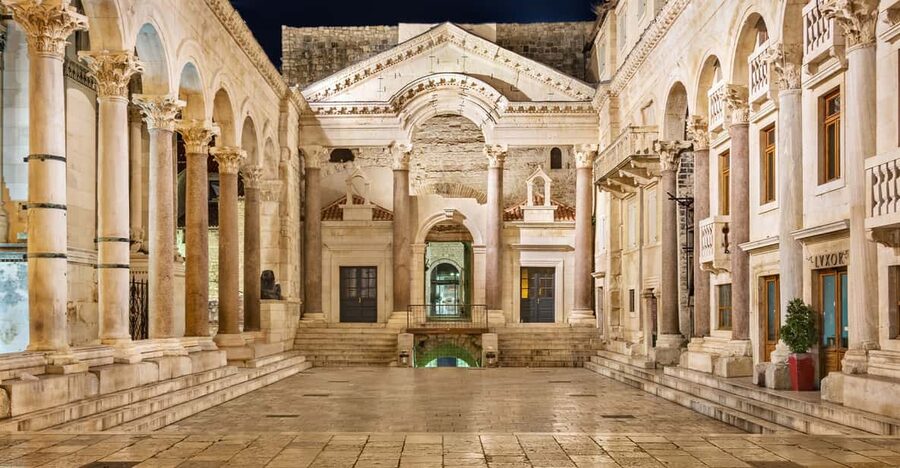
If you have just arrived in Split, the palace can feel confusing. The walls are old, but the streets inside them are active. You may walk from a Roman courtyard into a café, pass a medieval church, and turn into a modern shopping street without realizing how the pieces fit together.
Jelena’s route gives you that framework quickly. She explains not only who built the palace and why, but also how later generations changed it and how people use the center now. That matters because Split’s appeal comes from the overlap of eras, not from one isolated monument.
The guide’s background adds another useful layer. Jelena is originally from Bosnia and Herzegovina and has lived in Split for many years, so she can place the city within the wider Balkans rather than treating it as a separate postcard destination. You get local history, regional context, and advice for the rest of your stay.
The tone is relaxed and interactive. Children and teenagers can follow the stories more easily than a formal lecture, and adults have room to ask about architecture, daily life, and the area’s past. One family with a 13-year-old found the mix of history, humor, and questions held everyone’s attention.
More Diocletian's Palace Tours in Split:
- Split: Old Town and Diocletian Palace Walking Tour
★ 4.9 · 4,727 reviews - Walking Tour of Split and Diocletian’s Palace
★ 5.0 · 2,588 reviews - Split & Diocletian’s Palace Walking Tour
★ 5.0 · 1,125 reviews
Meeting Gregory of Nin at the Golden Gate
The tour begins at the large statue of Bishop Gregory of Nin, just outside the palace’s north entrance. Look for the black umbrella. The meeting point is close to the Golden Gate, so you are immediately placed beside one of Split’s most striking Roman remains.
The Golden Gate was the grand northern entrance to Diocletian’s Palace. Jelena uses it to explain the palace layout and the way its gates once controlled movement in and out. Starting here makes sense: you begin with the palace as a planned imperial complex before entering the busy center that grew inside and around it.
The statue itself is also part of modern Split’s public life. It gives you a first reminder that this is not simply an ancient site. The city’s identity is built from Roman, medieval, religious, regional, and present-day pieces.
Finding the guide should be simple, but the center can be busy. Arrive with enough time to locate the statue and the umbrella, especially if you are meeting the group during a crowded part of the day.
People’s Square and the changing city
From the palace area, the walk continues to People’s Square, the main square of Split. This stop helps connect the imperial complex with the later city that developed around it.
Here, the point is not just to look at old façades. You learn how public spaces shaped local life and how Split expanded beyond the original palace walls. The square also gives you a helpful contrast with the more enclosed palace courtyards.
I like this part because it shows why a walking tour is more useful than simply ticking off monuments. A guide can point out how the city’s streets, squares, and buildings relate to one another. Without that explanation, it is easy to see a series of attractive places without understanding the pattern.
Jupiter’s Temple and the palace’s religious layers
Jupiter’s Temple is one of the essential palace stops. It gives you a direct look at the religious side of Diocletian’s imperial project and the way later periods reused ancient structures.
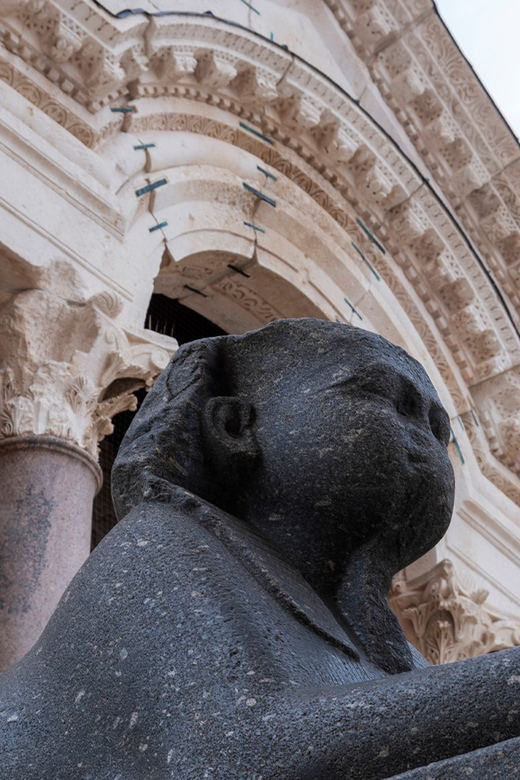
Jelena explains the temple’s role within the palace and helps you read the remains in relation to the surrounding streets. The Egyptian sphinx is another memorable detail in this area. Its presence is a striking reminder of the emperor’s reach and of the many influences folded into the palace.
This is also a place where the guide’s storytelling matters. Ancient ruins can look small or incomplete when viewed without context. With a clear explanation, you can better understand what the building meant and how it fits into the original plan.
The route is primarily a walking and viewing experience. You should not expect every stop to include a long interior visit or a separate museum presentation.
More Palaces to Tour in Split:
- Split: Diocletian Palace & Old Town Guided Walking Tour
★ 4.7 · 882 reviews - Split Old Town and Diocletian’s Palace Tour
★ 4.8 · 716 reviews - Split: Game of Thrones Tour with Diocletian’s Palace Cellar
★ 4.8 · 545 reviews - Diocletian’s Palace and Old Town SMALL GROUP Walking Tour
★ 5.0 · 502 reviews
Peristyle, the palace’s grand central space
The Peristyle is the visual center of the tour and one of the most memorable places in Split. It is a formal open space framed by substantial Roman architecture, later religious buildings, and the everyday movement of the city.
Jelena explains how the square functioned within the palace and why it remains such an important meeting point. This is where the past and present are easiest to see at once. Ancient columns and stonework share space with people sitting, walking, taking photographs, and going about their day.
The Peristyle can be crowded and noisy, particularly when other groups or events are nearby. That is worth knowing if you prefer quiet archaeological sites. At the same time, the activity helps you understand that the palace is part of Split’s living center rather than a remote ruin.
Several people who took the tour found Jelena easy to hear and follow even with noise around them. Her habit of explaining the plan at the beginning and returning to the main ideas at each stop is useful here, since the square contains several layers of information.
Cathedral of Saint Domnius from the outside
The Cathedral of Saint Domnius is one of the clearest examples of Split’s changing religious and architectural identity. The building occupies part of the former palace complex, and its setting makes the relationship between Roman imperial space and later Christian use especially clear.
The tour discusses the cathedral from outside. It does not include entry into the cathedral, the monastery or mausoleum area, or the bell tower. If you want to see those spaces, plan a separate visit and check current opening arrangements on your own.
That limitation is not necessarily a problem. If your main goal is to understand the palace layout and get oriented, the exterior explanation gives you the essential context without adding another admission or slowing the route. If you specifically want religious interiors or a high view over Split, you should treat this tour as an introduction rather than a complete visit.
The Vestibule and the promised group selfie
The Vestibule is one of the tour’s more unusual stops. This domed passage once formed part of the palace’s ceremonial approach, and its shape makes it easy to picture how imperial visitors moved toward the private and formal areas of the complex.
This is also where the group takes its selfie beneath the dome. It is a small touch, but a useful one. Most walking tours end with photographs of buildings; this gives you a shared memory tied to a specific part of the palace.
The Vestibule can also help you appreciate the palace as a sequence of spaces rather than a collection of separate ruins. The Golden Gate, Peristyle, temple area, cathedral, and Vestibule make more sense when you understand how they connected.
Diocletian’s Cellars and what you actually see
The route continues to the cellars, also called the palace substructures. These lower spaces are important because they preserve the original plan and show how the palace was supported and organized.
You receive a guided explanation and see the cellar area, but the tour does not include the museum section of the cellars. This distinction is important when comparing it with a longer palace visit. The cellar stop gives you a strong introduction, while a separate ticket and extra time may be needed for a fuller examination.
I see this as a sensible choice for a first orientation. Spending too long underground can leave you with less sense of the living city above. In 90 minutes, the route gives you enough to understand the palace’s structure before sending you back into Split’s streets.
Ending on the Riva promenade
The tour finishes on the Riva, Split’s famous waterfront promenade. This is a good ending because it shifts your attention from imperial walls to the city’s present-day social life.
Jelena can use the final minutes to suggest places to eat, sights to visit next, and local experiences to consider. The personal recommendations are one of the strongest practical features of the tour. You are not left with facts alone; you get help deciding what to do with the rest of your time.
The restaurant and bar vouchers may also improve the value of the experience, particularly if you are interested in trying local food. The exact savings and participating businesses can vary, so check the current voucher details when booking or meeting the guide.
What $41 buys you
At $41 per person, this is not the cheapest way to walk around Split. You can see many palace streets and exterior landmarks without paying for a guide. The question is whether you want the background, structure, and local advice that turn those sights into a connected story.
For a first-time visit, I think the price can make sense. In 90 minutes, you cover the main orientation points and save yourself the work of figuring out the palace’s layout alone. The small group is especially valuable compared with a large walk of more than 30 people, where questions are harder and it can be difficult to hear.
The added vouchers and personalized suggestions give the tour some value beyond the walk itself. I would book it early in a Split stay, then use Jelena’s advice to shape the following days.
You should not choose this tour if you want a slow archaeological examination, a full cathedral visit, or extensive time inside the cellar museum. It is designed as a clear first introduction, not as a complete palace ticket.
Who will get the most from this walk
I recommend it for first-time visitors who want the basic story of Split before exploring alone. It also suits solo visitors, couples, families, and small groups who prefer conversation over a scripted lecture.
The English is described as clear and easy to follow, including for people who are not fully confident English speakers. Jelena also makes space for questions and adjusts to practical needs such as shade, water, and bathroom breaks, which can matter during warm months.
History fans will appreciate the detail, but you do not need a strong background in Roman history. The humor and present-day context keep the experience accessible. Families may like the short length and the selfie stop, while people on a tight schedule can cover a great deal without committing half a day.
The main physical limitation is access. The activity is not suitable for wheelchair users, and the route takes place through the historic center, where ancient surfaces and confined spaces may be difficult for anyone with limited mobility.
Timing, group size, and practical planning
The walk lasts 90 minutes and is offered at scheduled starting times. Since the palace center can be noisy and crowded, the small group limit of 10 is a real advantage. You can usually stay closer to the guide, hear the explanations, and ask questions without holding up a large crowd.
Wear comfortable shoes and bring water, especially in warm weather. The tour is short, but it covers several outdoor areas and some enclosed historic spaces. Meeting at the statue of Gregory of Nin with the black umbrella should make the start easy to identify.
The activity is offered in English with a live guide. You can cancel up to 24 hours ahead for a full refund, and you can reserve now while paying later, which helps if your Split plans are still shifting.
Should you book it?
Book this tour if you want a friendly, well-organized introduction to Split that combines Roman history, city life, humor, and useful food advice. The small group, Jelena’s clear explanations, the Vestibule selfie, and the restaurant vouchers make it more practical than a basic monument walk.
Skip it if you already know the palace well or want full access to every interior, tower, and museum space. For most first-time visitors, though, the route gives you a strong map of the city in a manageable 90 minutes, then leaves you on the Riva with better ideas for what to do next.
FAQ
How long does the Diocletian’s Palace tour last?
The tour lasts 90 minutes.
How much does the tour cost?
The price is $41 per person.
What language is the tour in?
The tour is conducted in English by a live guide.
How many people are in the group?
The group is limited to 10 participants.
Where does the tour meet?
Meet in front of the large statue of Bishop Gregory of Nin, beside the Golden Gate, which is the north entrance to Diocletian’s Palace. Look for the black umbrella.
Where does the tour finish?
The tour finishes at Split’s Riva promenade.
Which major sights are included?
The route includes the Golden Gate, People’s Square, Jupiter’s Temple, Peristyle, Cathedral of Saint Domnius, Vestibule, Diocletian’s Cellars, and the Riva.
Does the tour include entry to the Cathedral of Saint Domnius?
No. The Cathedral is discussed from outside, but entry into the cathedral, monastery or mausoleum area, and bell tower is not included.
Does the tour include the entire cellar museum?
No. The tour visits and explains the cellar area, but does not include the museum section of the cellars.
Is the tour suitable for wheelchair users?
No. The activity is not suitable for wheelchair users.
Can I cancel for a full refund?
Yes. You can cancel up to 24 hours in advance for a full refund.
Can I reserve now and pay later?
Yes. The activity allows you to reserve your place and pay later.
Newly added in Split
- Split: Private Walking Tour and Diocletian’s Palace★ 5.0 · 3 reviews
- Split: Jewish Heritage & Diocletian’s Palace Walking Tour★ 5.0 · 3 reviews
- Split: Diocletian’s Palace Private walking tour★ 5.0 · 3 reviews
- Split and Diocletian’s Palace walking tour with a local guid★ 4.9 · 36 reviews
- Split: Private Walking Tour with Diocletian’s Palace★ 5.0 · 30 reviews
- Split: Old Town and Diocletian’s Palace Walking Tour★ 3.3 · 3 reviews
- Split: Old Town & Diocletian’s Palace Earlybird Walking Tour★ 4.0 · 12 reviews
- Diocletian’s Palace & Old Town Split Walking Tour★ 5.0 · 11 reviews
Diocletian's Palace Tours, compared.

Diocletian Palace & Old Town Guided Walking Tour
Read our review →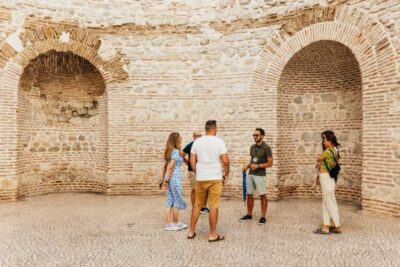

Game of Thrones Tour with Diocletian’s Palace Cellar
Read our review →
Diocletian’s Palace and Old Town SMALL GROUP Walking Tour
Read our review →
Browse the lists this tour appears in