
Review · PALACE ENTRY TICKETS
Siena: Palazzo Pubblico Entry Ticket
Siena’s Palazzo Pubblico is more than a pretty old town hall. Inside, entire rooms are covered with medieval and Renaissance paintings, including Simone Martini’s graceful Maestà. The building itself tells you how Siena wanted its government to look: serious, cultured, religious, and very aware of its public image.
I like two things especially. First, the art is still in its original setting, not stripped from the building and placed in a modern gallery. Second, the visit ends with the Loggia dei Nove, where you get an open view across the Sienese countryside. The main drawback is important: the famous Allegory and Effects of Good and Bad Government frescoes may be closed for restoration, so check the current display before booking.
Key points
- Simone Martini’s Maestà: See one of Siena’s finest Gothic paintings in the great Sala del Mappamondo.
- Frescoed rooms: Spinello Aretino, Martino di Bartolomeo, Taddeo di Bartolo, and Beccafumi all appear along the route.
- A view beyond the square: The Loggia dei Nove gives you a broad look over the countryside behind the palace.
- One-hour visit: The museum works well as a focused stop during a day in Siena.
- Simple entry arrangement: Exchange your voucher at the ticket office inside the Cortile del Podestà.
- Tower not included: Torre del Mangia requires a separate ticket, available at the palace ticket office.
Why Palazzo Pubblico matters in Siena
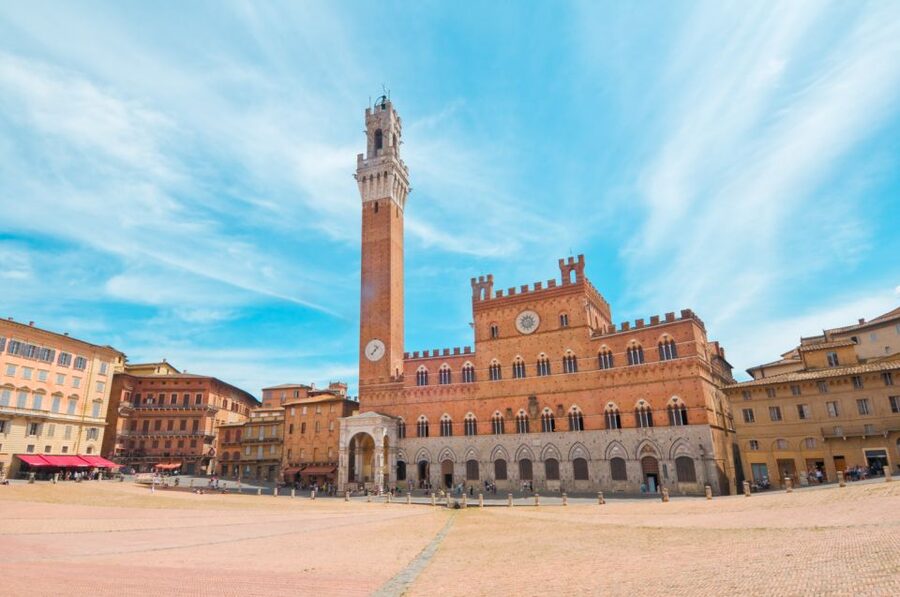
The Palazzo Pubblico occupies one side of Siena’s famous Piazza del Campo, the shell-shaped square where the Palio horse race takes place. From outside, its brick facade and tall tower are familiar Siena images. Inside, the Civic Museum shows why this building mattered so much to the city.
This was not simply a residence or a church. It was the working home of Siena’s civic government. The rooms were used for councils, ceremonies, religious reflection, and political display. The paintings were not random decoration. They presented ideas about faith, justice, good government, and the responsibilities of rulers.
That context makes the museum more rewarding than a quick march past pretty frescoes. You are seeing political art in the rooms where political decisions were made. Even if you know little about medieval Siena, the layout helps you understand how seriously the city took public life.
The ticket costs about $7 per person, a modest price for a central Siena sight with this amount of original art. You do not get a guide or an audio guide, so the value depends on how much you enjoy looking closely and reading the available information on your own. For many people, the low price makes this an easy addition to a day in the city.
More Palace Entry Tickets in Italy
- Venice: Doge’s Palace Reserved Entry Ticket
★ 4.6 · 42,716 reviews - Florence: Palazzo Vecchio Entrance Ticket & Audioguide
★ 4.4 · 4,822 reviews - Florence: Entrance Ticket to Pitti Palace
★ 4.5 · 4,528 reviews
Entering through the Cortile del Podestà
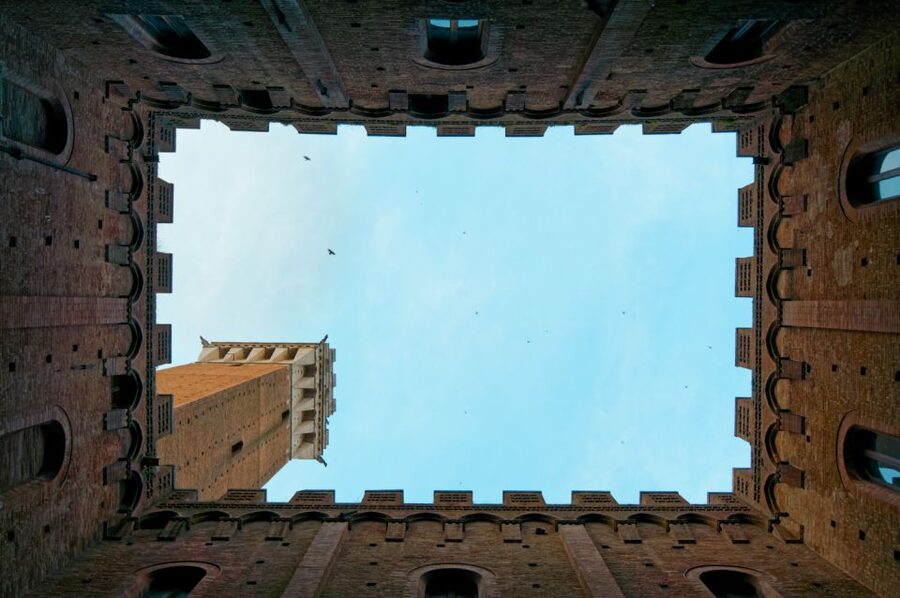
Do not follow a map pin only to the outside wall of the palace. The ticket office is inside the Cortile del Podestà, the inner courtyard. Enter the courtyard, find the ticket desk, and exchange your voucher for the museum entry ticket.
This detail sounds minor, but it can save you a few minutes of confusion. The exterior entrance along Via di Salicotto can make it seem as if you have reached the wrong place. You have not. Continue into the courtyard.
Arrive about 10 minutes before your booked time. You need a passport or identity card, and large bags or luggage are not allowed. Flash photography is also prohibited, which is good news for the fragile wall paintings.
The visit is listed at about one hour. That is enough for a steady look through the open rooms, but it is not generous if you want to study every figure and political symbol. I would allow extra time around the museum if your schedule permits, especially because the building and the square deserve attention before or after your timed entry.
Sala del Risorgimento and the story of Italian unification
The route begins in the Sala del Risorgimento, a room devoted to the life of Vittorio Emanuele II, the first king of Italy. Its frescoes belong to a later period than the medieval rooms that follow, so this opening section gives the visit a different tone.
The paintings present national history rather than Siena’s medieval government. They help connect the palace to the larger story of Italy, which became a unified kingdom in the 19th century. If your main interest is Gothic or Renaissance art, this room may feel less immediately exciting than the later halls, but it gives useful context.
I find it helpful to notice the change in style as you move through the museum. The palace is not frozen in one century. Its rooms reflect different periods and different ideas about power, identity, and public memory.
Spinello Aretino in the Sala di Balìa
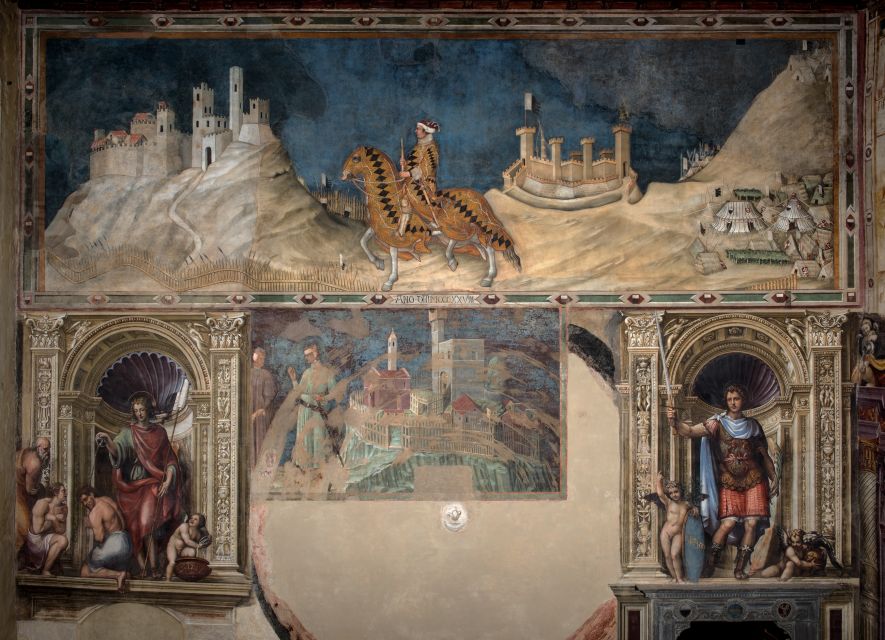
Next comes the Sala di Balìa, with wall paintings from the 15th century by Spinello Aretino and Martino di Bartolomeo. This is where the museum’s visual impact really builds. The walls are not lightly decorated. They are covered with scenes, figures, borders, and details that reward a slow look.
You will need to resist the urge to glance once and move on. Fresco cycles can seem crowded at first, especially when you are trying to take in the room as a whole. Look at the edges, the painted architectural frames, and the expressions of the figures. The fine details are part of the pleasure.
The room also shows why original placement matters. The paintings relate to the architecture around them. They are not isolated panels with white space between each work. The room itself is the artwork.
Same city, another grand address:
- Doge’s Palace & St. Mark’s Basilica with Terrace Access Tour
★ 4.7 · 10,697 reviews - Venice: Doge’s Palace and St Mark’s Basilica Walking Tour
★ 4.4 · 6,291 reviews - Legendary Venice: Doge’s Palace, St Mark’s & VIP Terrace Access
★ 4.5 · 5,033 reviews - Venice: Doge’s Palace and St. Mark’s Basilica Tour
★ 4.5 · 3,734 reviews
Carved coffers and reliquaries in the Sala dei Cardinali
The Sala dei Cardinali shifts attention from wall painting to objects and craftsmanship. Precious carved coffers hold reliquaries, bringing a strong religious element into the civic setting.
This room is useful for breaking up the fresco-heavy route. After several walls of painted scenes, the carved wood and reliquaries give your eyes a different kind of detail. Look for the workmanship in the coffers, not just the objects kept inside them.
The room also reminds you that Siena’s public culture was closely tied to religion. Civic authority and religious devotion were not separate worlds. The palace’s art and furnishings repeatedly connect government, morality, and faith.
Beccafumi’s vault and Taddeo di Bartolo’s chapel
In the Sala del Concistoro, look upward. The room is known for its vault by Domenico Beccafumi, one of Siena’s most important painters. Ceiling paintings can be easy to miss when a room is crowded or when you are focused on the walls, so take a moment before leaving to scan the full vault.
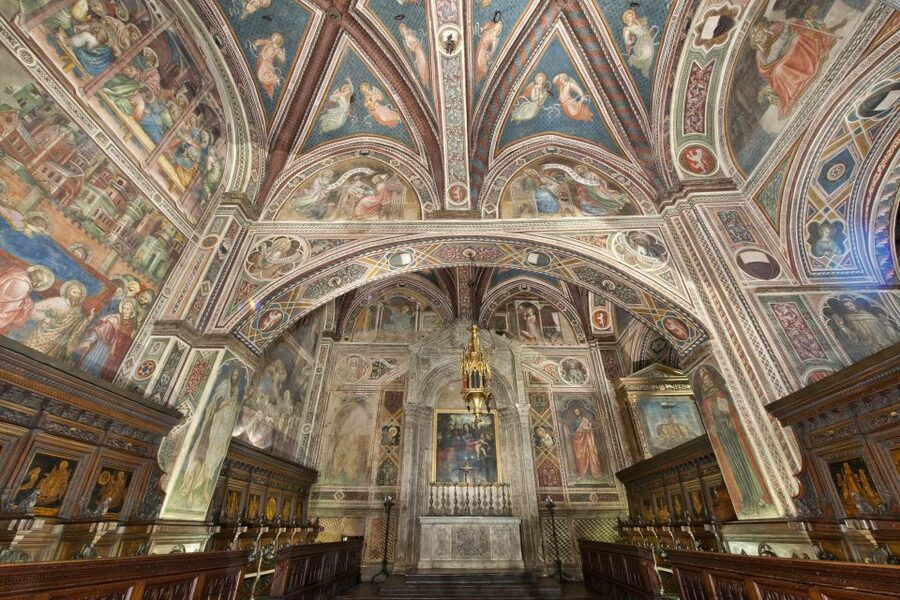
The room is followed by a chapel painted by Taddeo di Bartolo in the 15th century. The chapel provides a more intimate setting than the large council halls. Its decoration is a reminder that the people who worked in this political building also operated within a religious world.
I like this part of the route because it shows several forms of decoration in a short space: large civic imagery, a carefully designed ceiling, and a chapel with its own devotional purpose. You are not simply ticking off paintings. You are seeing how the palace functioned room by room.
Simone Martini’s Maestà in the Sala del Mappamondo
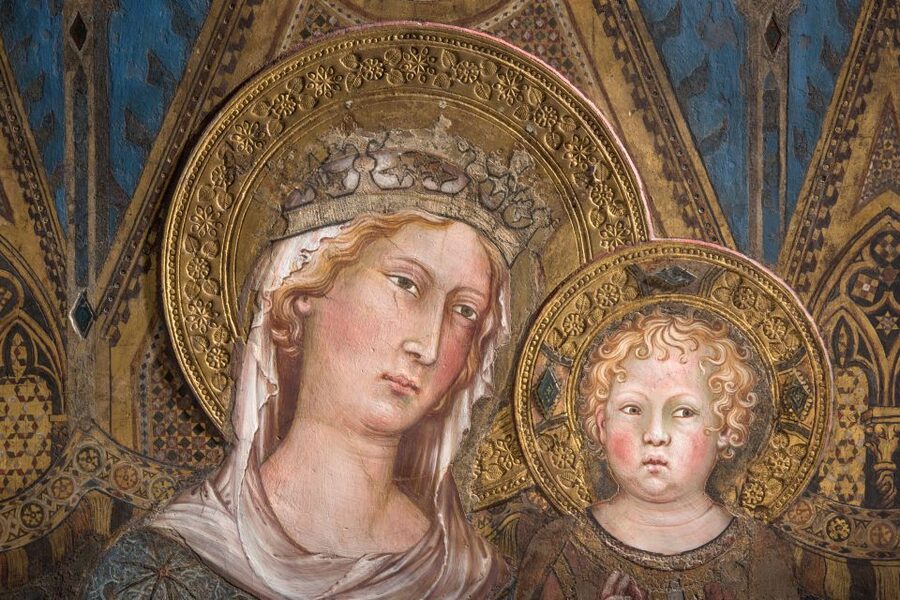
The high point for many people is the Sala del Mappamondo, the widest room in the palace. It was used as the meeting place of the General Council, so its size made practical sense. It also gave Siena a grand setting for one of its most important paintings.
Here you will see Simone Martini’s Maestà, a Gothic masterpiece showing the Virgin Mary enthroned. The painting has the elegance associated with Simone Martini: slender figures, refined lines, decorative richness, and a graceful sense of movement. It is beautiful, but it also carries political meaning. Mary was closely linked with Siena’s identity and protection, making the image appropriate for a major civic room.
Give yourself time here. The painting can look familiar if you have already seen reproductions, but its position inside the palace changes the experience. You can consider the relationship between the image, the council room, and the government that met there.
One disappointment needs a clear warning. The famous Allegory and Effects of Good and Bad Government by Ambrogio Lorenzetti may be under restoration and unavailable. This is a major work, and anyone booking mainly to see it should confirm its status first. Even without it, the Maestà and the other frescoed rooms provide a strong visit.
The Loggia dei Nove and the countryside view
The ticket also includes the Loggia dei Nove, a 14th-century gallery at the back of the palace. This open area offers a view over the Sienese countryside, a welcome change after the darker interior rooms.
The view is not just a pleasant extra. It helps explain Siena’s position and the setting that the city government was managing. After looking at paintings about civic duty and good rule, you can look outward at the territory beyond the walls.
Bring a little patience here. The Loggia is a good place to pause, take in the view, and let the rooms settle in your mind. The open outlook is one of the most praised parts of the visit, and it adds variety to an itinerary otherwise spent indoors.
Do not confuse this gallery with the top of Torre del Mangia. The tower is not included in this ticket. If you want the tower, you can buy a separate ticket directly at the ticket office, subject to availability and current opening arrangements.
What this $7 ticket delivers
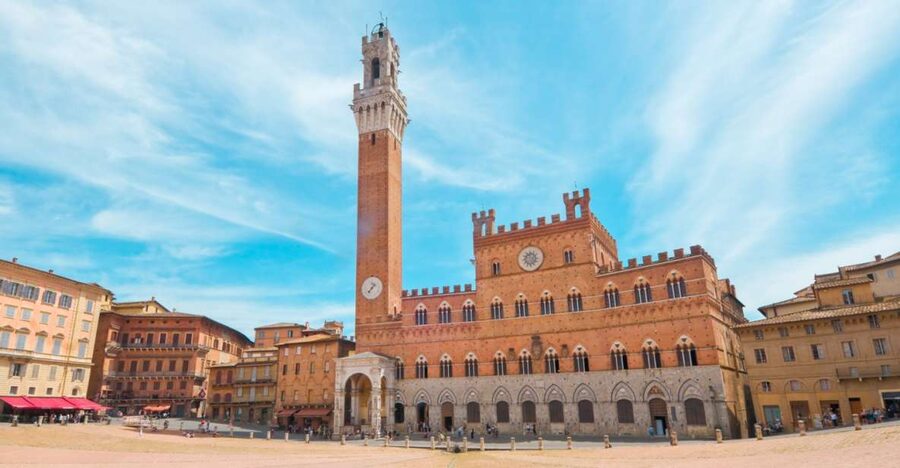
At roughly $7, this is one of the better-value art stops in Siena. You get entry to a historic civic building, several rooms of original frescoes, the Maestà, religious objects, and the Loggia dei Nove. The visit also takes only about an hour, so it fits neatly between other sights in the old center.
The limitations are just as clear. This is not a guided tour. No guide is included, and there is no audio guide. If you want a detailed explanation of every allegory, artist, and political reference, you will need to prepare in advance or arrange separate help.
The small-group setup is limited to 10 people, but the core experience remains a self-guided museum visit. The small number may make the entry process feel more manageable, though it does not turn the visit into a private tour.
Prebooking can be useful if your day in Siena is tightly planned. The ticket office exchange is generally straightforward, and having a reserved time can remove one uncertainty. Still, check opening hours because they can change, and access may be suspended for extraordinary events.
Access, timing, and useful practical details
The museum is wheelchair accessible. The elevator door is 69 centimeters wide and the elevator is 83 centimeters deep, so check those measurements against your mobility equipment before arriving.
Plan to leave large bags and luggage elsewhere, since they are not allowed inside. Assistance dogs are allowed, but other pets are not. Bring your passport or identity card for entry.
The official visit duration is one hour. I would choose a time that gives you room before or after the museum rather than placing it directly against another fixed booking. Siena’s center is compact, but the square can be busy, and finding the courtyard entrance may take longer than expected if you are unfamiliar with the palace.
If the voucher exchange causes confusion, remember the essential instruction: enter the Cortile del Podestà and go to the ticket office. The ticket is exchanged there before you enter the museum.
Who should book the Civic Museum
I would recommend this visit to anyone interested in medieval art, civic history, religious painting, or Siena’s architecture. It is also a good choice if you want something substantial but not exhausting. One hour gives you a focused dose of art without taking over the whole day.
Families with older children may find the rooms engaging, especially if you turn the frescoes into a search for crowns, saints, rulers, symbols, and painted architecture. Art lovers will want longer than the basic hour, while casual sightseers can see the main rooms at a reasonable pace.
I would be more cautious if your only reason for booking is Lorenzetti’s Allegory and Effects of Good and Bad Government. Restoration work can change what is open, and the unavailable frescoes may be the single work you most want to see.
The museum also suits people who want a view without committing to the Torre del Mangia climb. The Loggia dei Nove gives you an attractive outlook over the countryside, though it is not the same as reaching the tower’s summit.
Should you book Palazzo Pubblico?
Yes, if you want original art in its original civic setting at a low price. The Maestà, the richly painted halls, the carved coffers, and the Loggia dei Nove make this a worthwhile hour in Siena.
Book with realistic expectations. You will not receive a guided explanation, the tower is separate, and Lorenzetti’s major frescoes may be closed for restoration. If those limits work for you, exchange the voucher in the inner courtyard, take your time in the Sala del Mappamondo, and save a few minutes for the view at the back of the palace.
FAQ
Where does the Palazzo Pubblico visit begin?
Enter the Cortile del Podestà inside the Palazzo Pubblico and find the ticket office. Exchange your voucher there before entering the Civic Museum.
How long does the visit take?
The stated duration is one hour. You can check available starting times when booking.
Is a guided tour included?
No. The ticket includes entrance to the Civic Museum only. A guide and audio guide are not included.
Is Torre del Mangia included?
No. Torre del Mangia requires a separate ticket, which can be purchased directly at the ticket office.
Is the museum wheelchair accessible?
Yes. The museum is wheelchair accessible. The elevator door is 69 centimeters wide and the elevator is 83 centimeters deep.
What should I bring?
Bring your passport or identity card. Large bags and luggage are not allowed, and flash photography is prohibited.
Can I cancel the booking?
You can cancel up to 24 hours in advance for a full refund. The reserve-now-and-pay-later option lets you hold a place without paying immediately.
Newly added in Italy
- Turin: Palazzo Madama Museum of Ancient Art Entrance Ticket★ 4.6 · 149 reviews
- Venice Doge’s Palace & St. Mark’s Semi-Private Tour, Max 6 People★ 5.0 · 192 reviews
- Colosseum, Roman Forum and Emperors’ Palace Private Guided Tour★ 5.0 · 14 reviews
- Doria Pamphilj Palace Gallery and Museum Private Tour with Local Guide★ 4.5 · 10 reviews
- Private Tour – National Museum of Palazzo Massimo★ 5.0 · 51 reviews
- Private Tour – Palazzo Barberini★ 5.0 · 23 reviews
- Palazzo Vecchio: Magnificent Private Tour★ 4.7 · 61 reviews
- Florence: Pitti Palace and Boboli Gardens Private Tour★ 4.8 · 46 reviews
Palace Entry Tickets, compared.
Buckingham Palace: The State Rooms Entrance Ticket
Read our review →
Prague Castle and Lobkowicz Palace Entry Tickets
Read our review →Browse the lists this tour appears in