
Review · DIOCLETIAN'S PALACE TOURS
YOUR BEST PRIVATE TOUR – amazing Split and Diocletian’s palace
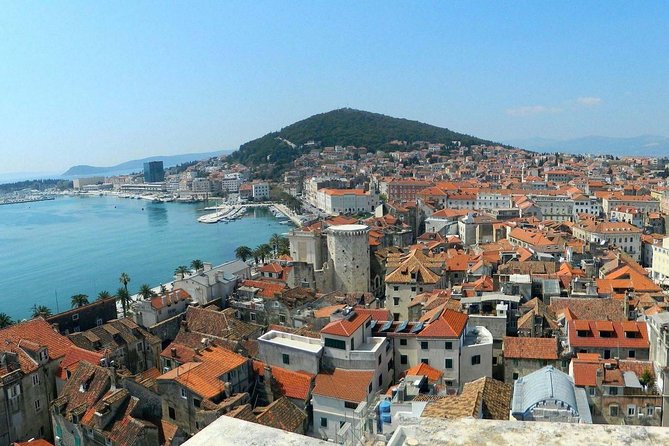
Diocletian’s Palace is not a ruin sitting apart from modern life. It is Split’s old town, where homes, shops, cafés, a cathedral, and narrow medieval lanes occupy the bones of a Roman emperor’s retirement palace. This private tour helps you read those layers instead of simply walking past them.
I like the flexible format, since you can spend more time on Roman history, local life, food, or architecture. I also like the small personal touches, including Nadalina chocolate and practical restaurant suggestions from guides such as Matt, Gita, Stella, Mirjana, and Peter. The main drawback is the price, $124.34 per person, plus entrance fees, and the route can feel hot in the middle of the day.
Key points to know before you book
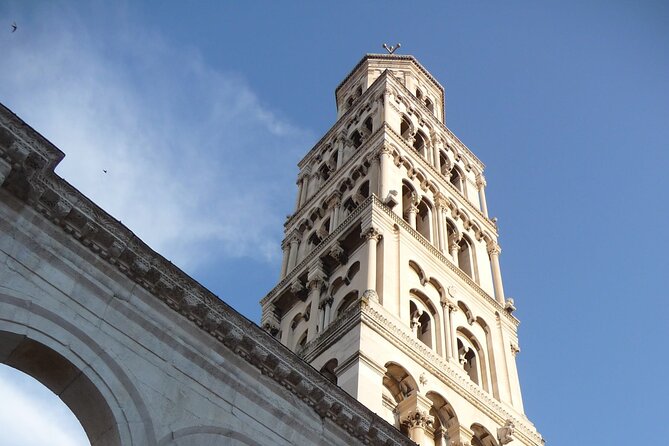
- A Roman palace became a living city: You walk through homes, squares, shops, and streets built inside and around Diocletian’s fourth-century complex.
- The private format is genuinely flexible: Your guide can adjust the pace and focus to suit your group.
- The palace substructures are the historical anchor: These remarkably preserved lower chambers show the palace’s original plan and construction.
- Morning is the smart choice: You get better light, cooler conditions, and a calmer start before Split fills up.
- Local details add value: The route can include Croatian history, food advice, a chocolate tasting, and insight into daily life.
- Budget for extra fees: The tour includes the guide and custom planning, but entrance costs are not included.
Why Diocletian’s Palace works best with a guide
You can walk through central Split without paying for a tour and still see plenty. The trouble is that the old town can be hard to read. A Roman column may sit beside a medieval house, which may share a wall with a modern shop. Without context, the city can look like a charming jumble.
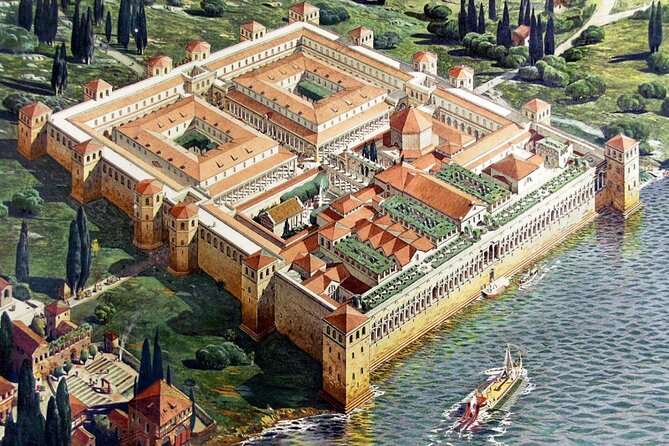
A private guide gives that jumble a clear order. You learn how Emperor Diocletian built the palace in the fourth century as a luxury retirement home, then how the complex changed after the nearby Roman town of Salona was destroyed. In the seventh century, people moved into the palace for safety, gradually turning it into the medieval city of Split.
That story is the heart of the experience. You are not simply touring a building. You are following a city that kept adapting to new rulers, new religions, new residents, and modern daily life.
The private setup matters most for questions and pacing. Guides have been praised for explaining ancient history, current local life, Croatian culture, food, and practical sightseeing advice. Matt, Gita, Stella, Mirjana, Peter, Boran, Lily, Natasa, Milos, and others have led this experience, so your guide will depend on the date and assignment.
More Private Palace Tours in Croatia
- SPLIT-PRIVATE Walking Tour of Diocletian’s Palace & Old Town
★ 5.0 · 467 reviews - Split by Private Electric Rickshaw – Palace & Hidden Gems
★ 5.0 · 412 reviews - Jewish Heritage & Diocletian’s Palace Private Split Tour
★ 5.0 · 80 reviews
Starting on the Riva, Split’s outdoor living room
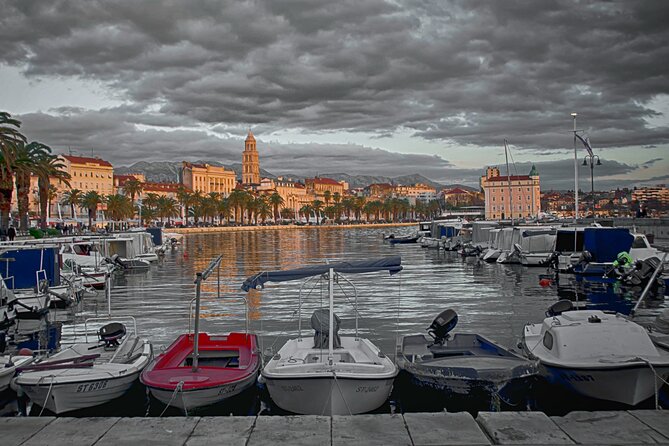
The meeting point is near the bronze model of Split’s historic core on the Riva, at Obala Hrvatskog narodnog preporoda 23. The Riva is Split’s broad waterfront promenade, and it is a useful place to begin because your guide can orient you to the city before the walls and lanes close in.
Your guide introduces Croatia, Split, and the plan for the walk. The suggested opening takes about ten minutes, but the private format allows some adjustment. If you are arriving by cruise ship, pickup is available at the port’s cruise dock exit gate. Hotel pickup is possible only for accommodations inside Split’s old town.
The Riva is also a good point for clarifying expectations. This is a walking tour, not a vehicle excursion, and the center includes uneven paving, steps, narrow passages, and crowded sections. Wear shoes that can handle old stone streets. If you are visiting in summer, I would choose a morning departure. One person specifically found the heat difficult and felt an evening route would have been better.
Entering the palace through the Bronze Gate
From the Riva, the walk moves toward the palace and its southern entrance. The suggested route spends about ten minutes introducing the complex before heading into the substructures.
The palace was built for Diocletian, a Roman emperor who ruled during a turbulent period. The guide explains how he rose to power, governed, enjoyed his years of authority, and finally abdicated before retiring to the Dalmatian coast. That final stage is unusual in Roman imperial history, and it gives the palace a more personal purpose than a standard military or political monument.
You also learn about the stone used to build the complex, including valuable material from the island of Brač. This regional connection helps place the palace within Dalmatia rather than treating it as an isolated Roman import.
The palace substructures reveal the original plan
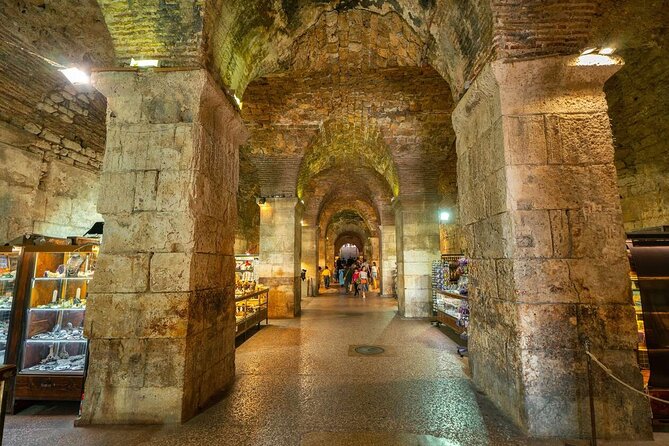
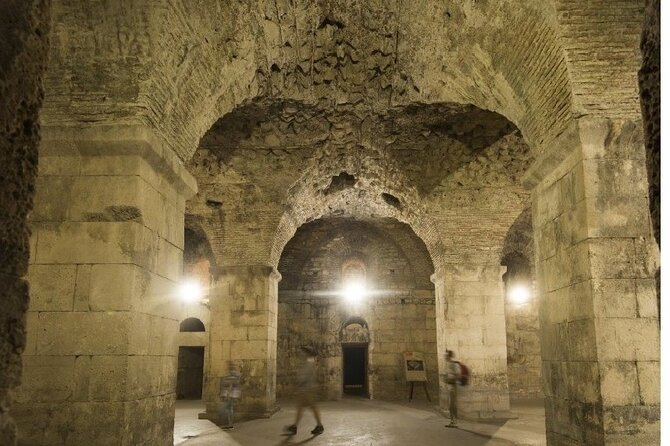
The basement, or palace substructures, takes about thirty minutes in the suggested route. An entrance fee is not included, so you should confirm the current cost when booking or before starting.
This is likely the most important paid sight on the walk. The lower rooms are remarkably well preserved, and they help you understand the palace above. In Roman construction, the lower level supported the upper chambers, so the basement gives you a clear sense of the original layout even where later homes and streets have altered the upper floors.
The guide also connects the palace to Salona, the nearby Roman capital. Salona’s importance helps explain why Split developed as it did. When invaders destroyed Salona, residents found protection within the palace walls. Over time, imperial rooms became homes, streets, workshops, and religious spaces.
That change from palace to city is easier to grasp underground. You can see the Roman engineering beneath the medieval and modern layers. If you care about architecture or ancient history, this portion alone helps justify choosing a private guide instead of wandering without explanation.
Same city, another grand address:
- Split: Old Town and Diocletian Palace Walking Tour
★ 4.9 · 4,727 reviews - Walking Tour of Split and Diocletian’s Palace
★ 5.0 · 2,588 reviews - Split & Diocletian’s Palace Walking Tour
★ 5.0 · 1,125 reviews - Split: Diocletian Palace & Old Town Guided Walking Tour
★ 4.7 · 882 reviews
The Peristyle and the palace’s many centuries
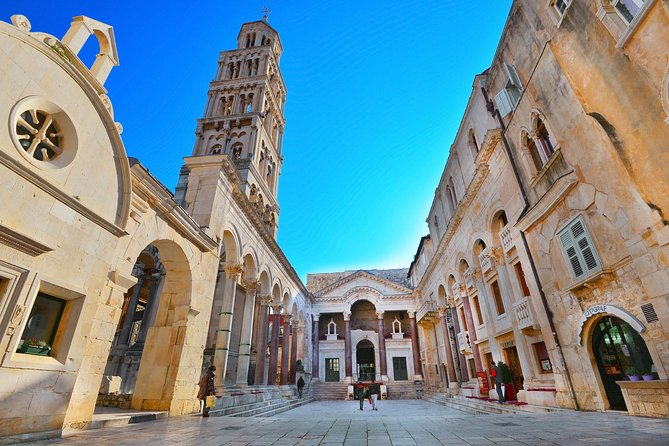
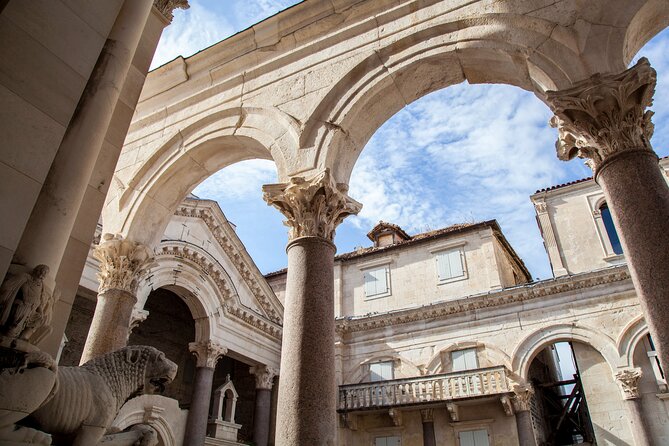
The Peristyle is the central square of Diocletian’s Palace, and the suggested stop lasts about fifteen minutes. It is one of the places where the city’s long timeline is easiest to see.
The square is surrounded by different periods of construction and reuse. Roman elements meet medieval buildings, the cathedral bell tower, noble residences, and later additions. Egyptian references also appear in the palace’s visual program, linking Diocletian’s imperial image to older traditions.
Your guide can explain how the square functioned in the original palace and how its meaning changed as Split grew around it. This is a good place to pause for photographs, though it can become crowded. A morning visit gives you the best chance of seeing the space before the day’s larger crowds arrive.
The Vestibule and a chance to hear Dalmatian singing
The circular Vestibule served as a formal entrance to Diocletian’s private chambers. The suggested stop is short, about seven minutes, but the room has a strong visual effect because of its shape and acoustics.
At times, a local Dalmatian singing group, known as a klapa, may perform here. This is not guaranteed, so treat it as a pleasant possibility rather than a promised part of the tour. Even without singing, the Vestibule gives you another look at the emperor’s private world and the ceremonial route into his apartments.
This is one of the moments when a guide’s timing and local awareness can help. A private guide may know how to explain the space without rushing you through it.
The Silver Gate, Decumanus, and the city’s Roman grid
The eastern, or Silver, Gate marks the beginning of the main east-west street known as the Decumanus. The stop itself is brief, about two minutes, but the gate helps you picture how the palace was organized.
Roman cities were often laid out with major streets crossing at right angles. The guide uses the gate and the Decumanus to explain the palace’s planning, movement, and links with the road toward Salona.
This is a good example of why short stops can still matter. You do not need twenty minutes at every gate. You need someone to tell you what the gate did and how it fits into the larger plan.
Nadalina chocolate brings the route into the present
The suggested route includes a stop at Nadalina, a local chocolate producer, for a couple of small treats with Mediterranean fruit or herbal flavors. The stop takes about seven minutes and is included in the tour.
It is closed on Sundays, when this part is skipped. That limitation is worth noting if food stops are important to you, though it does not affect the main historical portion of the walk.
I like this addition because it breaks up the stone and monuments with a modern local product. It can also help you understand how Split presents Dalmatian ingredients in a contemporary way. Some guides also give useful restaurant and food suggestions for later, which can be more valuable than a generic list of attractions.
Grgur Ninski and the Golden Gate
The large statue of Grgur Ninski, a tenth-century Croatian archbishop, is the next quick stop. It was made by Ivan Meštrović, Croatia’s best-known sculptor. The visit takes about five minutes.
You will notice the statue’s polished toe. The supplied information does not promise a specific custom around it, so your guide may explain local meaning if relevant, but the main point here is the meeting of Croatian religious history and twentieth-century art.
The Golden Gate is the palace’s main northern entrance. The suggested stop takes about five minutes and focuses on the gate’s defensive design, the Roman Cardo and Decumanus streets, and the road toward Salona.
The guide also explains the gate’s people trap concept. This is a clever defensive arrangement that made it harder for an enemy to pass directly through. The Golden Gate is more than a photo stop. It shows how the palace was designed as both an imperial residence and a fortified complex.
Split Synagogue and the medieval Jewish quarter
The walk continues to the former medieval Jewish ghetto and Split’s sixteenth-century synagogue. The suggested visit takes about fifteen minutes.
This portion adds a social and religious layer that can be missed if you focus only on emperors and monuments. It reminds you that the old town was not a museum built for sightseeing. It was a place where different communities lived, worked, worshiped, and left traces behind.
The synagogue is described as the third-oldest operating synagogue in Europe. If visiting it matters to you, ask your guide about current access and timing, since the route information does not guarantee entry beyond the area visit.
Three squares show medieval and later Split
Narodni Trg, or People’s Square, was the main square of medieval Split. The City Hall and several attractive palaces surround it. The suggested stop lasts about eight minutes, enough for an explanation and a look at the buildings without turning the square into a long lecture.
Fruit Square, Trg Braće Radić, was once the city’s market. A statue of Marko Marulić stands at its center. Marulić was a fifteenth-century Croatian poet and humanist, often called the father of Croatian literature.
These squares are useful because they show how daily life moved beyond the palace’s original imperial plan. Markets, city government, literature, and local commerce all became part of the old town’s identity.
The final suggested stop is Prokurative, a neo-Renaissance square surrounded by elegant buildings. It is often compared with St. Mark’s Square in Venice because of its architectural character. Cultural events and outdoor performances are held here, giving the walk a later, more open ending.
Timing, pace, and the value of a private guide
The advertised duration is about one hour and fifty minutes to two hours and ten minutes. The suggested stop times add up to roughly two hours, so expect a brisk but full overview rather than a slow museum-style visit.
The route is flexible. You can ask for more time at the palace, more attention to Croatian culture, or additional food and restaurant advice. Guides have also helped families, adjusted the pace, answered questions, and connected people with lunch options after the walk.
That flexibility is the strongest reason to pay for a private experience. A group tour follows the guide’s schedule. Here, your interests can shape the walk. If one member of your group is fascinated by Roman engineering and another cares more about food or local life, the guide can try to balance both.
The tradeoff is cost. At $124.34 per person, this is not a budget walk, especially since entrance fees are extra. The value improves for a group that wants personal attention and practical advice, particularly if you are in Split for only one day or arriving from a cruise ship.
Who should book this Split walk
I would choose this tour if you want a clear introduction to Split and prefer asking questions as you go. It suits families, couples, and small groups who want their own pace rather than a fixed public tour.
It is especially useful for first-time visitors who want to understand how Roman, medieval, religious, and modern Split fit together. The chocolate stop, food advice, and local stories also make it more than a standard monument walk.
I would think twice if you are happy exploring independently with a guidebook or if the price is a major concern. You will still see the palace and main squares on your own, and the route includes several brief exterior stops. Also consider the heat, especially in summer. Morning is the safer choice for comfort and clear views.
Should you book it?
Book this private tour if you want the palace explained as a living city, not just photographed as an ancient monument. The substructures, Peristyle, gates, synagogue, squares, and local food stop create a well-rounded introduction, while the private format lets you shape the experience.
Choose a morning time, confirm the meeting point, and budget for entrance fees. If you value a strong guide and personal pacing, the cost can be fair. If you mainly want a quick look at the old town, an independent walk will cost less.
FAQ
How long does the private Split tour last?
The tour lasts approximately one hour and fifty minutes to two hours and ten minutes.
What language is the tour offered in?
The tour is offered in English.
Is hotel pickup available?
Hotel pickup is available only if you are staying in accommodation inside Split’s old town. If you are staying outside the center, meet at the bronze model of Split’s historic core on the Riva.
Where do cruise ship passengers meet the guide?
Cruise ship passengers can be picked up at the port, at the cruise ship dock exit gate.
Are entrance fees included?
No. Entrance fees are not included in the tour price. The tour does include the licensed guide and custom tour organization.
Is this a private experience?
Yes. Only your group participates in the activity.
Is the Nadalina chocolate stop available every day?
No. Nadalina is closed on Sundays, so the chocolate stop is skipped that day.
More Private Palace Tours in Split
- Alhambra Private/Small Group Tour & Nasrid Palaces Skip the Line
★ 4.5 · 921 reviews - Bangkok: Grand Palace, Wat Pho, and Wat Arun Private Tour
★ 4.8 · 855 reviews - Mutianyu Great Wall&Summer Palace Excursion:Group/Private Options
★ 5.0 · 816 reviews - Private Tour of Sintra, Cabo da Roca and Cascais with 2 Palaces
★ 5.0 · 770 reviews
More Diocletian's Palace Tours in Split
- Split Old Town and Diocletian’s Palace Tour
★ 4.8 · 716 reviews - Split: Game of Thrones Tour with Diocletian’s Palace Cellar
★ 4.8 · 545 reviews - Diocletian’s Palace and Old Town SMALL GROUP Walking Tour
★ 5.0 · 502 reviews - 90-min Diocletian Palace Walking Tour
★ 5.0 · 323 reviews
Newly added in Split
- Jewish Heritage & Diocletian’s Palace Private Split Tour★ 5.0 · 80 reviews
- Split: 1.5-Hour Walking Tour and Diocletian’s Palace★ 4.7 · 256 reviews
- Split: Diocletian’s Palace Virtual Reality Experience★ 4.4 · 308 reviews
- 90-min Diocletian Palace Walking Tour★ 5.0 · 323 reviews
- Split by Private Electric Rickshaw – Palace & Hidden Gems★ 5.0 · 412 reviews
- SPLIT-PRIVATE Walking Tour of Diocletian’s Palace & Old Town★ 5.0 · 467 reviews
- Diocletian’s Palace and Old Town SMALL GROUP Walking Tour★ 5.0 · 502 reviews
- Split: Game of Thrones Tour with Diocletian’s Palace Cellar★ 4.8 · 545 reviews
Diocletian's Palace Tours, compared.
Diocletian Palace & Old Town Guided Walking Tour
Read our review →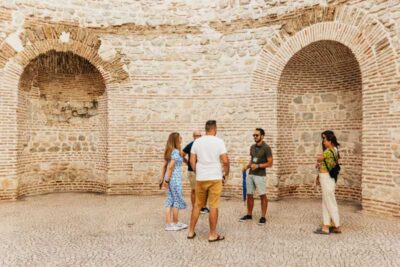

Game of Thrones Tour with Diocletian’s Palace Cellar
Read our review →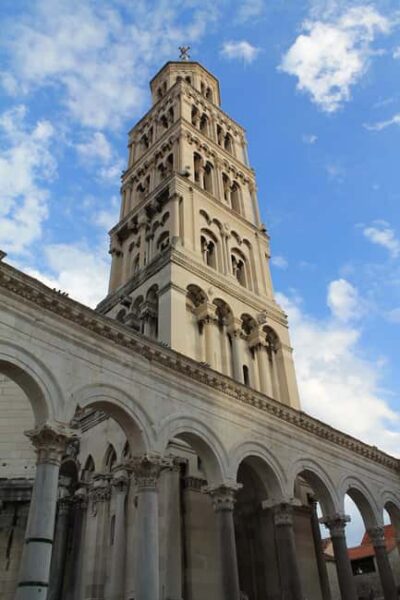
Diocletian’s Palace and Old Town SMALL GROUP Walking Tour
Read our review →
Browse the lists this tour appears in