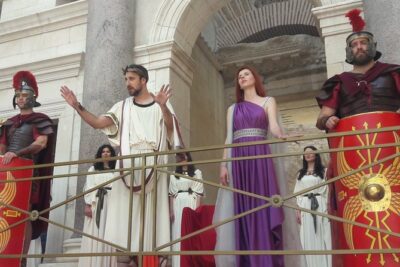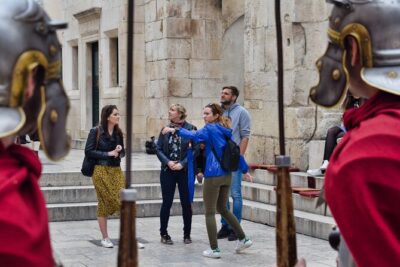
Review · DIOCLETIAN'S PALACE TOURS
Split: Private Walking Tour with Diocletian’s Palace
Split’s best sightseeing happens where daily life and ancient stone share the same address. This private walk takes you through the 1,700-year-old Diocletian’s Palace, but it also brings you into markets, squares, churches, and the waterfront. The palace is not a fenced-off ruin. It is the city center.
I like the private format, which lets you ask questions, slow down for architecture, or focus on history instead of following a large crowd. I also like the local touch: guides such as Slavko, who was born and raised in Split, can connect Roman ruins with present-day life and offer practical tips for the rest of your stay.
The main consideration is that this is a walking tour over old stone streets, and it is not suitable for wheelchair users. The advertised duration ranges from 90 minutes to five hours, so confirm the exact length and what is included if you want a longer visit or particular interior access.
Key points to know before booking
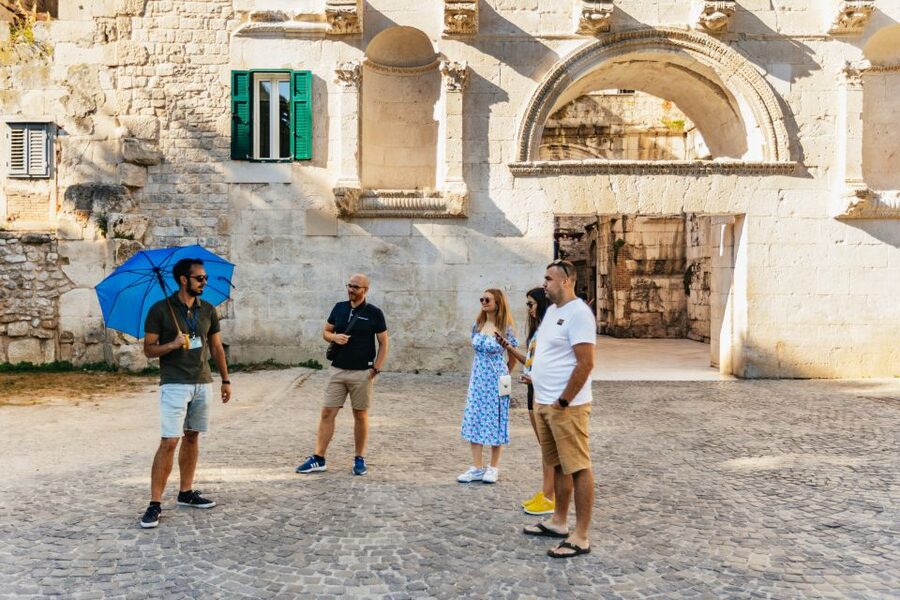
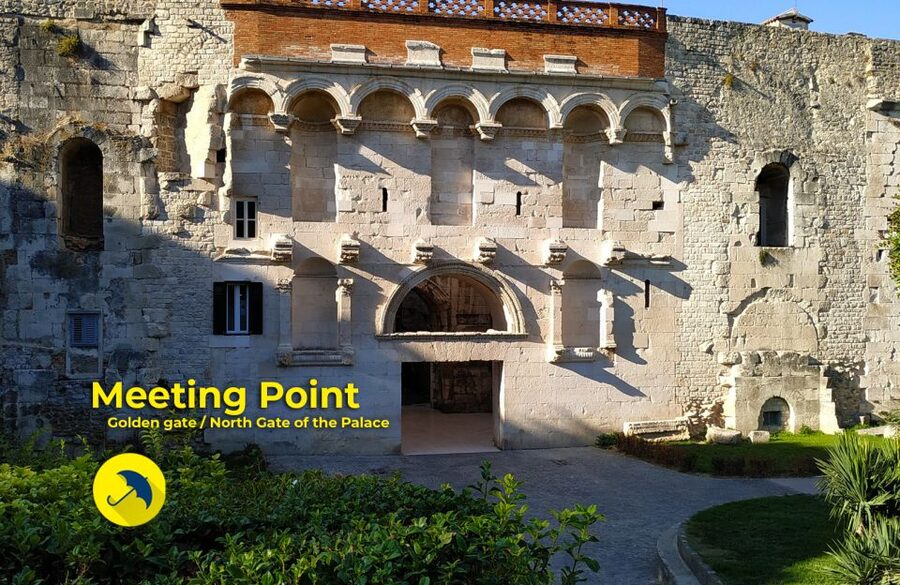
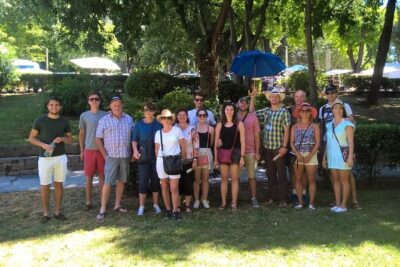
- The Golden Gate is your starting point: Look for the guide with a blue umbrella at the north entrance to Diocletian’s Palace.
- You get a truly private group: The $117 price covers up to two people, making it more appealing for a couple than for a solo visitor.
- The palace is still part of Split: You move from Roman ruins to cafés, shops, churches, markets, and working city streets.
- The standard route lasts about 90 minutes: It includes the cellars, Peristil, St Duje, Vestibul, Riva, and several historic squares.
- The pace can be adjusted: Your guide can focus on architecture, Roman history, local life, or family interests.
- Four languages are offered: You can request English, German, Spanish, or French.
Why Diocletian’s Palace is different from a normal ruin
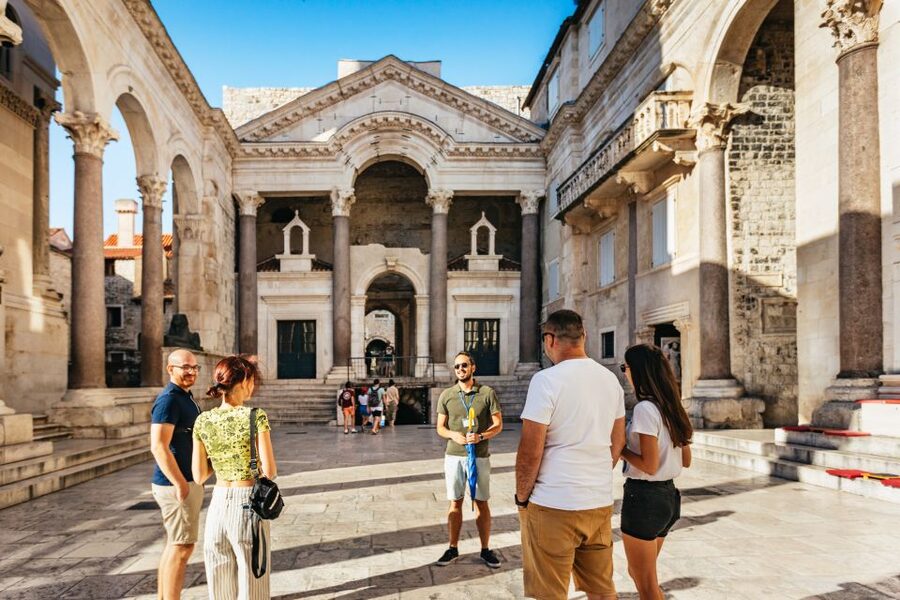
I find Split easier to understand once you stop thinking of Diocletian’s Palace as one isolated monument. The emperor’s complex forms the core of the modern city, with homes, cafés, shops, churches, and public spaces built into and around its ancient walls.
The Roman emperor Diocletian retired here in the early fourth century. Over time, later residents adapted the palace rather than abandoning it. That is why a Roman column can appear beside a medieval wall, while a Renaissance palace or Baroque detail fills the next view.
Your guide helps you read those layers. Without help, you may see handsome stone lanes and scattered ruins. With context, you can understand why the streets follow an ancient plan, why the gates matter, and how the palace changed from an imperial residence into a living urban center.
This is also where a private guide earns the fee. You can ask why one building is Roman and another is medieval, or pause when a detail catches your eye. On a group tour, the guide has to keep everyone moving. Here, the route can respond to you.
More Palace Walking Tours in Croatia
- Split: Old Town and Diocletian Palace Walking Tour
★ 4.9 · 4,727 reviews - Walking Tour of Split and Diocletian’s Palace
★ 5.0 · 2,588 reviews - Split & Diocletian’s Palace Walking Tour
★ 5.0 · 1,125 reviews
Meeting at the Golden Gate
The tour begins at the Golden Gate, the north gate of Diocletian’s Palace. It is a sensible meeting point because the gate is easy to identify and leads directly into the old center.
Look for a guide carrying a blue umbrella. That small detail matters in a crowded historic district, especially if several walking tours are starting nearby. The meeting point is in central Split, so you should allow enough time to reach the gate without rushing.
The Golden Gate itself deserves more than a quick hello. It was one of the main entrances to the palace, and your guide spends about 10 minutes here. You can expect an introduction to the city, the emperor, and the Roman structure beneath the streets.
The route returns to the Golden Gate at the end. That makes the tour practical for a first look at Split, since you finish where you began instead of having to find your way back from an unfamiliar corner.
A quick stop at the Game of Thrones Museum
The listed route includes a short guided stop at the Game of Thrones Museum, about five minutes. This is a small part of the walk, not the main reason to book it.
It can be useful if you enjoy the television series and want to connect filming locations with the old center. Still, the tour’s real focus is Split itself: its Roman remains, medieval streets, churches, and public squares.
If the museum is important to you, ask your guide how much time is available and whether admission is part of your arrangement. The tour information includes taxes, fees, and handling charges, but it does not clearly promise a separate museum admission.
People’s Square and Fruit Square
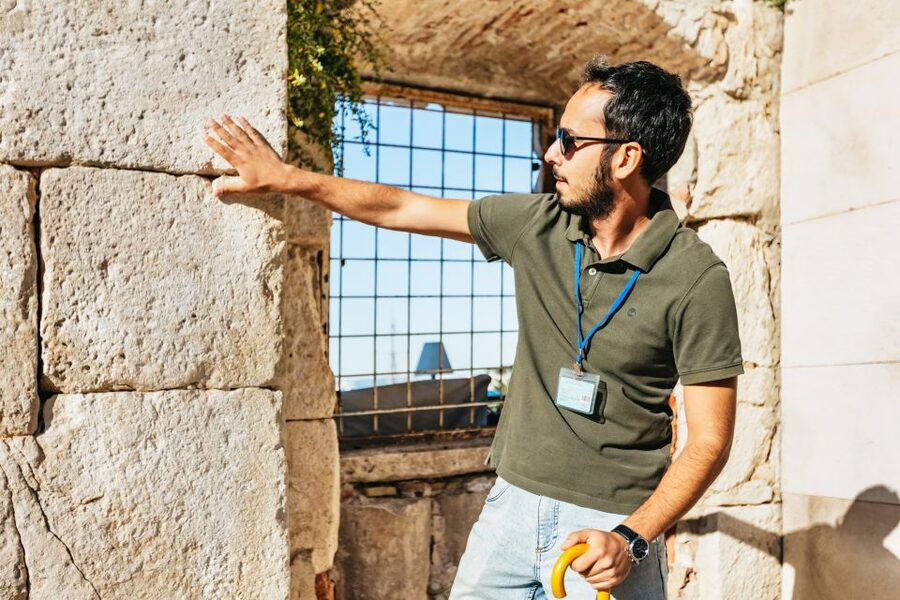
People’s Square, known as Pjaca, brings you into the medieval and later city. The stop lasts about 10 minutes, enough for your guide to point out the changing styles of Split’s buildings and explain how public life developed outside the Roman palace.
This is a good place to look up. The old center mixes Romanesque churches, Gothic palaces, and later Renaissance and Baroque buildings. You do not need to be an architecture specialist. A clear guide can show you how the shapes, windows, and decorations differ.
Fruit Square follows, with another 10-minute explanation. Despite its name, the important point here is the square’s role in the city and its surrounding historic buildings. The name connects to the fruit market once held there, while the setting shows how Split’s public spaces grew around the older palace.
I like these two stops because they prevent the tour from becoming a single-topic Roman history lesson. You see how Split kept changing after the emperor’s time.
More Palace Walking Tours in Split
- Split: Diocletian Palace & Old Town Guided Walking Tour
★ 4.7 · 882 reviews - Diocletian’s Palace and Old Town SMALL GROUP Walking Tour
★ 5.0 · 502 reviews - SPLIT-PRIVATE Walking Tour of Diocletian’s Palace & Old Town
★ 5.0 · 467 reviews - 90-min Diocletian Palace Walking Tour
★ 5.0 · 323 reviews
Riva Harbor and the everyday city

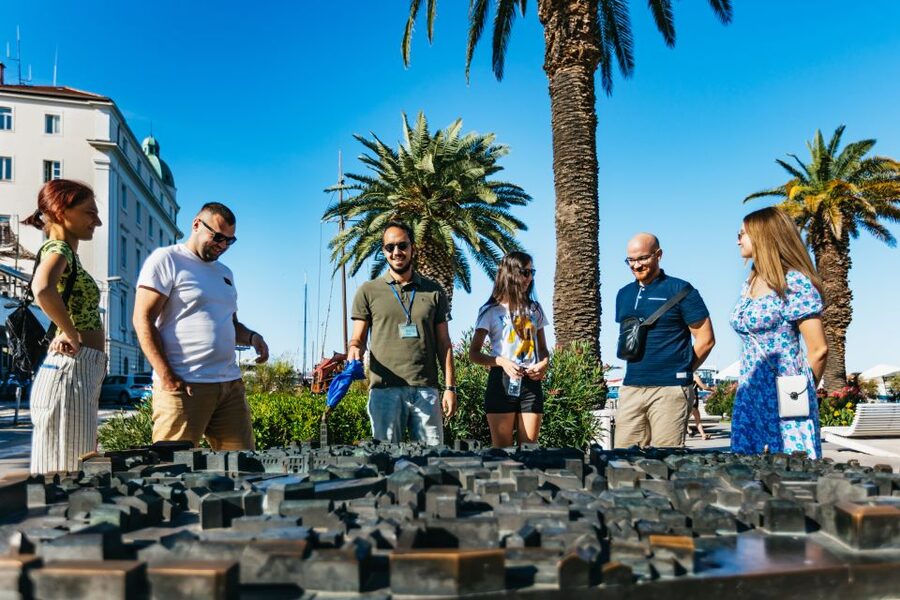
The walk then reaches Riva, Split’s waterfront promenade, for about 10 minutes. This is where the city opens toward the harbor and where you can get a feel for modern Split.
Riva is not an ancient ruin, and that is precisely its value on this route. You see the city as residents use it, not only as a historic display. Your guide can place the waterfront in the wider story of Split and point out how the old center connects with the harbor.
The tour is designed to be flexible, so this is a useful moment to say what interests you. If you care about local life and orientation, ask for practical suggestions. If you prefer architecture and history, your guide can keep the focus on buildings and the city’s development.
Several people who booked this experience singled out the guides’ ability to answer questions and offer local recommendations. Antonia, for example, was praised for taking time with detailed questions about Split’s history, architecture, and unusual place in the past. That is the sort of exchange a private tour handles well.
The Diocletian’s Cellars
The Diocletian’s Cellars receive about 15 minutes, the longest stop on the standard route. That extra time makes sense. The underground spaces are among the clearest places to understand the palace’s original plan.
The cellars supported the imperial rooms above and preserve the shape of the Roman complex. Your guide can explain how the underground layout relates to the palace and help you distinguish original Roman structure from later changes.
This stop can feel more atmospheric than the open squares, but it may also be less comfortable if you dislike uneven stone or enclosed spaces. Wear firm, comfortable shoes, as advised for the entire walk.
The cellars are also a reminder that Split is not a collection of disconnected sights. What you see below helps explain what you see at Peristil above.
Peristil, the palace’s great central space
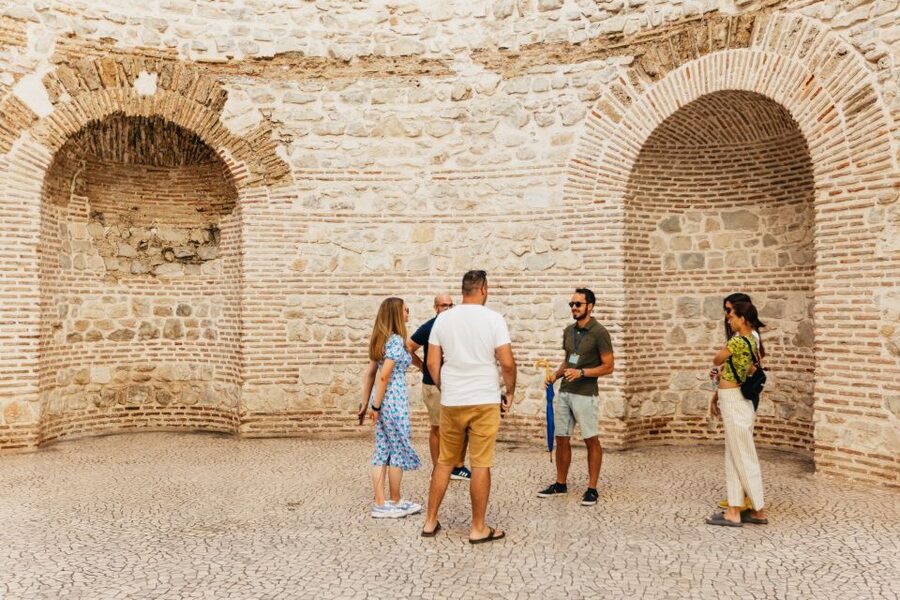
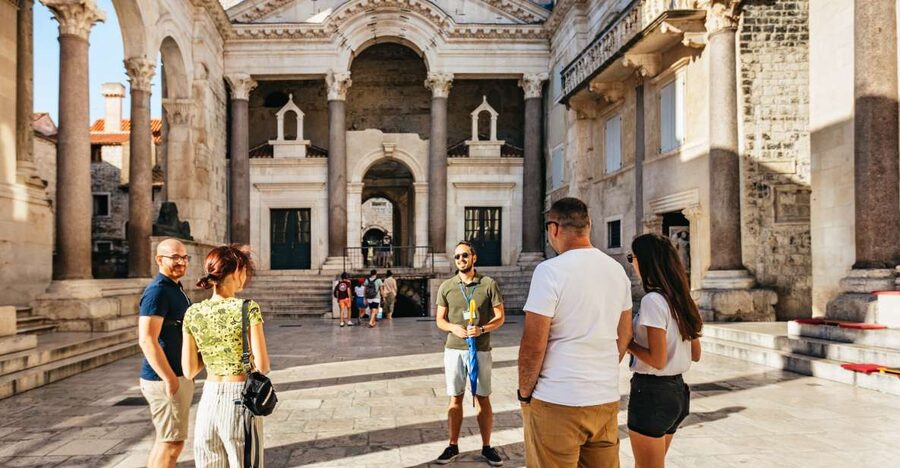
Peristil is the visual center of the palace route, with about 10 minutes of guided time. This grand Roman courtyard gives you the clearest sense of imperial scale.
Here, your guide can explain how the palace was organized and why this space mattered. It is one of those places where a short explanation changes the way you look at the stone, columns, and surrounding buildings.
Peristil can be one of the busiest points on the route. A private guide cannot remove the crowds, but can adjust the pace and position the explanation more effectively than a large group may manage. Slavko was especially noted for avoiding huge groups and creating a quieter private experience, a useful skill in a compact old center.
If you want photographs, say so. A private format makes it easier to pause briefly without holding up a large party.
St Duje and the story of Diocletian
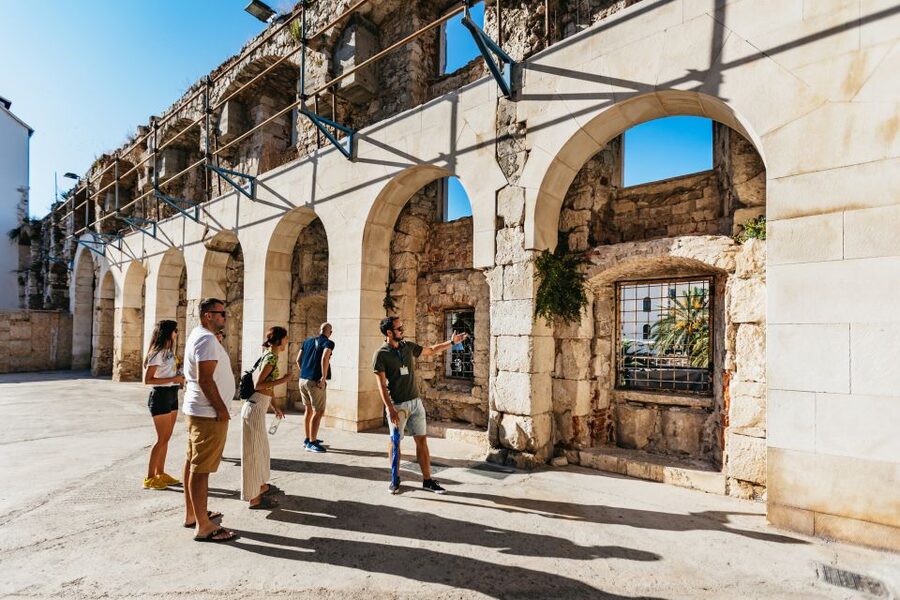
The Cathedral of Saint Domnius, usually called St Duje, receives about 10 minutes. It is one of the most unusual stops because the building began as Diocletian’s mausoleum and later became a Christian cathedral.
Diocletian is remembered as the last famous persecutor of Christians, and he was interred at the site in 311 AD. The cathedral’s later role creates a striking contrast between the emperor’s original purpose and the Christian building that now occupies it.
Your guide can explain that the cathedral is part of the palace story, not a separate attraction placed nearby. This is one of the tour’s strongest history lessons: Roman imperial power, later Christianity, and the medieval city all meet in one structure.
The itinerary allows about 10 minutes here, so do not expect a long architectural study unless you arrange a longer or customized tour. If religious art or church interiors matter to you, ask in advance how much time your guide can devote to the cathedral.
Vestibul and the final return
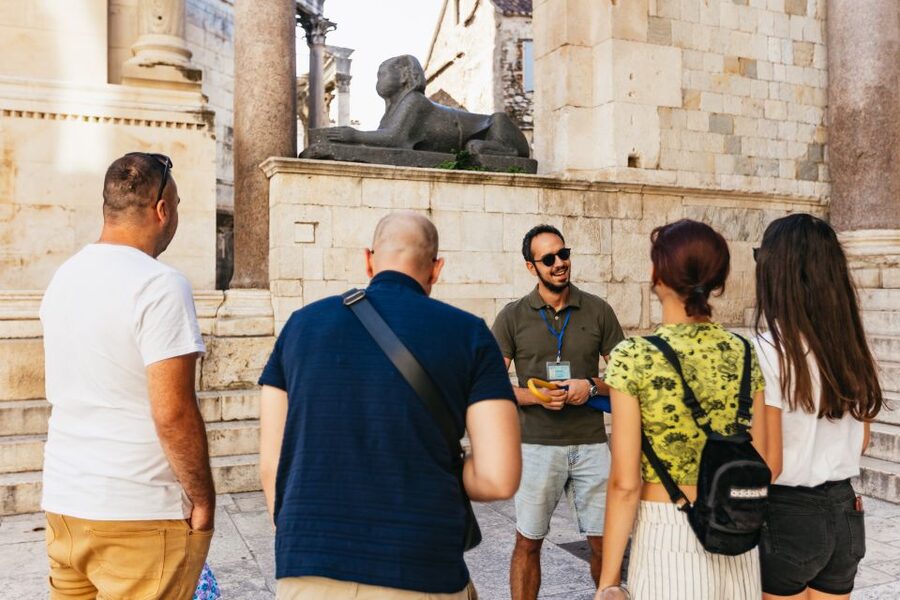
Vestibul receives another 10-minute guided stop. This circular Roman entry space connected the palace’s public and private areas, and its unusual form makes it easy to remember.
By this stage, the sequence of stops should make more sense. You have seen the gate, public squares, waterfront, underground structure, central courtyard, cathedral, and palace entrance. The Vestibul helps tie those parts together.
The route then returns to the Golden Gate. That ending is convenient for a first orientation walk, since you can continue exploring the old center on your own or use the guide’s suggestions for the rest of your time in Split.
What the private format is worth
The price is $117 per group of up to two people. For a couple, that works out to $58.50 each before any personal extras, which is a reasonable price if you want a private guide and the ability to shape the conversation.
For one person, the same group price is harder to justify than a shared tour. For two people who care about history, architecture, or a relaxed pace, the value improves because you are not paying per seat in a large group and can ask as many questions as time allows.
The duration is listed as 90 minutes to five hours. The detailed route adds up to about 90 minutes, while the longer option appears intended for a more customized experience. Confirm the exact duration when you choose a time, especially if you want a longer walk through the medieval center or more attention at the cathedral and palace interiors.
The included items are a professional local guide, a private sightseeing tour, and taxes, fees, and handling charges. No transportation is listed, so plan on meeting and moving around on foot in central Split.
Who will get the most from this walk
I would choose this tour if you have limited time in Split and want the city explained rather than simply photographed. It works especially well on a first visit, since the route gives you a map of the center and shows how the Roman palace connects to later neighborhoods.
It also suits families. The guide can adjust the story for teenagers or younger listeners instead of delivering one fixed lecture. Antonia was praised for answering questions carefully, while another guide, Slavko, brought the perspective of someone born and raised in Split. Those details suggest that the experience can feel conversational rather than rehearsed.
History fans should appreciate the connection between Diocletian’s residence, St Duje, the cellars, and the medieval city. Architecture fans get several periods in one compact walk, from Roman structures to Romanesque churches, Gothic palaces, and Renaissance and Baroque buildings.
You may prefer another option if you want a long museum visit, a broad excursion outside Split, or a fully accessible route. This is a city-center walking experience over historic surfaces, and it is specifically not suitable for wheelchair users.
Bring comfortable shoes, sunglasses, and a sun hat. The advice is simple but practical, since much of the route is outdoors and the old streets can be hard underfoot. The guide can speak English, German, Spanish, or French, so check that your preferred language is available at your chosen time.
Should you book the Split private palace walk?
Book it if you want a personal introduction to Split, especially with only a short stay or with family and friends who ask different kinds of questions. The private setting, central route, and flexible pace are the main reasons to choose it.
I would be most inclined to book for two people. At $117 per group, the cost makes better sense when shared, and you gain a guide who can explain why the palace still functions as the heart of the city.
Skip it if you only want a quick list of sights or need a fully accessible route. Also check the exact duration and any admission details if you want more than the standard 90-minute circuit.
FAQ
Where does the tour begin?
The tour begins at the Golden Gate, the north gate of Diocletian’s Palace in Split. Look for a guide carrying a blue umbrella.
Where does the tour end?
The walk returns to the Golden Gate.
How long does the tour last?
The available duration ranges from 90 minutes to five hours. The listed route is organized as a 90-minute walk, while longer options can be customized.
Is this a private tour?
Yes. It is a private group experience, with the listed price covering up to two people.
Which languages are available?
Live guiding is available in English, German, Spanish, and French.
What sights are included?
The route includes the Golden Gate, Game of Thrones Museum, People’s Square, Fruit Square, Riva, Diocletian’s Cellars, Peristil, the Cathedral of Saint Domnius, and Vestibul.
Is the tour suitable for wheelchair users?
No. The activity is not suitable for wheelchair users. Comfortable shoes, sunglasses, and a sun hat are recommended.
More Private Palace Tours in Split
- Split: Private Walking Tour and Diocletian’s Palace
★ 5.0 · 3 reviews - Split: Diocletian’s Palace Private walking tour
★ 5.0 · 3 reviews
More Private Palace Tours in Croatia
- Split by Private Electric Rickshaw – Palace & Hidden Gems
★ 5.0 · 412 reviews - YOUR BEST PRIVATE TOUR – amazing Split and Diocletian’s palace
★ 5.0 · 83 reviews - Jewish Heritage & Diocletian’s Palace Private Split Tour
★ 5.0 · 80 reviews - Split: Palace & Old Town Private Walking Tour-Entrance incl.
★ 4.8 · 8 reviews
Newly added in Split
- Split: Private Walking Tour and Diocletian’s Palace★ 5.0 · 3 reviews
- Split: Jewish Heritage & Diocletian’s Palace Walking Tour★ 5.0 · 3 reviews
- Split: Diocletian’s Palace Private walking tour★ 5.0 · 3 reviews
- Split and Diocletian’s Palace walking tour with a local guid★ 4.9 · 36 reviews
- Split: Old Town and Diocletian’s Palace Walking Tour★ 3.3 · 3 reviews
- Essential Diocletian’s Palace Tour for First-Time Visitors★ 4.9 · 79 reviews
- Split: Old Town & Diocletian’s Palace Earlybird Walking Tour★ 4.0 · 12 reviews
- Split: Palace & Old Town Private Walking Tour-Entrance incl.★ 4.8 · 8 reviews
Diocletian's Palace Tours, compared.

Diocletian Palace & Old Town Guided Walking Tour
Read our review →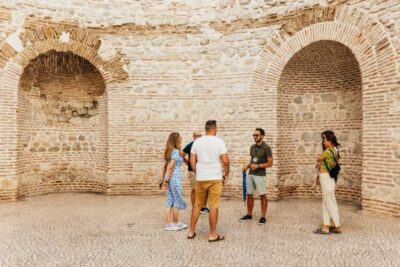

Game of Thrones Tour with Diocletian’s Palace Cellar
Read our review →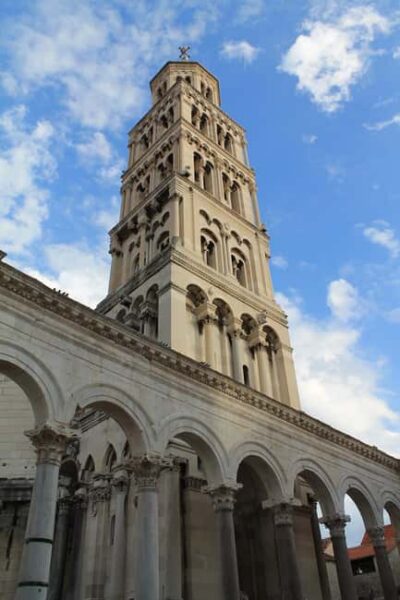
Diocletian’s Palace and Old Town SMALL GROUP Walking Tour
Read our review →