
Review · ROME PALACE TOURS
Colosseum Special Access on Arena Floor, Roman Forum and Palaces
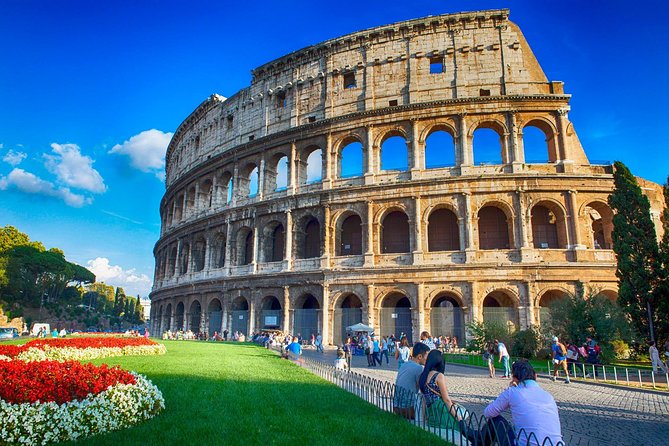
The best part of this Rome tour is the chance to walk onto the Colosseum arena floor, following the route once used by gladiators and performers. You also see the first and second levels before moving on to Palatine Hill and the Roman Forum, giving you one clear three-hour introduction to ancient Rome.
I like the small-group format, capped at 24 people, and the way a strong guide can turn a stack of old stones into a story about emperors, politics, public spectacle, and daily life. I also like the practical route: you begin beside the Arch of Constantine and finish in the Forum, close to public transport and many central Rome sights.
The main drawback is the physical demand. Expect stairs, uneven paving, heat, and a fair amount of walking. The Forum and Palatine Hill can also feel long if your main goal is the Colosseum. Timed entry means arriving late can cost you the entire visit.
Key points to know before booking
- Arena-floor access: Use the special access gate and stand inside the Colosseum rather than viewing the arena only from above.
- Three major sites: The tour covers the Colosseum, Palatine Hill, and Roman Forum in about three hours.
- Guide quality matters: Past guides including David, Deborah, Polina, Jason, Francesca, and Eugene have been praised for clear storytelling and humor, but your guide is assigned on the day.
- A moderate group size: The maximum is 24 people, with a smaller-group upgrade available for a more personal visit.
- Bring identification: Every person needs a passport or ID matching the full name supplied at booking.
- Plan for stairs: Palatine Hill and the Colosseum involve uneven surfaces and many steps, making this a poor fit for anyone with serious mobility limits.
Entering the Colosseum through the arena gate
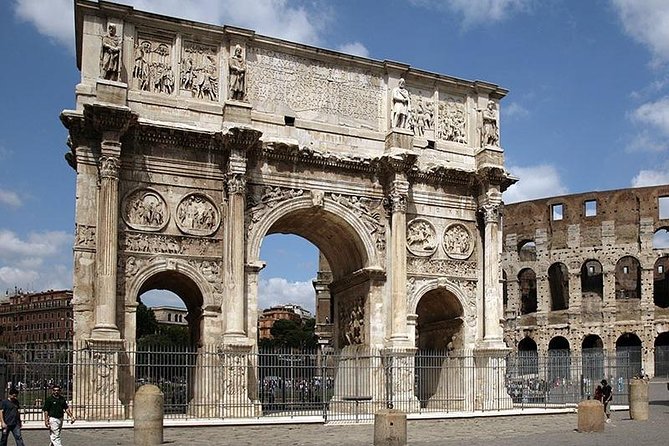
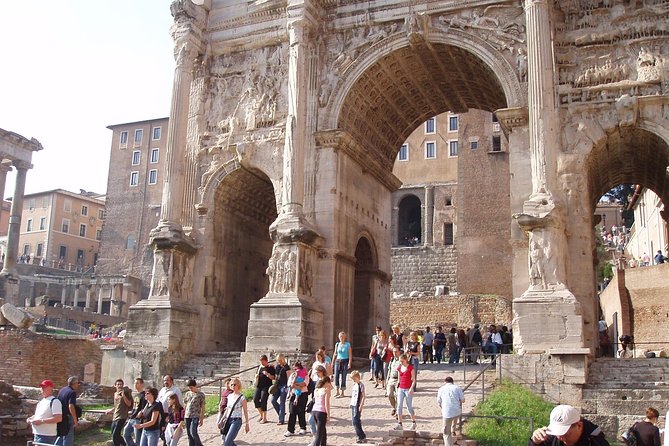
The tour begins at the Arch of Constantine, on Piazza del Colosseo. This is a useful meeting point because the arch is easy to identify beside the Colosseum, and the surrounding area has public transport links. One practical landmark is the nearby free still and sparkling water station. Bring a refillable bottle, especially in warm weather.
Once your group is assembled, the guide leads you toward the Colosseum entrance. You need to arrive on time. The tickets are timed, and if you miss the entry window, the ticket may expire. This is not like showing up late for a restaurant reservation and quietly joining the table. The site controls entry tightly, so leave extra time for traffic, finding the Arch of Constantine, and locating the tour representative.
The special access gate takes you onto the arena floor, the most memorable feature of this experience. From there, the building feels less like a distant monument and more like a working theater. You can look up toward the seating tiers and picture how the crowd watched spectacles below. The arena was built to handle crowds of roughly 70,000 people, a startling scale even after centuries of damage.
The guide explains the games held here, including gladiator fights, exotic animal hunts, executions, and other public spectacles. This subject can be grim, but it helps explain why the Colosseum mattered to ancient Roman society. It was not simply a sports venue. It was a tool of power, a place where emperors displayed wealth and reinforced their connection with the people.
The arena floor also gives you strong photo opportunities, but the visit is not only about posing in the center. A good guide uses the space to explain how the show worked, who controlled it, and how the crowd experienced it. Guides such as David have been praised for mixing dry humor with serious history, checking on the group, and finding good positions near exhibits even when the building is crowded.
More Palaces to Tour in Italy:
- Venice: Doge’s Palace Reserved Entry Ticket
★ 4.6 · 42,716 reviews - Doge’s Palace & St. Mark’s Basilica with Terrace Access Tour
★ 4.7 · 10,697 reviews - Venice: Doge’s Palace and St Mark’s Basilica Walking Tour
★ 4.4 · 6,291 reviews
First and second levels: the Colosseum at a useful pace
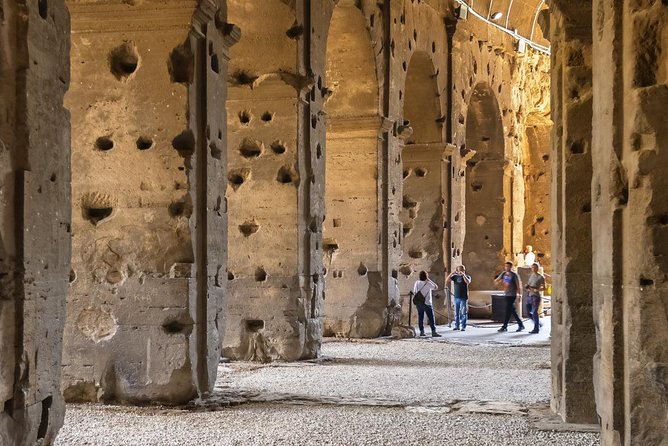
The Colosseum portion lasts about 90 minutes, making it the longest part of the visit. You see the first and second levels as well as the arena floor. That balance works well for first-time visitors because you get both the close view from below and the wider perspective from the seating areas.
From the upper levels, the design becomes easier to understand. You can see how the stadium was organized and how different sections served different parts of the Roman population. The guide fills in the details that are hard to read from the ruins alone, including the political purpose of the games and the practical operation of the building.
The pace is usually active but not rushed. Past tours have allowed time for photographs and questions, and several guides have been praised for keeping the group together while making room for individual interests. David, Deborah, Cynthia, Polina, Jason, Francesca, and Eugene are among the guides singled out for clear explanations, humor, patience, or strong command of the subject. That does not guarantee who you will get, but it shows how much the guide shapes the experience.
Crowds can make the Colosseum feel chaotic. A guide helps by choosing where to stop, keeping the group moving, and explaining what you are looking at before you lose sight of the group. Radios or listening devices may be used, though one person with mobility issues reported losing contact with the guide while using an elevator. If you need an elevator or have trouble with stairs, tell the operator and guide early.
The tradeoff is time. Ninety minutes sounds generous, but the Colosseum is large and busy, and the arena floor adds a special-access stop that takes part of the visit. If your priority is underground chambers or every corner of the monument, this is not that tour. The focus is the arena floor, the first two levels, and the main stories.
Palatine Hill and the story of Rome’s beginnings
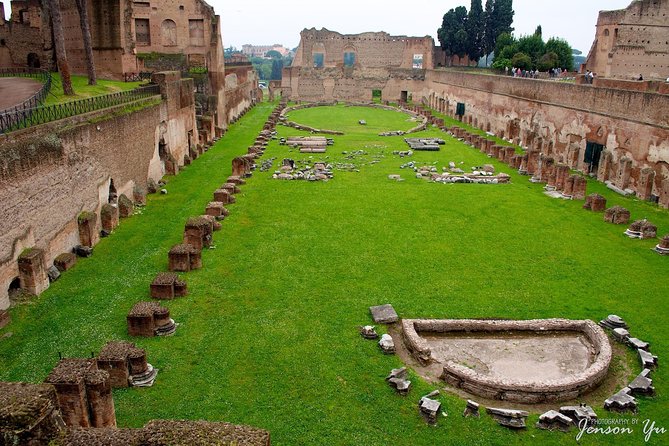
After the Colosseum, the route continues to Palatine Hill for about 45 minutes. This hill is tied to the traditional founding of Rome nearly 3,000 years ago, and it later became the preferred residential district for emperors. The tour connects those two ideas: the mythic beginning of Rome and the imperial center that followed.
The remains include imperial palace structures, with the formal name Palatine Hill often associated with Caesar’s Palace in the tour presentation. You also encounter layers from different periods, including ancient remains, Renaissance changes, and more recent construction linked with Benito Mussolini. That mix can be confusing without a guide, since the site is spread across a broad area and the remains do not always announce what they were.
This is where a good storyteller earns the price of admission. The ruins are less immediately dramatic than the Colosseum, but the hill helps you understand how Rome’s ruling class lived and how power shifted over time. Guides have used stories about emperors, political decisions, and imperial behavior to make the remains easier to follow.
You should also expect some physical work here. The hill includes slopes, stairs, and uneven paths. One route descends from the top of Palatine Hill toward the Forum, which can be hard for anyone with limited mobility. In summer, heat adds another challenge. A thoughtful guide may pause in shade and remind you to drink water, but you should still arrive prepared.
Some people prefer spending more of their time inside the Colosseum and less on Palatine Hill. If that sounds like you, remember that this is a combined Ancient Rome tour, not a Colosseum-only visit. The hill is part of the value, but it will not appeal equally to everyone.
The Roman Forum, where public power took shape
The final 45 minutes take place in the Roman Forum. You finish here in the center of the ancient city, which is convenient if you want to continue sightseeing, find a restaurant, or reach public transport.
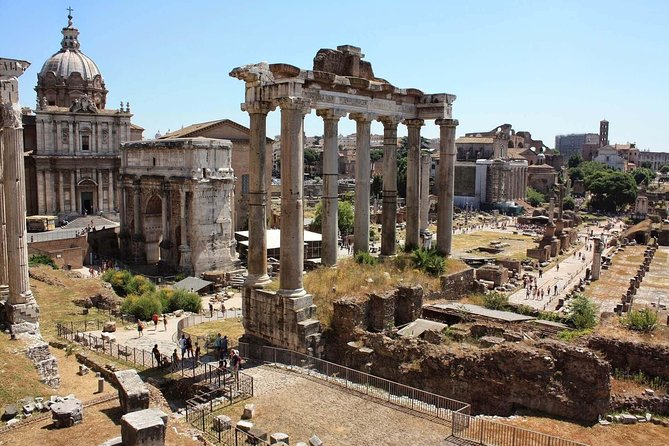
The Forum was the political and religious heart of ancient Rome. It was where laws, ceremonies, speeches, elections, and state decisions shaped an empire that stretched from Iraq to Scotland. The stones can look scattered at first, but the guide gives you a map in words.
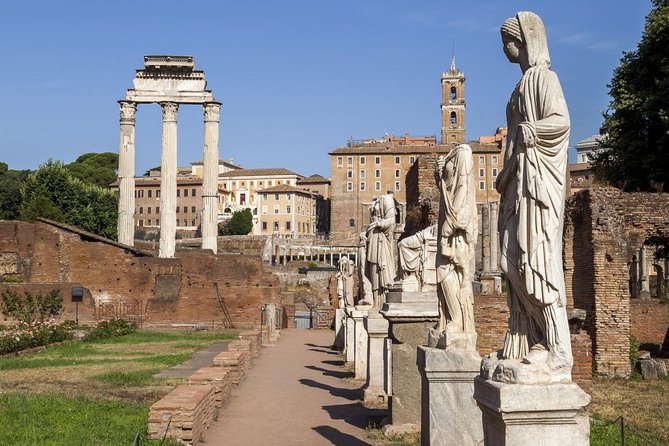
Stops include major pagan temples and tombs, the Senate house, the house of the Vestal Virgins, and the tomb associated with Julius Caesar. These landmarks matter because they show how Roman public life mixed religion, government, military ambition, and personal power. The Forum is not a single building with a simple route. It is a wide archaeological area, and the guide helps you connect separate ruins into one functioning center.
The Forum portion can feel slower after the visual punch of the Colosseum. Some people find the extra detail rewarding, while others would rather have more time inside the stadium. A past visitor left early to catch a train after finding the latter part of the tour longer than expected. If you have a fixed departure, book the tour with a generous buffer after the scheduled three hours.
The end point is useful. You are not returned to a distant neighborhood or locked into a group lunch. You finish near the center of Rome, with easy access to the rest of your day. You may also choose to stay in the archaeological area longer if site rules and your ticket access allow it, though the guided portion itself ends in the Forum.
Same city, another grand address:
- Legendary Venice: Doge’s Palace, St Mark’s & VIP Terrace Access
★ 4.5 · 5,033 reviews - Florence: Palazzo Vecchio Entrance Ticket & Audioguide
★ 4.4 · 4,822 reviews - Florence: Entrance Ticket to Pitti Palace
★ 4.5 · 4,528 reviews - Venice: Doge’s Palace and St. Mark’s Basilica Tour
★ 4.5 · 3,734 reviews
What the $84.48 price gets you
At $84.48 per person, this is not the cheapest way to see the Colosseum. The value rests in three things: timed admission, the arena-floor access, and the guide’s interpretation of all three sites.
The arena floor is the key reason to consider paying more. It changes your physical relationship with the Colosseum and gives the guide a strong place to explain the games. You also avoid the uncertainty of arriving at the site without a clear plan for what matters most.
The price makes less sense if you want only quick photographs or if you already know the Forum and Palatine Hill well. A self-guided visit may suit you better if you prefer to move slowly, skip ruins that do not interest you, or spend most of your time in the Colosseum. It may also be better for anyone who cannot comfortably keep up with a group.
The smaller group upgrade can improve the experience, especially in crowded spaces. A group of up to 24 is manageable, but it is not private. If asking questions, hearing every explanation, and staying close to the guide are important to you, the smaller option is worth considering.
Practical planning for heat, crowds, and stairs
Wear shoes with good grip. The surfaces are uneven, and the route includes stairs and slopes. This is not a good place for flimsy footwear or a relaxed stroll in dress shoes.
Carry water and protect yourself from the sun. The route can take about three hours, and parts of Palatine Hill and the Forum offer limited shade. Guides have sometimes helped groups find shade and keep hydrated, but you should not rely on that alone.
Have your passport or ID with you. Each person must present a valid document that matches the full name provided during booking. This requirement applies to entry at the Colosseum and Roman Forum, so check the spelling of every name before you pay.
The tour is offered in English. The quality of communication can vary by guide, and one poor experience involved a strong accent and a dry presentation. Most of the named guides received praise for clear English, humor, attention to questions, and strong command of the subject, but no tour can promise a particular guide unless the operator confirms one.
Cancellation is flexible only up to a point. You receive a full refund if you cancel at least 10 full days before the start time. Cancellations or changes inside that window are not accepted, so do not book this far ahead unless your Rome plans are fairly firm.
Who should book this Ancient Rome tour?
I would choose this tour for a first visit to Rome, especially if you want the major ancient sites covered in one morning or afternoon. The arena floor gives it a stronger focus than a basic Colosseum visit, while Palatine Hill and the Forum add the political and residential context that the stadium alone cannot provide.
It also suits you if history becomes easier to remember through stories. Guides such as David, Polina, Jason, Deborah, and Eugene have been praised for making complex material funny, clear, and easy to follow. A good guide can also keep you oriented when crowds and ruins begin to blur together.
I would hesitate if you have serious mobility limits, dislike group pacing, or want a leisurely, self-directed day. The stairs and rough ground are real, and the Forum and Palatine Hill may test your patience after the excitement of the Colosseum. If you have a train to catch, allow extra time beyond the stated three hours.
Should you book it?
Book this tour if arena-floor access is your main goal and you want a guide to connect the Colosseum with Rome’s imperial palaces and political center. The three-hour format gives you a useful overview without consuming an entire day, and the end point leaves you well placed for more sightseeing.
Skip it in favor of a self-guided visit if you need a slow pace, want underground access instead, or care far more about the Colosseum than Palatine Hill and the Forum. For most first-time visitors who can manage the stairs, this is a well-rounded way to meet ancient Rome, with the arena floor providing the memorable centerpiece.
FAQ
How long does the tour last?
The tour lasts approximately three hours. About 90 minutes are spent at the Colosseum, followed by roughly 45 minutes at Palatine Hill and 45 minutes in the Roman Forum.
Where does the tour begin?
The meeting point is the Arch of Constantine on Piazza del Colosseo, 00184 Rome, Italy.
Where does the tour end?
The tour concludes in the Roman Forum, in the center of Rome. The area has access to public transportation, restaurants, shopping, and other major sights.
Is the arena floor included?
Yes. The tour includes special access through a gate leading to the Colosseum arena floor, along with visits to the first and second levels.
What identification do I need?
Each person must present a valid passport or ID document matching the full name supplied at booking. Full names are required for all people when booking.
Is the tour suitable for people with mobility issues?
The tour requires moderate physical fitness and includes many stairs, slopes, and uneven surfaces, especially around Palatine Hill and the Forum. Anyone with mobility concerns should consider these conditions carefully before booking.
Newly added in Italy
- Anagni: Entrance ticket to the Boniface VIII Palace★ 3.4 · 3 reviews
- Venice: Doge Palace, San Marco Basilica & Rialto Bridge★ 4.7 · 75 reviews
- Turin: Palazzo Madama Museum of Ancient Art Entrance Ticket★ 4.6 · 149 reviews
- Venice Doge’s Palace & St. Mark’s Semi-Private Tour, Max 6 People★ 5.0 · 192 reviews
- Colosseum, Roman Forum and Emperors’ Palace Private Guided Tour★ 5.0 · 14 reviews
- Doria Pamphilj Palace Gallery and Museum Private Tour with Local Guide★ 4.5 · 10 reviews
- Private Tour – National Museum of Palazzo Massimo★ 5.0 · 51 reviews
- Private Tour – Palazzo Barberini★ 5.0 · 23 reviews
Rome Palace Tours, compared.
Opera Concert at Palazzo Poli – Fontana di Trevi
Read our review →

The Great Opera Arias Concert at Palazzo Poli – Trevi Fountain
Read our review →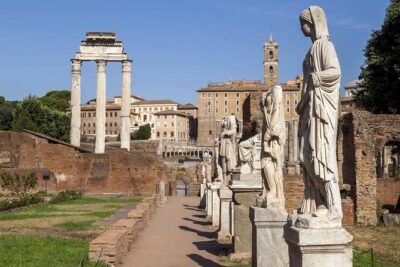
Colosseum Underground, Roman Forum & Cesar Palace Special Access
Read our review →
Palazzo Barberini Galleria Corsini Ticket & Audioguide
Read our review →
Vittoriano with Rooftop & Palazzo Venezia Hosted Entry
Read our review →
Private Tour – National Museum of Palazzo Massimo
Read our review →
Browse the lists this tour appears in