

Review · DIOCLETIAN'S PALACE TOURS
Split: Diocletian Palace & Old Town Guided Walking Tour
Split’s greatest surprise is that Diocletian’s Palace is not a museum. Roman walls, courtyards, medieval streets, shops, homes, cafés, and laundry all share the same old stone shell. This short walk gives you the story that makes the jumble readable.
I like the compact route and the guides’ easy way with questions. Ina, Nataša, Darko, and Tin are repeatedly praised for clear explanations, humor, and a real feel for Split’s past and present. I also like the price: at $17, it is a sensible way to get your bearings before exploring on your own.
The trade-off is time. At about 50 minutes, this is a brisk introduction, not a slow archaeological study. The cathedral bell tower is mentioned as a highlight, but you should confirm whether climbing it is part of your departure, since the core walk focuses on the palace and Old Town.
Key Points
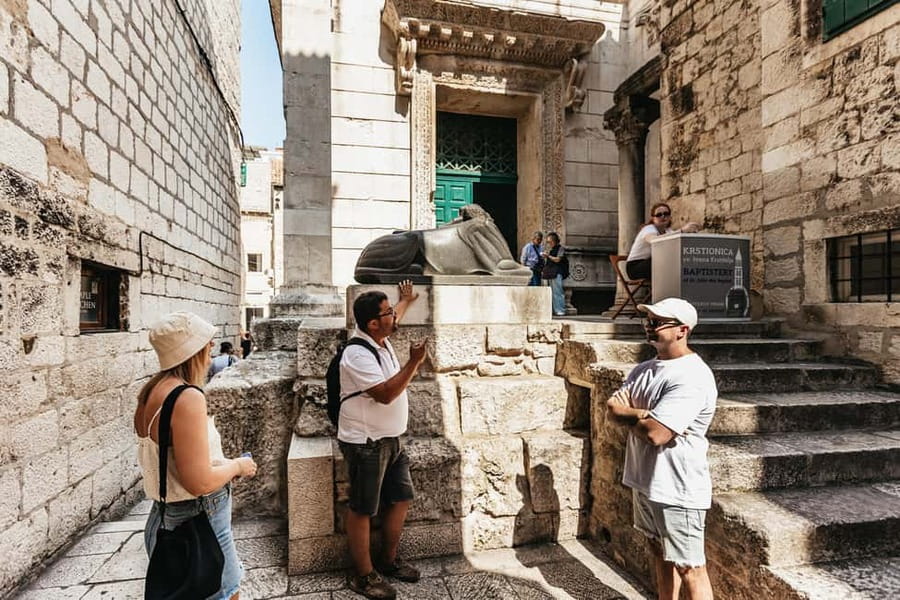
- Roman palace turned living city: Diocletian’s former retirement complex now forms the center of Split’s Old Town.
- A short, useful introduction: The route takes roughly 50 minutes, making it well suited to hot days, cruise stopovers, and first-day orientation.
- Four original gates: You pass through the Bronze, Silver, Golden, and Iron Gates, each giving a different view of the palace plan.
- Strong local guiding: Ina, Nataša, Darko, Tin, and other guides are praised for humor, clear storytelling, and patient answers.
- Small details beyond the main sights: The walk includes the Benedictine, 15th-century Town Hall, Fruit Square, and the emperor’s private observatory.
- Easy to plan: The meeting point is beside an open-top red bus, and cancellation is free up to 24 hours before the tour.
Why This Short Split Tour Works

Split can feel confusing at first. The Riva waterfront leads toward a maze of stone lanes, but the palace is not laid out like a neat attraction with one obvious entrance and a clear beginning. Roman walls were reused, altered, and built around for centuries.
That is why a guide helps here. You are not just looking at columns and worn stone. You are learning how an imperial complex became a town, and why residents still move through spaces first built for a Roman emperor.
The tour costs $17 per person. I consider that fair value for a focused local introduction, especially if Split is your first stop in Croatia or you have only a few hours in the city. You get a guide, a clear route, and context for several major sights without committing half a day.
The format suits people who prefer a useful overview to a long lecture. It also works well in summer heat. Several visitors describe the length as just right, and one particularly practical advantage is that you can use the rest of your day to return to the places that interest you most.
Do not book this expecting a private archaeological examination. The route may include around 15 people, and one person wished for a microphone. In a busy courtyard, you may need to stay close to the guide so you can hear every detail.
More Palace Walking Tours in Croatia
- Split: Old Town and Diocletian Palace Walking Tour
★ 4.9 · 4,727 reviews - Walking Tour of Split and Diocletian’s Palace
★ 5.0 · 2,588 reviews - Split & Diocletian’s Palace Walking Tour
★ 5.0 · 1,125 reviews
Meeting at the Riva and Finding the Red Bus
The walk begins at Apodos Travel Agency, near Split’s Riva promenade. The meeting point is identified by an open-top red bus and staff in red or white shirts. This is useful because the Riva has plenty of activity, cafés, tour vehicles, and people heading toward the palace.
Allow a little extra time to find the bus. One person had trouble locating the exact spot when the sightseeing bus was delayed, so look for the red city sightseeing bus stop rather than only searching for a shop sign.
The Riva is a good place to begin. Palm trees, cafés, and the Adriatic sit just outside the palace walls, giving you an immediate sense of Split’s unusual character. Ancient stone and modern life are close together here, not separated into different districts.
Your guide connects you with the walking group before leading you toward Diocletian’s Palace. The tour is offered in English, Spanish, and Italian. Guide assignments vary, but the names that appear often in the feedback include Ina, Nataša, Darko, Tin, and Ena.
Entering Diocletian’s Palace Through Four Gates
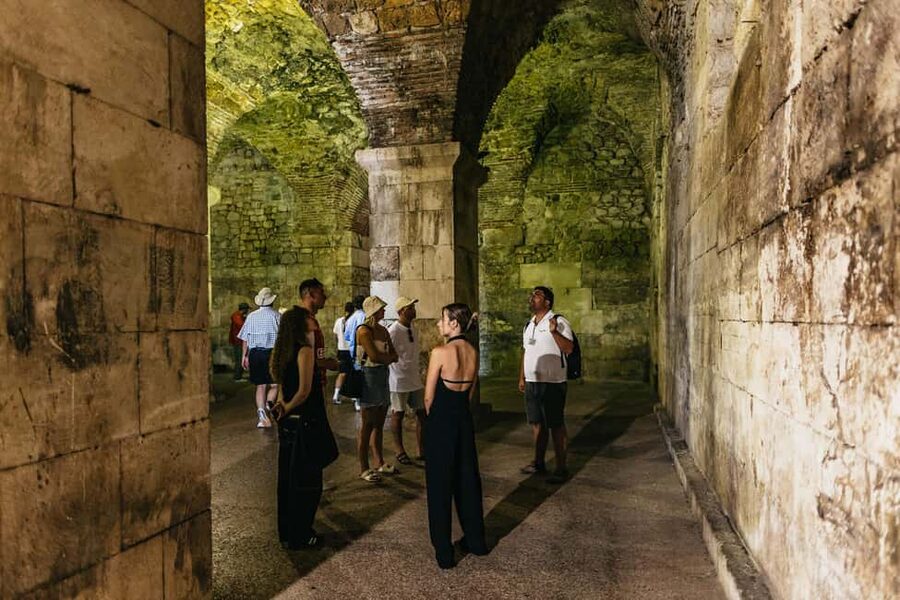
Diocletian built the palace in the fourth century AD as a home for his later years. It was not simply a grand house. It combined private rooms, ceremonial areas, religious spaces, service buildings, and fortified entrances.
The four gates help you understand the basic plan:
- The Bronze Gate opens toward the sea.
- The Silver Gate leads through the eastern side.
- The Golden Gate marks the northern entrance.
- The Iron Gate connects with the western side and later city streets.
Walking through all four is more useful than seeing one gate in isolation. You begin to grasp the palace as a working complex with controlled access and different routes for people moving through it.
The gates also show how the building changed. Roman architecture remains visible, but the city grew around it. Medieval and later additions softened the original military character, while homes and businesses made the palace part of everyday Split.
Bring comfortable shoes. The route crosses uneven stone and cobbled surfaces, with about 15 to 30 steps along the way. The walk is wheelchair accessible, and one guide was praised for helping a group choose paths with few or no steps, but the historic surfaces still require care.
The Cellars and the Peristyle Courtyard
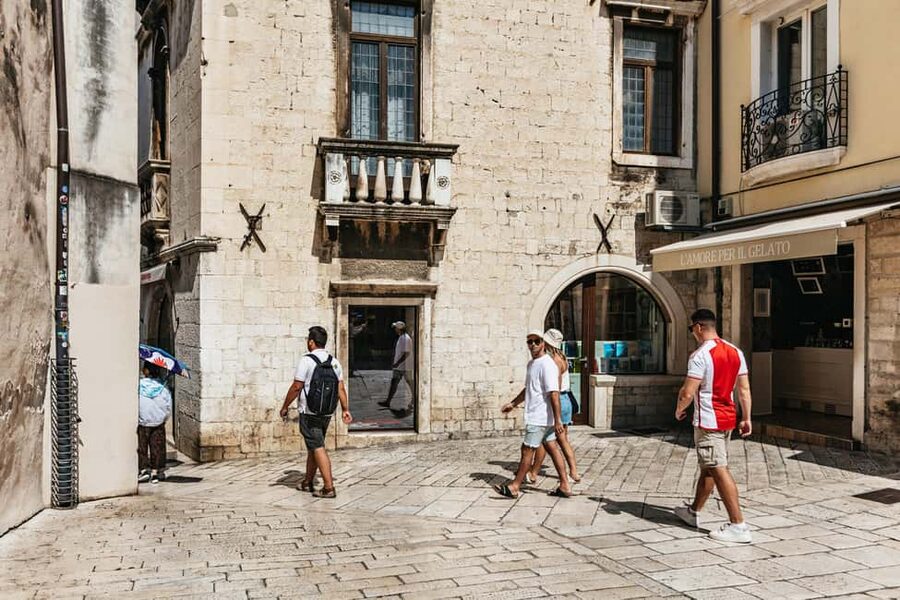
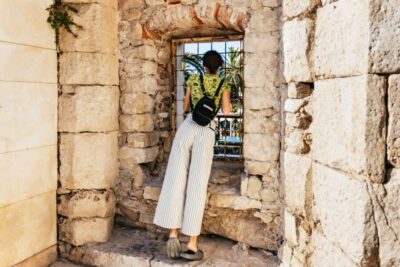
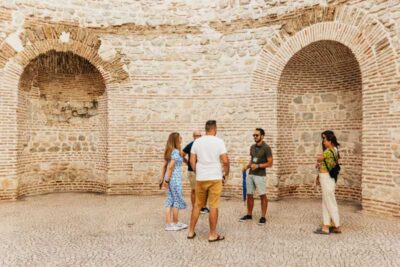
The palace cellars are one of the most memorable sections of the route. They preserve the shape of the rooms above and show how the lower level supported the imperial apartments. They also make the palace plan easier to read because the surviving walls and arches are often clearer underground.
The cellars can be busy, and the stone floor may be damp or uneven. Still, this is where a guide’s explanation pays off. Without context, a series of arches can seem like a collection of ruins. With the palace plan in mind, you can see how these rooms relate to the emperor’s private quarters.
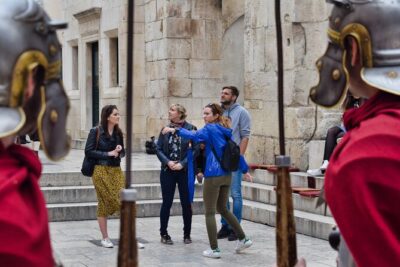
Next comes the Peristyle, the palace’s ceremonial central courtyard. It is one of the spaces that gives the complex its grand scale. Look up at the surrounding stone, columns, and high walls, then notice the modern life around them. People pass through, sit nearby, and continue along routes that have been used and altered for centuries.
I like the Peristyle because it connects the palace’s public and private sides. This was not just a decorative square. It helped frame the approach to the emperor’s apartments and created a formal setting for imperial power.
The guide will usually pause here for explanation and photographs. Stay close in the courtyard, especially during busy periods. The group may stop in a place where voices carry poorly, and keeping within earshot matters more than wandering off for the perfect picture.
More Palace Walking Tours in Split
- Diocletian’s Palace and Old Town SMALL GROUP Walking Tour
★ 5.0 · 502 reviews - SPLIT-PRIVATE Walking Tour of Diocletian’s Palace & Old Town
★ 5.0 · 467 reviews - 90-min Diocletian Palace Walking Tour
★ 5.0 · 323 reviews - Split: 1.5-Hour Walking Tour and Diocletian’s Palace
★ 4.7 · 256 reviews
The Emperor’s Rooms and Private Observatory
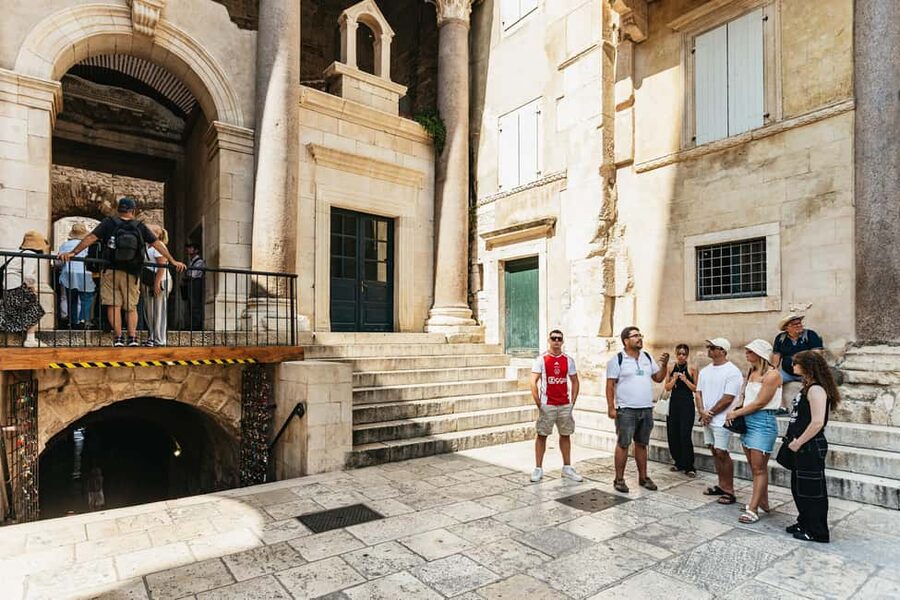
The tour includes the emperor’s former private chambers and private observatory. These spaces bring the story closer to Diocletian as a person rather than leaving him as a name attached to a huge building.
The palace was designed around his needs and status, but the surviving spaces are not all intact. Your guide helps separate what remains Roman from later construction and repairs. That distinction is one of the main reasons to take the walk instead of simply wandering through the palace with a phone map.
The observatory is especially useful as a reminder that this was a personal residence as well as a fortified complex. You can connect the grand ceremonial areas with the private life of the man who commissioned them.
Guide quality matters here. Ina is often praised for archaeological detail and for explaining how people living inside the palace kept it functioning as a community rather than a frozen monument. Nataša is described as an art historian with a strong command of Split’s story. Darko is praised for combining historical detail with humor.
The exact style depends on who leads your group. That is normal for a walking tour, but the repeated pattern is clear: guides tend to encourage questions and add practical suggestions for the rest of your time in the city.
St. Domnius Cathedral and the Bell Tower
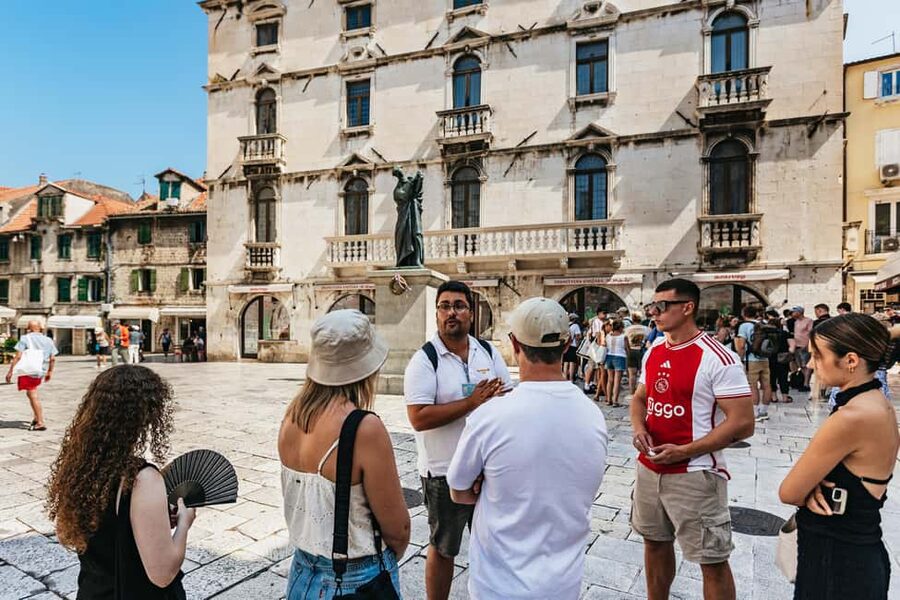
The Cathedral of St. Domnius, or Sv. Duje, occupies an important place in the palace story. It began as Diocletian’s mausoleum and later became a Christian cathedral, a sharp example of how Split’s religious and political life changed over time.
This is one of the strongest stops for understanding cultural change. The building is not a separate monument placed beside the palace. It uses a structure tied directly to the emperor and gives that structure a new purpose.
The bell tower offers panoramic views over Split and the harbor. Those views can help you read the city from above, especially after seeing how tightly the Old Town fits within the palace walls.
There is one point to clarify before booking. The experience description presents climbing the bell tower as something to enjoy, while the included features focus on the walking tour and Peristyle access. The tour itself is listed as about 50 minutes, so ask at the meeting point if the tower climb is included in your departure or should be done separately.
If it is separate, that is not a major flaw. You can still use the guided walk to understand the cathedral, then decide if you want to spend extra time and money on the tower.
Benedictine, Town Hall, and Fruit Square
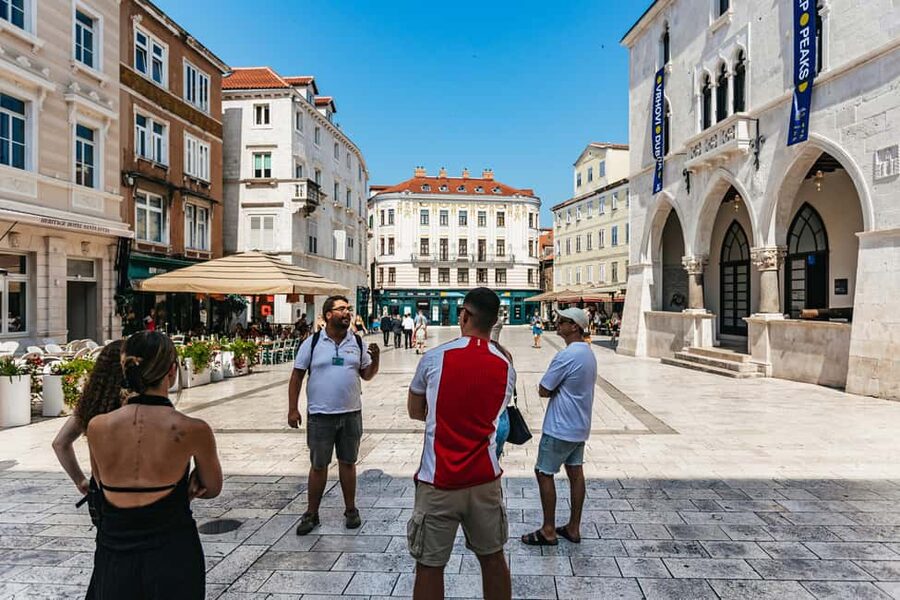
The best part of this tour may be the smaller stops between the famous ones. You see the Benedictine, the 15th-century Town Hall, and the baroque monuments of Fruit Square.
These locations prevent the walk from becoming a single-monument tour. Split’s identity comes from layers, and the later buildings explain how the Roman complex was adapted by medieval and Venetian-era communities.
The Town Hall is a useful reminder that city government developed inside and around the old palace. Fruit Square adds a different mood, with later architecture and a more open urban setting. Your guide connects these places instead of treating them as unrelated photo stops.
I also value the attention to local life. Darko, for example, has been praised for pointing out small businesses still linked to traditional crafts and food production. That kind of detail makes the walk more practical. You leave with more than dates and building names, and you may have ideas for where to return afterward.
The route is still an overview. You will not spend long inside each location, and some places may be viewed from outside or explained while moving. If you want detailed art history, religious architecture, or Roman engineering, plan a separate visit after the tour.
Guide Style and Group Experience
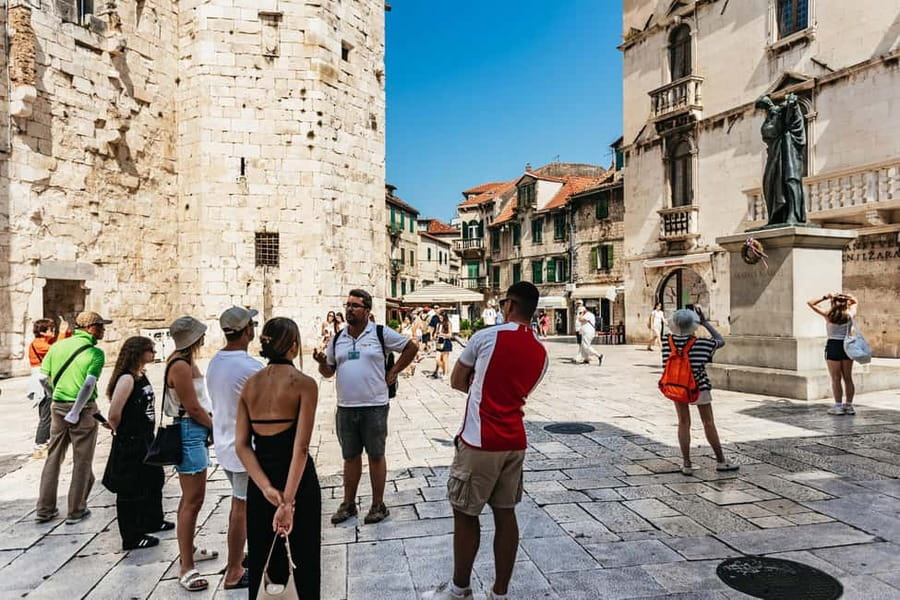
The guide is the main reason to book this instead of using a self-guided map. The strongest feedback centers on clear explanations, enthusiasm, humor, and patience with questions.
Ina is repeatedly praised for making the history easy to follow without overloading the group. Nataša is noted for her art history background and passion for Croatian history. Darko brings humor and local context, while Tin is praised for a confident delivery and for keeping an eye on people at the back.
Those details matter in a compact tour. A guide who moves too quickly can turn 50 minutes into a blur of names. The better approach is to give you a few solid ideas: how the palace was built, how it changed, and how people still use it.
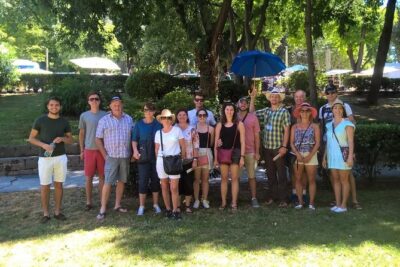
Groups can vary. One departure became a private tour because only one booking was made, while another had around 15 people. You cannot count on a private experience, but the format appears manageable for a small group.
The only recurring practical concern is sound. One person suggested a microphone, and courtyards can be noisy. Keep near the guide, and do not hesitate to ask for a point to be repeated.
Timing, Heat, and What to Bring
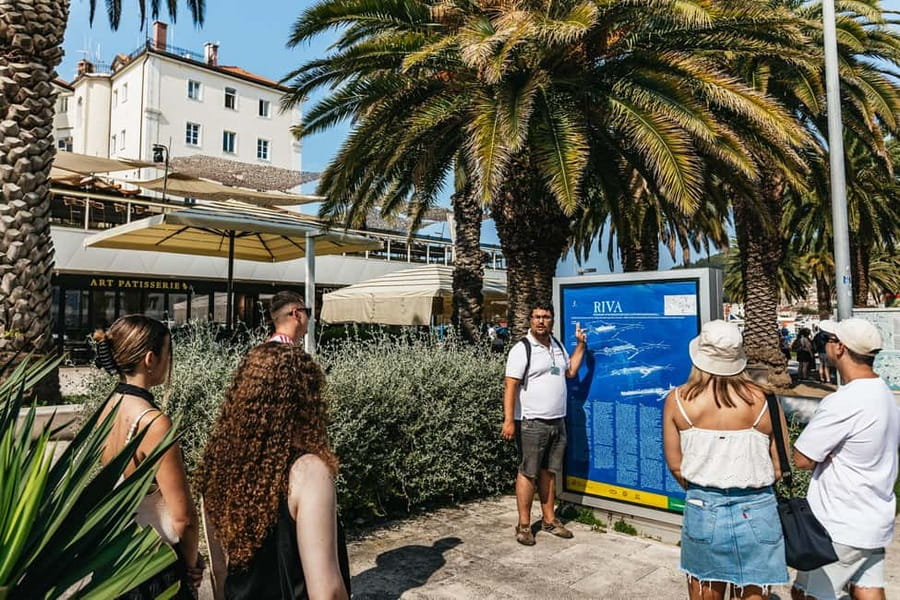
The tour lasts about 50 minutes, though the itinerary is also described as lasting one hour. Treat it as a short walk with a little flexibility rather than a tightly timed 50-minute performance.
That length is helpful in summer. Split’s stone streets can hold heat, and a longer walk in direct sun is not always pleasant. Sunglasses, a hat, and water are sensible. On windy days, long sleeves can make the waterfront more comfortable.
Wear shoes with a firm sole. The palace includes cobblestones, uneven surfaces, and steps. Strollers and wheelchairs may be manageable on routes with few steps, but you should be prepared for historic paving and confirm any specific access needs in advance.
The tour does not include meals, drinks, transportation to the starting point, personal purchases, or souvenirs. Plan to arrive independently at the Riva meeting area.
You can cancel up to 24 hours before departure for a full refund, and reserve now while paying later. Those terms are useful if your Split schedule depends on a ferry, cruise arrival, or changing weather.
Who Will Get the Most from It
I would choose this tour for a first visit to Split, a short port stop, or the beginning of a longer stay. It gives you a framework, then leaves enough time to revisit the palace, climb the tower if appropriate, eat, shop, or explore the waterfront.
It is also a good choice for families and mixed-age groups. The walk is short enough for young children, and one guide helped a group with toddlers, a stroller, and wheelchair users find easier paths.
History fans will appreciate the Roman foundation and the way later cultures altered the site. People less interested in dates may enjoy the human angle: an emperor’s residence became a living neighborhood, with shops, homes, government buildings, and religious spaces fitted into the old structure.
I would look elsewhere if you want an all-day tour, interior access to every major sight, or a slow photography walk. The route is designed to cover the main ideas efficiently. Its strength is focus, not depth.
Is the $17 Price Worth It?
At $17, this is a good-value orientation tour. You get a local guide, the palace’s main spaces, the four gates, Old Town context, and enough background to make later exploring more rewarding.
The value is highest when you arrive without much preparation. Split’s ruins can be visually impressive but hard to interpret. A well-paced explanation turns scattered walls into a story about imperial planning, medieval reuse, Venetian influence, and modern city life.
The price does not cover food, drinks, transport, or personal expenses. It also may not cover every optional feature suggested in the description, especially the bell tower climb. Think of the fee as payment for the guided introduction, not a ticket package for every monument in the center.
Should You Book This Split Walking Tour?
Book it if you want a short, affordable first look at Split with a guide who can explain why the palace still functions as a city. The $17 price is reasonable, and the 50-minute length is especially useful in hot weather or on a tight schedule.
Go early in your stay if you can. You will understand the Old Town better afterward, and the guides often add practical suggestions for what to see next.
Skip it if you already know Diocletian’s Palace well or want a detailed archaeological tour. For most first-time visitors, though, this is a practical introduction with strong guiding, a clear route, and just enough Roman, medieval, and Venetian Split to send you exploring on your own.
FAQ
How long does the Diocletian’s Palace walking tour last?
The activity is advertised as 50 minutes, while the palace portion of the itinerary is also described as about one hour. Plan for a short walk of roughly 50 to 60 minutes.
Where does the tour meet?
Meet at Apodos Travel Agency near an open-top red bus. Staff wearing red or white shirts will connect you with the guide.
Which languages are available?
The live tour guide is available in English, Spanish, and Italian.
Is the tour wheelchair accessible?
Yes, the activity is listed as wheelchair accessible. The route includes uneven and cobblestone surfaces, with about 15 to 30 steps. A guide may be able to use paths with fewer steps.
What should I bring?
Bring comfortable shoes, water, and a camera. Sunglasses and a hat are recommended on sunny days, and long sleeves can help on windy days.
Can I cancel the booking?
Yes. You can cancel up to 24 hours in advance for a full refund. The reserve-now, pay-later option also lets you hold a place without paying immediately.
More Diocletian's Palace Tours in Split
- Split Old Town and Diocletian’s Palace Tour
★ 4.8 · 716 reviews - Split: Game of Thrones Tour with Diocletian’s Palace Cellar
★ 4.8 · 545 reviews - Split: Diocletian’s Palace Virtual Reality Experience
★ 4.4 · 308 reviews - YOUR BEST PRIVATE TOUR – amazing Split and Diocletian’s palace
★ 5.0 · 83 reviews
Newly added in Split
- Jewish Heritage & Diocletian’s Palace Private Split Tour★ 5.0 · 80 reviews
- YOUR BEST PRIVATE TOUR – amazing Split and Diocletian’s palace★ 5.0 · 83 reviews
- Split: 1.5-Hour Walking Tour and Diocletian’s Palace★ 4.7 · 256 reviews
- Split: Diocletian’s Palace Virtual Reality Experience★ 4.4 · 308 reviews
- 90-min Diocletian Palace Walking Tour★ 5.0 · 323 reviews
- Split by Private Electric Rickshaw – Palace & Hidden Gems★ 5.0 · 412 reviews
- SPLIT-PRIVATE Walking Tour of Diocletian’s Palace & Old Town★ 5.0 · 467 reviews
- Diocletian’s Palace and Old Town SMALL GROUP Walking Tour★ 5.0 · 502 reviews
Diocletian's Palace Tours, compared.

Game of Thrones Tour with Diocletian’s Palace Cellar
Read our review →
Diocletian’s Palace and Old Town SMALL GROUP Walking Tour
Read our review →

Browse the lists this tour appears in