

Review · DIOCLETIAN'S PALACE TOURS
Walking Tour of Split and Diocletian’s Palace
Diocletian’s Palace is not a single grand building waiting behind a fence. It is the living center of Split, with homes, shops, cafés, lanes, churches, and ancient stone folded into one busy town. This 90-minute walking tour gives you a useful first look at how the Roman palace became the city around it.
I like the route for two reasons: it covers the palace’s main spine without wasting time, and it adds places such as Riva Harbor, Fruit’s Square, and the old synagogue. Guides including Antonella, Anton, Mario, and Marino have been praised for clear storytelling and local passion. The main caution is sound. Without headsets, a larger group can make it hard to hear, especially when several tours gather in the same square.
Key points to know before booking
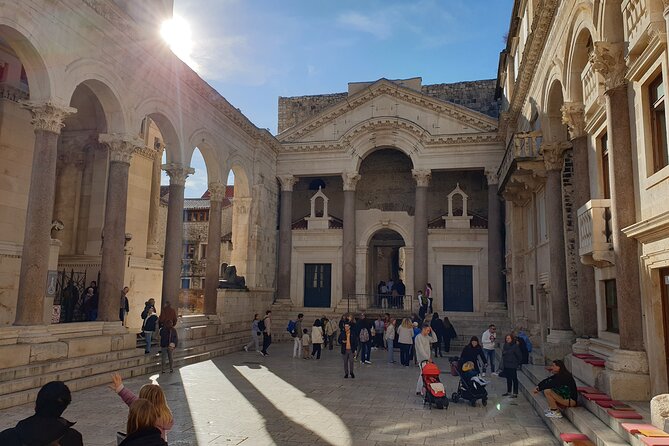
- The palace is still part of daily life: You walk through a real city, not an isolated archaeological park.
- The route covers seven useful stops: You see the Peristyle, Vestibule, substructures, Golden Gate, Riva Harbor, Fruit’s Square, and Split Synagogue.
- The English-language guide makes the difference: Antonella, Anton, Mario, Marino, and Maggie have all led highly praised tours, though the guide is assigned rather than selected.
- Paid areas are not included: No admission tickets come with the tour, and the museum section of the substructures is not visited.
- Sound can be the weak point: The maximum group size is 20, and there are no headsets listed.
- Wear sensible shoes: Expect high, uneven steps, and do not book if stairs are a serious problem for you.
Why this is a smart first look at Split
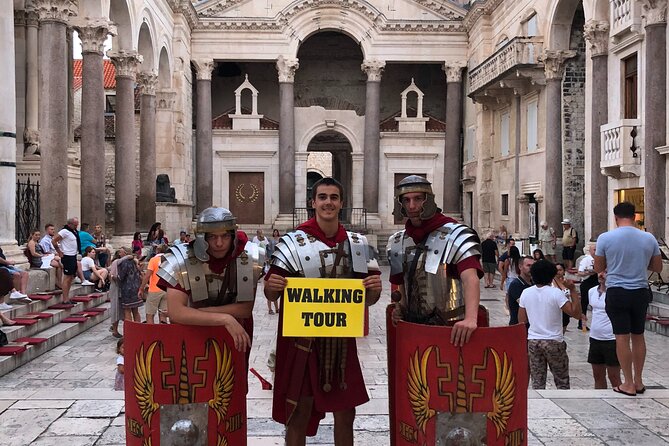
At $48.37 per person, this is not the cheapest way to walk around Split. You can enter much of the old center on your own without paying for a guide. The value comes from having someone explain why a Roman emperor built a palace here, how the palace changed after the Roman period, and why modern Split still follows its ancient walls.
That context matters. On your own, the Peristyle may look like a handsome stone square. With a good guide, it becomes the palace’s central stage and the place from which the rest of the complex makes sense. The Golden Gate becomes more than an old entrance, and the Riva becomes more than a pleasant waterfront walk.
The tour is especially useful if you have only one day in Split, are visiting on a cruise stop, or want help planning the rest of your time. Several guides have used humor, personal examples, and story-based teaching rather than simply reciting dates. Antonella has been praised for clear English and an engaging manner, while Anton and Mario have received strong marks for warmth and enthusiasm.
Still, the experience depends heavily on the person holding the guidebook. One assigned guide was described as hard to follow and unfocused, while another tour began about 20 minutes late after a booking problem. Those cases appear to be exceptions within a high overall rating, but they are worth keeping in mind.
More Palace Walking Tours in Croatia
- Split: Old Town and Diocletian Palace Walking Tour
★ 4.9 · 4,727 reviews - Split & Diocletian’s Palace Walking Tour
★ 5.0 · 1,125 reviews - Split: Diocletian Palace & Old Town Guided Walking Tour
★ 4.7 · 882 reviews
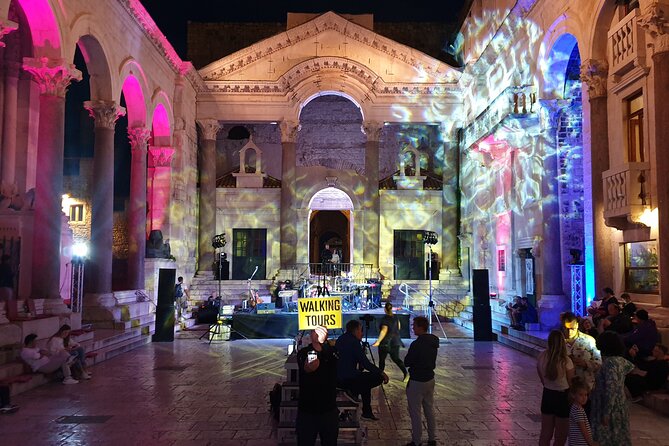
Starting at the Peristyle, the palace’s great meeting point
The meeting point is on Peristil ulica, at the Peristyle itself. This is a central location, but the starting point can be hard to spot if you are unfamiliar with Split’s narrow old lanes. Give yourself extra time and look for the open Roman square rather than expecting a large modern tour office.
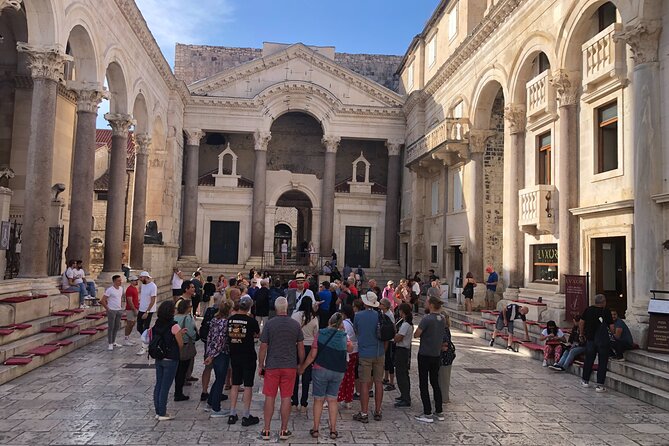
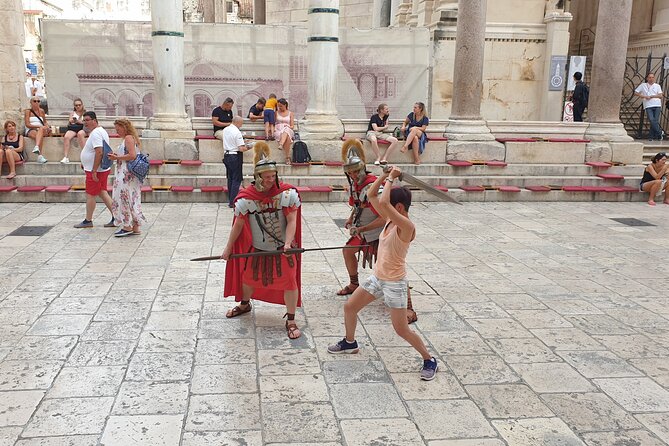
The Peristyle is the right place to begin because it connects to almost every other part of the palace. You spend about 15 minutes here, learning how the square worked within Diocletian’s imperial complex and how it still functions as one of Split’s main public spaces.
This is also the busiest part of the route. If several groups arrive at once, it can become difficult to hear. I would stand close to the guide without blocking other people, and I would not drift toward the back of the group. The company does not list wireless headsets, and sound was a repeated concern for some visitors.
The Vestibule and the sound of Dalmatia
The Vestibule takes only about five minutes, but it gives you a change of mood. This round space once formed part of the emperor’s approach to his private quarters. Here the guide explains its purpose and place in the palace.
You may also hear traditional Dalmatian singing. The wording is careful, so it is not guaranteed, but the possibility adds a human touch to what could otherwise be a short stop among old stones. The Vestibule is also one of the places where a soft-spoken guide can be difficult to hear, so stay near the center of the group.
The short visit means you should not expect a full musical presentation or a long architectural lecture. Think of it as a compact introduction before the route moves into the lower levels and outer gates.
Palace substructures and what lies beneath the city
The substructures receive about 10 minutes. They help you understand how the upper palace was supported and how the lower spaces changed function over time. This part of the route is valuable because it shows that the palace was not just a collection of decorated rooms. It was a working complex built on a large and carefully planned base.
There is an important limit: the museum section of the substructures is not included. No admission tickets are included in the tour, and you can visit that museum separately after the walk. If you want a longer look underground, budget additional time and a separate ticket.
This is one reason the tour works best as an introduction rather than a complete palace visit. You get orientation, an explanation of the construction, and a plan for what to see next. You do not get every paid interior.
The steps here may be high or uneven. The activity is not recommended if you have trouble with high steps, and sensible shoes are a better choice than smooth soles or delicate sandals.
More Palace Walking Tours in Split
- Diocletian’s Palace and Old Town SMALL GROUP Walking Tour
★ 5.0 · 502 reviews - SPLIT-PRIVATE Walking Tour of Diocletian’s Palace & Old Town
★ 5.0 · 467 reviews - 90-min Diocletian Palace Walking Tour
★ 5.0 · 323 reviews - Split: 1.5-Hour Walking Tour and Diocletian’s Palace
★ 4.7 · 256 reviews
The Golden Gate and Gregory of Nin
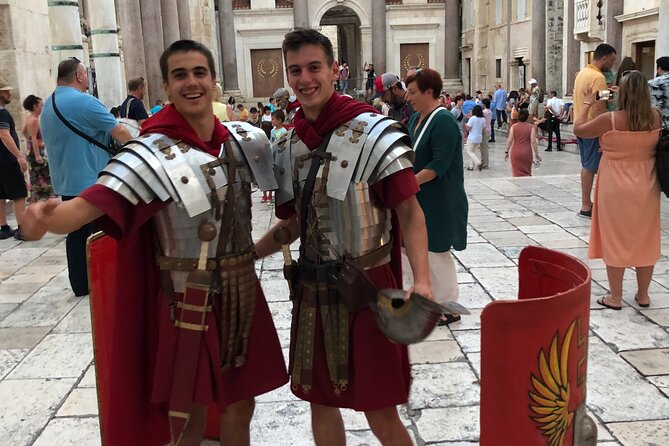
The Golden Gate is the palace’s main entrance and one of the clearest places to picture Split’s Roman past. The guide explains how the gate fitted into the original complex, then turns attention to the statue of Gregory of Nin.
The statue matters because Gregory is linked with Croatian language and national history. The stop gives the tour a wider focus. You are no longer hearing only about one emperor and one building. You are also being introduced to the people and symbols that shaped Croatian identity.
This is a good place to ask questions if your guide welcomes them. Mario, Antonella, and Anton have been praised for answering questions beyond the basic route. Other guides may be more formal or less focused, so the amount of conversation can vary.
Riva Harbor, where the ancient palace meets modern Split
After the palace interior, the walk reaches Riva Harbor. You spend about 15 minutes here, making it one of the longer stops. The waterfront offers a useful contrast to the tight stone lanes inside the palace.
You see a bronze model of Diocletian’s Palace and hear about the history of the Riva promenade. The model can help you understand the palace’s scale and shape, especially after walking through spaces that can feel confusing on the ground.
I like this stop because it gives you room to step back. The palace is easier to understand when you can see its overall form rather than only one arch, wall, or courtyard at a time. Riva also helps you locate the old center in relation to the harbor.
Do not expect a separate harbor excursion. This is still a walking tour focused on Split’s historic core, with the Riva used as a viewpoint and a chapter in the city’s story.
Fruit’s Square and Split’s Venetian layer
Fruit’s Square, officially Trg Brace Radic, adds another period to the tour. Here you learn about a 15th-century Venetian citadel and Marko Marulic, often called the father of Croatian literature.
This stop is useful because Split was not shaped by the Romans alone. The route shows how later powers and local writers left their mark on the city. The square also helps break up the palace material, giving you a look at the wider old center rather than keeping every explanation inside the imperial complex.
The guide spends around 10 minutes here. That is enough for a clear introduction, but not enough for a full study of Venetian rule or Croatian literature. If those subjects interest you, note the names and return later with more time.
Passing the Split Synagogue

The final listed stop is the Split Synagogue, dating to the 16th century. The guide explains the history of the Jewish community in Split, adding a social and religious dimension to the walk.
You pass by the synagogue rather than taking part in a full interior visit. Admission is not included, and no tickets are included anywhere on the tour. The stop is brief, about 10 minutes, but it widens the story once again. A city is not just its rulers and monuments. It is also made by the communities that lived, worked, worshipped, and traded there.
The route ends back at the meeting point. That makes the tour easy to combine with an independent visit to the substructures museum or with more time around the old center.
Guide quality, group size, and hearing the story
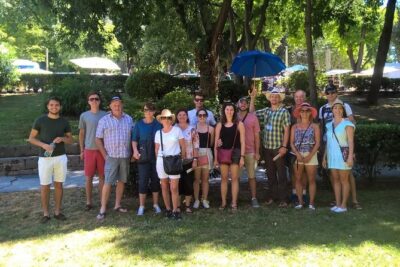
The tour has a maximum of 20 people, which is smaller than a large coach group but not necessarily intimate. The best experience will come when the group is near the lower end of that limit. One small group had only four people, making it easy to ask questions and stay close to the guide.
At full capacity, the lack of headsets becomes more important. Split’s old center can be crowded, and other guides may be speaking nearby. If you have hearing difficulty, stay close, tell the guide early, and consider choosing a quieter tour time if several departures are offered.
The most praised guides have been Antonella, Anton, Antonio, Mario, Marino, and Maggie. That does not mean you can request a specific person, so book for the route and subject rather than expecting one named guide. A strong guide can make the palace memorable, while a weak or hard-to-hear presentation can reduce the value of the fee.
The advertised duration is about one hour and 30 minutes. One account described a tour that lasted less than that, while another ran much longer because the guide became unfocused. For planning, allow at least 90 minutes and avoid placing a tight reservation immediately afterward.
Who will get the most from this tour
I would choose this experience if you want a clear introduction before exploring alone. It suits first-time visitors, people with one day in Split, families who want a story to follow, and anyone who prefers local explanation to reading signs at each stop.
It also suits visitors who enjoy history in manageable portions. The route moves quickly from imperial architecture to Croatian language, Venetian rule, the waterfront, and the Jewish community. You get a broad outline rather than an exhaustive lecture.
I would hesitate if you want entry to every paid area, a museum visit, or a quiet private tour. The fee does not cover admission, and a group of up to 20 can feel crowded. I would also think twice if stairs are difficult or if you need guaranteed audio equipment.
The free cancellation rule is practical: cancel at least 24 hours before the start time for a full refund. Within 24 hours, the fee is not refunded, and changes are not accepted. The tour also requires a minimum number of participants, so a cancellation for that reason leads to a different date or experience, or a full refund.
Is $48.37 good value?
The price makes sense when you view the tour as a foundation. You pay for an English-speaking guide, a structured route, and explanations that help you use the rest of your time in Split well. You are not paying for museum entry, a private guide, transportation, or a long palace interior visit.
For a solo visitor, the cost can feel high compared with walking independently. For a couple or family, the total rises quickly, especially if you later add paid palace areas. The strongest value comes when the guide is clear, focused, and able to answer questions.
My practical advice is to book this near the beginning of your stay, not at the end. The tour can show you where to return, explain which paid sections interest you, and make the confusing old center easier to navigate. If you already know Roman and Croatian history well, you may prefer to walk alone and spend the money on the substructures museum instead.
Should you book the Split walking tour?
Book it if you want a guided first pass through Split, especially on a one-day visit. The route covers the major palace spaces and adds the Riva, Fruit’s Square, Gregory of Nin, and the Split Synagogue. Guides such as Antonella and Anton have made the experience lively, clear, and personal.
Skip it if you need guaranteed headsets, a private group, or included admission tickets. The main risk is not the route. It is being placed in a crowded group with a guide you cannot hear well.
For most first-time visitors, I see this as a useful starting point, provided you stay near the guide and leave time afterward for the paid sections you want to visit.
FAQ
How much does the walking tour cost?
The listed price is $48.37 per person.
How long does the tour last?
The advertised duration is approximately one hour and 30 minutes.
What language is the tour offered in?
The tour is offered in English.
Where does the tour begin?
It begins at Peristil ulica, Peristil ul., 21000 Split, Croatia.
Where does the tour end?
The activity ends back at the meeting point.
Are admission tickets included?
No. Admission tickets are not included. The museum section of the palace substructures is also not visited during the tour.
How many people can join the tour?
The maximum group size is 20 people.
Is the tour suitable for people who have trouble with high steps?
No. The activity is not recommended for people who have issues with high steps.
What is the cancellation policy?
You can cancel at least 24 hours before the start time for a full refund. Cancellations or changes made less than 24 hours before the start time are not refunded or accepted.
More Diocletian's Palace Tours in Split
- Split Old Town and Diocletian’s Palace Tour
★ 4.8 · 716 reviews - Split: Game of Thrones Tour with Diocletian’s Palace Cellar
★ 4.8 · 545 reviews - Split: Diocletian’s Palace Virtual Reality Experience
★ 4.4 · 308 reviews - YOUR BEST PRIVATE TOUR – amazing Split and Diocletian’s palace
★ 5.0 · 83 reviews
Newly added in Split
- Jewish Heritage & Diocletian’s Palace Private Split Tour★ 5.0 · 80 reviews
- YOUR BEST PRIVATE TOUR – amazing Split and Diocletian’s palace★ 5.0 · 83 reviews
- Split: 1.5-Hour Walking Tour and Diocletian’s Palace★ 4.7 · 256 reviews
- Split: Diocletian’s Palace Virtual Reality Experience★ 4.4 · 308 reviews
- 90-min Diocletian Palace Walking Tour★ 5.0 · 323 reviews
- Split by Private Electric Rickshaw – Palace & Hidden Gems★ 5.0 · 412 reviews
- SPLIT-PRIVATE Walking Tour of Diocletian’s Palace & Old Town★ 5.0 · 467 reviews
- Diocletian’s Palace and Old Town SMALL GROUP Walking Tour★ 5.0 · 502 reviews
Diocletian's Palace Tours, compared.

Diocletian Palace & Old Town Guided Walking Tour
Read our review →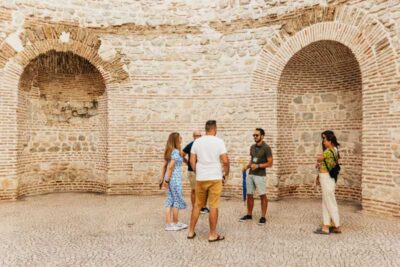

Game of Thrones Tour with Diocletian’s Palace Cellar
Read our review →
Diocletian’s Palace and Old Town SMALL GROUP Walking Tour
Read our review →
Browse the lists this tour appears in