
Review · PALACE WALKING TOURS
Tokyo Castle & Imperial PalaceーShogun Walking Tour
Edo Castle was once Japan’s largest fortress, yet its most impressive defenses are easy to miss if you simply stroll through the Imperial Palace grounds. This two-hour walk puts the gates, guardhouses, stone walls, and castle ruins into a clear story about shoguns, samurai, and the long-running imperial system.
I like the small-group format of up to 10 people, which makes it easier to ask questions and hear the guide among Tokyo’s open public grounds. I also like the mix of serious history and peaceful scenery, especially the koi pond and Ninomaru Garden. The main drawback is that you do not enter the Emperor’s residence, and the tour is conducted in English only. A second practical concern is the activity information, which also gives a maximum of 60 people, so confirm the expected group size before booking.
Key points to know before you book
- Edo Castle’s defenses: Learn how gates, walls, guardhouses, slopes, and watchtowers protected the shogun.
- A useful two-hour introduction: The route covers major castle remains without taking up half your day.
- English-only guiding: Japanese language support is not available.
- Gardens and history together: See the former castle tower site, Ninomaru Garden, seasonal plants, and koi.
- Strong guide-led experience: Guides including K, Keiko, Ai, Yuuki, Shin, and Mako have been praised for clear explanations, humor, stories, and visual aids.
- Bring water and good shoes: You will walk in exposed areas and tackle steep slopes or stairs.
Why Edo Castle is more than a garden walk

The Imperial Palace grounds can look like a pleasant green break in central Tokyo. Without context, though, it is hard to picture the enormous political machine that once operated here.
This tour helps you see the present site as the former heart of Edo, the city that became Tokyo. The focus is not only on the emperor. You also learn about the shogun, the samurai who guarded him, and the defensive design that made Edo Castle difficult to attack.
The castle was never breached. That fact gives the route a useful thread. Each gate, wall, guardhouse, and tower becomes part of one question: how did this place protect its ruler?
I find that approach more useful than a simple parade of dates. The guide connects the physical remains to the people who used them. Lower-ranking samurai worked at one guardhouse, larger numbers were stationed at another, and higher-ranking officers held duties closer to the inner gate.
The experience is designed for a group of no more than 10, which should allow for a more personal exchange than a large coach tour. However, the supplied activity details also list a maximum of 60 participants. That is worth checking when you book, since the difference could affect how easily you hear the commentary.
More Palace Walking Tours in Japan
- Tokyo: Imperial Palace and Shogun Historical Walking Tour
★ 5.0 · 2,251 reviews - Tokyo Castle & Imperial PalaceーShogun Walking Tour
★ 4.7 · 1,068 reviews - Tokyo: Imperial Palace Japanese History Walking Tour
★ 4.9 · 987 reviews
Starting at Wadakura Fountain Park
The meeting point is the Starbucks Coffee at Kokyo Gaien Wadakura Fountain Park, 3-1 Kōkyogaien, Chiyoda City. The location is near public transportation and places you beside the broad open grounds outside the palace area.
Arrive ready to walk. This is not a ride-through sightseeing trip, and the value comes from seeing the remains at foot level. You can examine the scale of the stonework, look across the former defensive approaches, and pause for photographs.
The palace grounds require a security check. Do not bring knives or alcohol. The Emperor’s residence is not open to the public, so keep your expectations focused on the surrounding grounds, historic structures, and gardens rather than an interior palace visit.
The route is listed as ending back at the meeting point, while the itinerary also says the tour concludes in front of the ginkgo-lined avenue stretching toward Tokyo Station. Ask your guide for the exact finishing point on the day, especially if you have a timed reservation afterward.
Sakurada Tatsumi Yagura, a surviving Edo-period turret
The first stop is Sakurada Tatsumi Yagura, a surviving turret from the Edo period. This is a good opening sight because it gives you a solid piece of the old castle before the walk moves through gates and gardens.
The guide explains the security systems that still shape access to the Imperial Palace today. You begin to notice that the castle was not protected by one giant wall alone. Its safety came from layers of barriers, controlled movement, guard posts, and carefully planned approaches.
The stop lasts about 20 minutes, making it the longest single pause on the route. That extra time should help you get oriented and understand the basic layout before moving deeper into the former castle grounds.
Otemon Gate and the logic of castle defense
At Kokyo Otemon Gate, you see two massive gates and stone walls from the original castle. The stop lasts about 10 minutes, but the subject is one of the tour’s most useful: how the design slowed, confused, and exposed anyone trying to reach the shogun.
Look closely at the relationship between gate openings and the stone walls. The point is not merely that the walls are old or impressive. Their placement shaped how people entered and moved through the castle.
This is where a guide adds real value. A sign can tell you a gate’s name. A good guide can explain why there were multiple gates and what that meant for castle security. K, one of the guides praised for this tour, is described as clear, enthusiastic, and able to answer questions in detail. Other guides, including Ai and Tomo, have also been singled out for explaining the grounds in an engaging way.
More Palace Walking Tours in the world:
- Venice: Doge’s Palace and St Mark’s Basilica Walking Tour
★ 4.4 · 6,291 reviews - Split: Old Town and Diocletian Palace Walking Tour
★ 4.9 · 4,727 reviews - Walking Tour of Split and Diocletian’s Palace
★ 5.0 · 2,588 reviews - Bangkok: Grand Palace and Wat Phra Kaew Guided Walking Tour
★ 4.4 · 2,417 reviews
Three guardhouses and the samurai ranks
The next three stops turn the castle’s defenses into a human story. At Constable Guardhouse, you learn about the lower-ranking samurai who worked there and why the position mattered.
At Hyakunin Bansho Guardhouse, the scale increases. This was a large guardhouse where many samurai were stationed. The name and location help explain that castle security required a substantial workforce, not just a few elite warriors near the shogun.
Obansho Guardhouse brings you closer to the inner gate and the higher-ranking samurai who served there. Together, the three stops show a hierarchy. You are not simply looking at three old buildings. You are following the movement from outer security to more trusted positions near the castle’s center.
Each stop is scheduled for about 10 minutes. That keeps the tour moving, though it also means the explanations must stay focused. If you want a long discussion of samurai life, this will feel brief. If you want a clean introduction before exploring more of Japan’s history on your own, the pacing makes sense.
The guides can make a major difference here. Keiko has used laminated images of former castle layouts, guard towers, and the imperial family to make the past easier to picture. That kind of visual aid is especially helpful when the original structures are gone or heavily altered.
Fujimi-yagura and the view from a watchtower
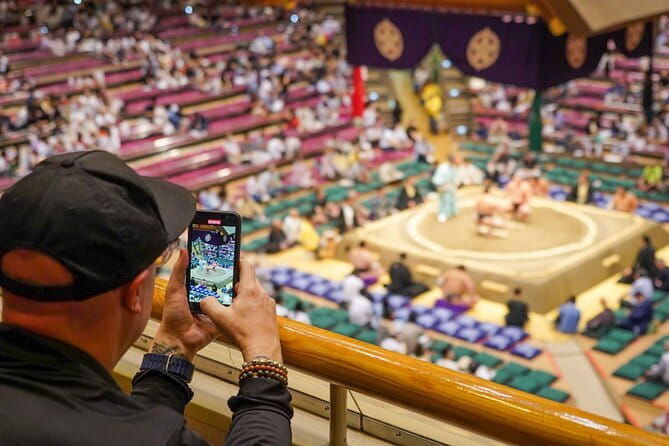
Fujimi-yagura is an old watchtower overlooking the grounds. Here, the discussion turns to its former role and what made the structure special.
Watchtowers are easy to understand in theory, but the location gives the explanation more force. You can consider what guards needed to see, how a tower fit into the wider defense system, and why height mattered in a fortified castle.
The route includes steep slopes and stairs, so this is one point where comfortable footwear matters. There are no stated health restrictions, and most people can participate, but the tour is not a flat pavement stroll. If you are managing limited mobility, ask before booking rather than assuming the palace grounds will be easy.
The castle model at Kokyo Sannomaru Shozokan

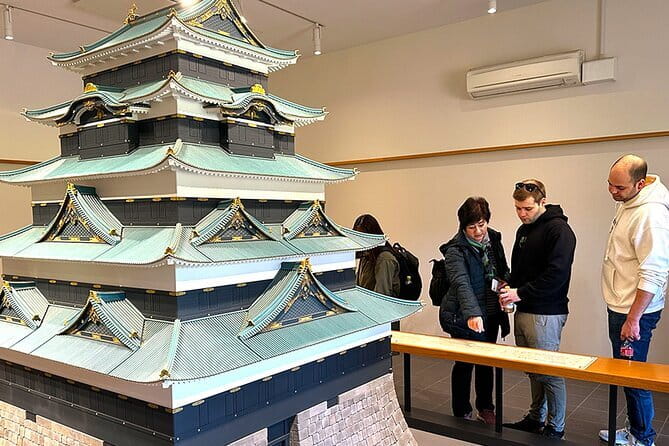
Kokyo Sannomaru Shozokan adds a visual break from the outdoor walk. You can see a scale model of the former Edo Castle and visit a souvenir shop with palace-related goods.
The model is valuable because the modern grounds no longer show the entire castle as it once existed. A scale view can help you connect the separate gates, guardhouses, walls, and tower sites into one huge complex.
This stop lasts about 10 minutes, so it is more of a focused viewing point than a long museum visit. Guides such as Keiko have also brought printed images to show how the castle looked in earlier periods. If you learn best through maps and pictures, pay close attention here.
The former main tower site
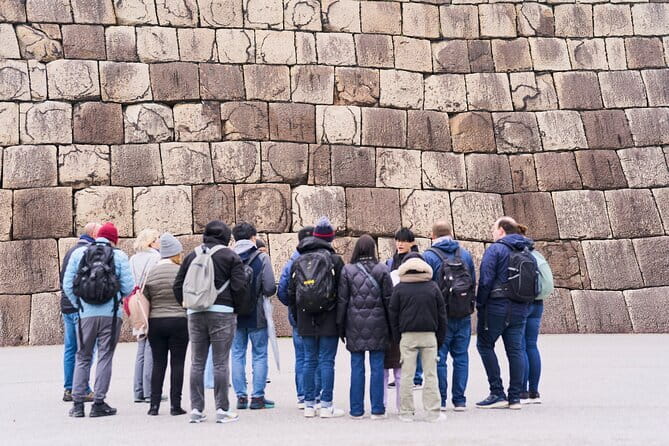
The East Gardens of the Imperial Palace contain the former site of Edo Castle’s main tower. The tower itself is no longer standing, and the guide explains why and what remains.
This is one of the most important stops for understanding the difference between historical importance and surviving architecture. You will not see a complete castle keep rising above Tokyo. Instead, you see the ground and remains of a structure that once represented the center of power.
The stop is scheduled for about 15 minutes. That gives the guide time to explain the lost tower rather than brushing past an empty site. It also gives you a chance to appreciate how much of the castle story depends on layout, foundations, and imagination.
The tour’s broader lesson about the 2,600-year imperial system fits here, though the Edo period and shogun era receive much of the attention. If your main goal is an interior view of imperial life today, this is not the right activity. If you want to understand how the castle grounds connect samurai government with the modern Imperial Palace, it works well.
Ninomaru Garden, koi, and a quieter side of the grounds
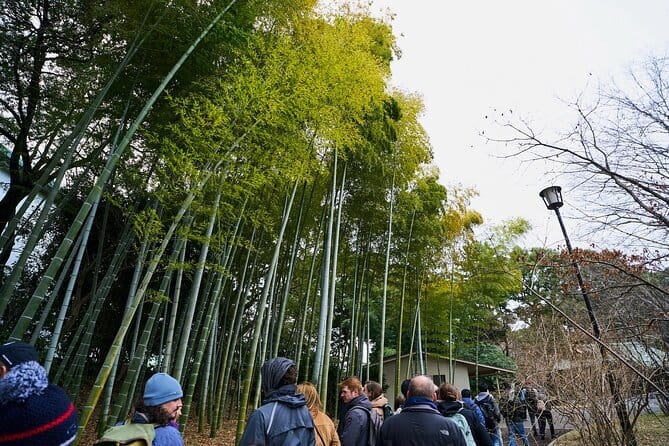
Ninomaru Garden changes the pace. After stone walls, guarded gates, and military history, you reach a traditional Japanese garden with seasonal plants and a pond filled with koi.
The stop lasts about 15 minutes. I like that the route saves room for this calmer setting. You get more than a history lecture and a series of fortifications. You also see how the former castle grounds function as a beautiful public space today.
The garden is a good place for photographs, but do not treat it as a long garden visit. The tour moves on, and the main purpose remains the relationship between the garden and the former castle site.
Several guides have been praised for pointing out the beauty of the pond and trees while explaining the past. Dai, for example, is noted for combining clear historical information with attention to the garden. On a hot day, this section may feel welcome, though much of the route is exposed to the sun.
What the guide adds to the experience
The tour’s strongest feature is the guide’s storytelling. The grounds are free to enter at the listed stops, so you are paying for explanation, structure, and the chance to ask questions.
The best guide accounts describe a lively style rather than a dry lecture. K is praised for humor, passion, and detailed answers. Shin is described as particularly strong on the palace grounds, Japanese history, and the Edo period. Yuuki, Yuta, Nana, Mayuko, Anju, Franky, and Mako are also praised for friendly explanations, patience, and enthusiasm.
You should not assume every guide will speak with the same ease. One person left disappointed because the guide’s English was difficult to follow and felt a guide was unnecessary for the garden. That is the clearest warning in the feedback. Since the tour is English only, clear spoken English is central to its value.
The good news is that the activity is built around questions and conversation. Nana is noted for taking extra time with a family, while Yuuko and Shin are praised for answering questions. If you want to understand the difference between a shogun and an emperor, or why a guardhouse mattered, use the time to ask.
Price, length, and practical value
At $23.88 per person, this is a reasonably priced introduction to one of Tokyo’s most important historic areas. The entrance stops are listed as free, so the price is not buying admission. It is paying for a planned route and about two hours of interpretation.
That is good value if you are new to Japanese history or find large historic sites hard to read on your own. The tour gives you a framework you can use later at museums, castles, and other Edo-period sites.
The value is weaker if you prefer to wander silently, take long photographs, or read signs at your own pace. The Imperial Palace grounds can be visited without this tour, and one critical experience found the guide unnecessary. You are paying for the story, not for special access to the Emperor’s residence.
The pace is described as just right by several people, but conditions matter. In hot weather, bring water, a hat or umbrella, and sun protection. One guide reportedly handed out sweets and menthol napkins during an especially hot walk, but you should not count on that as a standard service.
Wear shoes that can handle slopes and stairs. Rain is possible, and one guide continued explaining the grounds in wet weather, but a rain-ready plan will make the two hours more comfortable.
Free cancellation is available if you cancel at least 24 hours before the start time. Changes or cancellations inside that window are not refunded.
Who should book this castle walk?
I would choose this tour early in a Tokyo visit if I wanted a quick grounding in the shogun era, samurai ranks, and the Imperial Palace grounds. The two-hour length leaves the rest of the day open, and the route combines major historic points with a garden and koi pond.
It suits first-time visitors, families who want history explained in plain terms, and anyone who looks at castle ruins and wonders what used to be there. The visual materials used by some guides can also help children and adults who find dates and names hard to retain.
I would skip it if your priority is entering the Emperor’s residence, seeing lavish palace interiors, or spending a full morning in a garden. I would also hesitate if steep slopes, stairs, strong sun, or English-only commentary would make the walk difficult.
Should you book the Tokyo Castle and Imperial Palace Shogun Walking Tour?
Yes, if you want the Imperial Palace grounds to make historical sense rather than appear as a pleasant but silent park. The price is fair, the route covers the key surviving defenses, and the guide can turn empty spaces into a clear story about Edo Castle and the shoguns.
Book with realistic expectations. You will see gates, guardhouses, ruins, a model, and a garden, not the Emperor’s residence or a complete castle. Confirm the group size, prepare for sun and stairs, and treat the guide’s English delivery as an important part of your decision. For most first-time visitors who want a focused history lesson with attractive scenery, it is a worthwhile two-hour stop.
FAQ
How long is the Tokyo Castle and Imperial Palace Shogun Walking Tour?
The tour lasts approximately two hours.
What language is the tour conducted in?
The tour is conducted in English only. Japanese language support is not available.
Where does the tour begin?
It begins at Starbucks Coffee in Kokyo Gaien Wadakura Fountain Park, 3-1 Kōkyogaien, Chiyoda City, Tokyo 100-0002, Japan.
What places are included on the walk?
The route includes Sakurada Tatsumi Yagura, Kokyo Otemon Gate, Constable Guardhouse, Hyakunin Bansho Guardhouse, Obansho Guardhouse, Fujimi-yagura, Kokyo Sannomaru Shozokan, the former Edo Castle main tower site, and Ninomaru Garden.
Can I enter the Emperor’s residence?
No. The Emperor’s residence is not open to the public during this activity.
Is there a security check?
Yes. You must pass a security check to enter the Imperial Palace area. Do not bring knives or alcohol.
Is the tour suitable for most people?
Most people can participate, but the route includes steep slopes and stairs. Comfortable footwear is recommended.
What is the cancellation policy?
You can cancel for a full refund up to 24 hours before the experience starts. Cancellations or changes made less than 24 hours before the start time are not refunded.
More Royal Palace Tours in the world
- Madrid: Royal Palace Fast-Access Admission Ticket
★ 4.6 · 13,856 reviews - Madrid: Royal Palace Expert Guided Tour with Skip-the-Line
★ 4.7 · 8,407 reviews - Amsterdam: Royal Palace Entry Ticket + Audio guide
★ 4.6 · 7,889 reviews - Dubai To Abu Dhabi: Grand Mosque, Royal Palace & Etihad Towers
★ 5.0 · 7,632 reviews
Newly added in the world
- Avignon: Around The Palace Tour★ 4.5 · 13 reviews
- Ayutthaya Full-Day Tour with Bang Pa In (Summer Palace)★ 5.0 · 2 reviews
- Bali: Gate Of Heaven and Water Palace Tirta Gangga Package★ 4.7 · 3 reviews
- Aranjuez: Royal Palace Guided Tour★ 4.5 · 93 reviews
- Asia Continent & Topkapı Palace & Harem. Guided, Small group★ 4.9 · 3 reviews
- Kornik Castle and Rogalin Palace Half-Day Private Tour★ 5.0 · 2 reviews
- Antananarivo: Guided Tour and sunset in queen’s palace★ 3.9 · 13 reviews
- Royal Palace of Aranjuez Small-Group Tour with Entry Ticket★ 5.0 · 2 reviews
Palace Walking Tours, compared.
Doge’s Palace and St Mark’s Basilica Walking Tour
Read our review →

Grand Palace and Wat Phra Kaew Guided Walking Tour
Read our review →
Imperial Palace and Shogun Historical Walking Tour
Read our review →
Madrid Old Town & Royal Palace Walking Tour Skip the Line Ticket
Read our review →
Knossos: Knossos Palace Skip-the-Line Guided Walking Tour
Read our review →
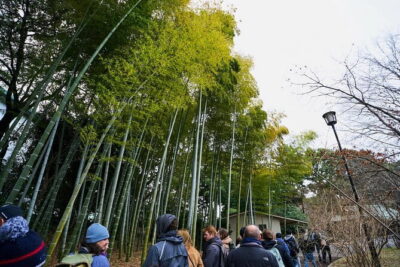
Tokyo Castle & Imperial PalaceーShogun Walking Tour
Read our review →Browse the lists this tour appears in