
Review · PALACE GARDENS AND GROUNDS
Tokyo: Edo Castle Ruins & Imperial Palace East Garden Tour
Edo Castle is mostly gone, but its stone walls, gates, guardhouses, moats, and garden paths still tell a powerful story. This two-hour walk connects the world of shoguns with the modern Imperial Palace, giving you a useful introduction without asking you to spend half a day on your feet. Otemon Gate and the old castle defenses are the real stars.
I like the way the tour moves from the Wadakura Fountain and moat into the former castle grounds, so the story unfolds in a sensible order. I also like the stop at Ninomaru Garden, where koi ponds and clipped greenery offer a quiet finish. The main caution is guide quality. Some guides, including Isao and Mari, have been warm and thorough, while one guest found the commentary too thin for the price.
Key points to know before you book
- The tour visits the former Edo Castle grounds, not the Imperial Palace interiors.
- Otemon Gate and the old guardhouses explain how samurai-era security worked.
- The Tenshu-dai offers broad views across the surrounding area.
- Ninomaru Garden is the calmest and most scenic part of the walk.
- The $37 price is reasonable when your guide provides strong historical context.
- Comfortable shoes matter because the experience is a walking tour over two hours.
Why Edo Castle is worth your time
Tokyo can feel like a city built for the present, with trains, towers, shops, and crowds competing for your attention. The Imperial Palace East Garden offers a different view. Beneath the greenery and broad paths are the remains of Edo Castle, once the center of political power in Japan.
The castle was tied to the Tokugawa shoguns, who ruled Japan for more than two and a half centuries. Later, the site became associated with the emperors and the Imperial Palace. You will not enter the palace buildings or the inner grounds where the Imperial Family resides. Instead, you explore the public gardens and the surviving parts of the old castle.
That distinction matters. If you expect palace rooms, ornate interiors, or a tour of the emperor’s residence, this is not the right activity. If you want to understand how power was organized in old Tokyo, the stone walls, gates, moats, and guard posts give you plenty to work with.
I find this kind of tour most useful early in a Tokyo visit. A guide can explain what you are looking at before you encounter castle references elsewhere in Japan. Without context, a stone platform may look like just another old wall. With context, it becomes part of a carefully planned defensive system.
More Palace Gardens and Grounds in Japan
- Imperial Palace East Garden and Edo Castle Walking Tour in Tokyo
★ 5.0 · 510 reviews - Tokyo: Imperial Palace East Gardens Walking Tour
★ 4.8 · 353 reviews - Tokyo Castle, Imperial Palace, Shogun & Garden Walking Tour
★ 5.0 · 211 reviews
Starting at Wadakura Fountain and the moat
Meet your guide outside the Wadakura Free Rest Area, in front of the entrance. Look for the yellow sign. This is a practical meeting point because it gives you an indoor place to orient yourself before the walk begins.
The first stop is Wadakura Fountain National Park. The fountain was built to commemorate a royal wedding, and the guide explains its connection to the Imperial family. It is a modern counterpoint to the older castle remains ahead. You begin with the site’s present-day identity, then move backward into the age of shoguns and samurai.
The fountain stop lasts about ten minutes, followed by a short look at Wadakura Moat. Do not expect a long pause here. The moat is mainly useful as a visual clue. It helps you see how water once formed part of the castle’s defenses and separated key areas from possible attackers.
This opening section is also where the guide’s quality begins to matter. A strong guide can connect the royal wedding, the fountain, the moat, and the palace grounds into one clear story. A less talkative guide may leave you feeling that you are simply walking through a park.
Otemon Gate and the first line of defense
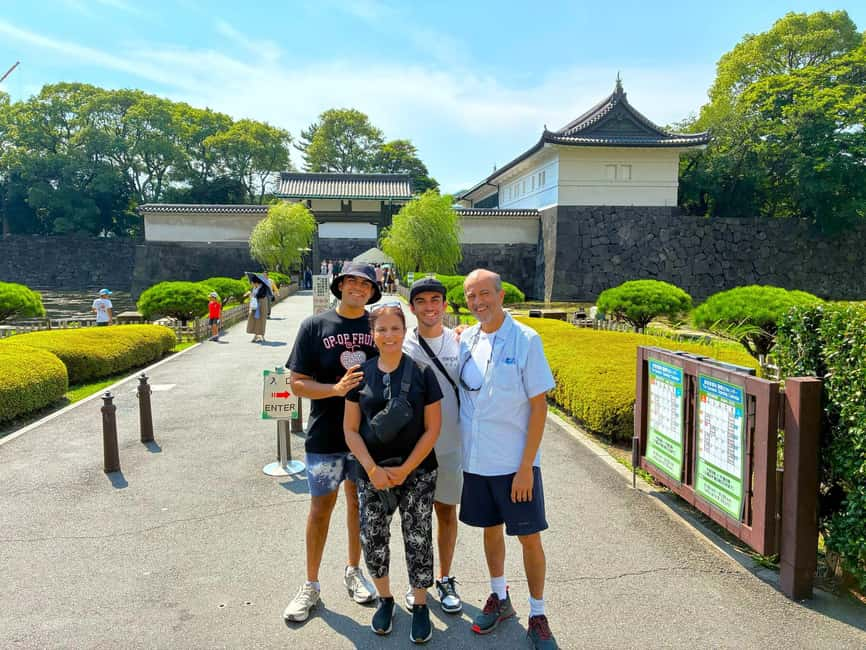
Otemon Gate is one of the most important stops on the route. It was a major entrance to Edo Castle, and its scale helps you picture the control needed to enter the castle compound. The tour gives you about ten minutes here, enough time for an explanation and photographs without turning the visit into a long architectural study.
The route then continues to the ruins of Ote San-no-mon Gate. These remains help show that access to the castle was not a simple matter of passing through one doorway. Castle entrances were arranged in stages, with turns, checkpoints, and controlled movement designed to slow or expose anyone approaching the inner areas.
You do not need specialist knowledge to appreciate this section. Look at the position of the gates and the heavy stone construction. Your guide should explain how the layout supported defense and why the approach to the castle was designed to make direct movement difficult.
For me, this is where the activity earns its price when the commentary is good. You are not only seeing old masonry. You are learning how a political center protected itself. That is a much more useful experience than taking photographs of a gate without knowing what it did.
Doshin Bansho and Hyakunin Bansho
The route continues through surviving castle security sites, including Doshin Bansho and Hyakunin Bansho. These guardhouses were part of the human side of castle defense. Walls and moats were only part of the system. Guards watched movement, checked access, and controlled who could proceed farther inside.
Hyakunin Bansho is especially useful for picturing the scale of the operation. The name refers to one hundred guards, and the site helps communicate that castle protection depended on organized personnel as much as stonework. Your guide can use these stops to explain the roles of samurai and lower-ranking officials within the castle compound.
Each stop receives about ten minutes. That is enough for a focused explanation, but not enough for a long lecture on every part of feudal Japanese society. I would treat this as a strong introduction rather than a full study of the Tokugawa period.
The route is also fairly exposed in places. Bring water, wear shoes that feel good on a long walk, and keep your camera ready. Flash photography is not allowed, and smoking is prohibited.
More Royal Palace Tours in Japan
- Tokyo: Imperial Palace and Shogun Historical Walking Tour
★ 5.0 · 2,251 reviews - Tokyo: Imperial Palace Japanese History Walking Tour
★ 4.9 · 987 reviews - Tokyo: Imperial Palace and Shogun Walking Tour
★ 4.9 · 935 reviews - Tokyo: Imperial Palace, Sensō-ji Temple, & Tokyo Tower Tour
★ 4.5 · 339 reviews
The castle ruins and Honmaru main hall site
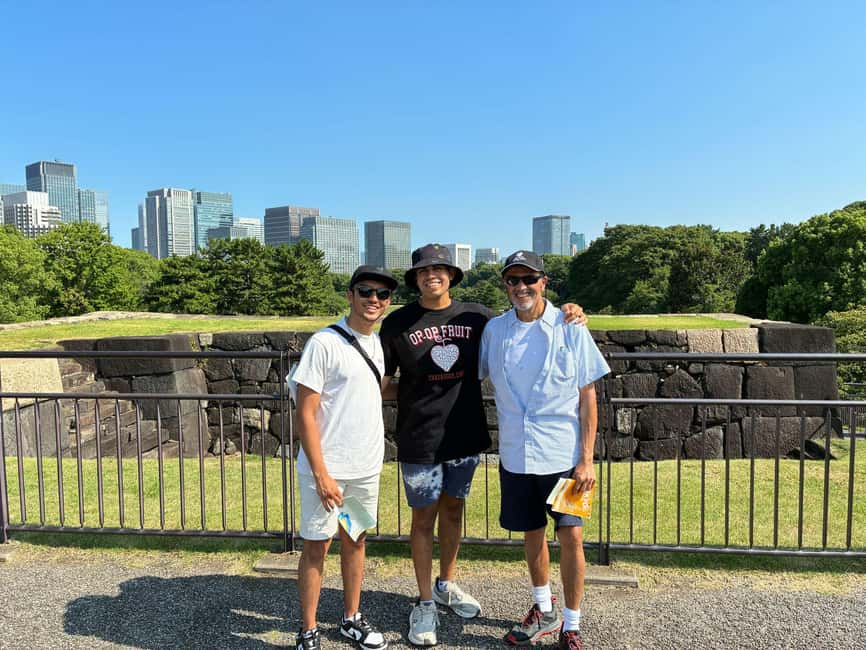
The Edo Castle Ruins section gives you time to look at the larger remains and understand the castle’s former scale. The experience does not present a complete reconstructed fortress. Instead, you read the site through foundations, walls, open spaces, and the guide’s explanation.
The Honmaru area was the castle’s main enclosure. The site of the main hall helps you picture where important political and ceremonial activity took place. Much of the original structure is gone, so this stop depends heavily on explanation. If your guide talks through the layout and purpose of the area, the empty ground becomes far more meaningful.
You will also see a reconstruction model of the Edo Castle keep. This is particularly helpful because the original keep is not standing. The model gives you a sense of the building’s height and design, while the remaining stonework shows what survives on the ground.
The model and the ruins work well together. One gives you the missing shape, and the other gives you the physical remains. You should not expect to climb through a restored keep or enter historic castle rooms. The reward is visualizing what once occupied the site.
Views from the Tenshu-dai
The Tenshu-dai is the base area associated with the castle keep. From here, you get panoramic views over the surrounding area. The view is not a mountain panorama or a high-rise observation deck experience. Its value comes from standing on the site where the castle’s tallest structure once helped define the center of power.
This is one of the better photo stops on the walk. It also gives you a short break from looking at gates and walls. Take time to notice the contrast between the open garden, the modern city, and the old castle platform.
The tour includes a stop connected with the prefectural trees, as well as Suwanotei tea house. These points add variety to the route. The trees provide a seasonal and regional touch, while the tea house brings in a quieter architectural element.
The exact balance of time can depend on your guide and group. The listed schedule gives roughly ten minutes at several of these stops, so expect short explanations rather than extended free time. If you want to linger for detailed photographs, ask your guide early so you know how much flexibility you have.
Ninomaru Garden and the koi pond
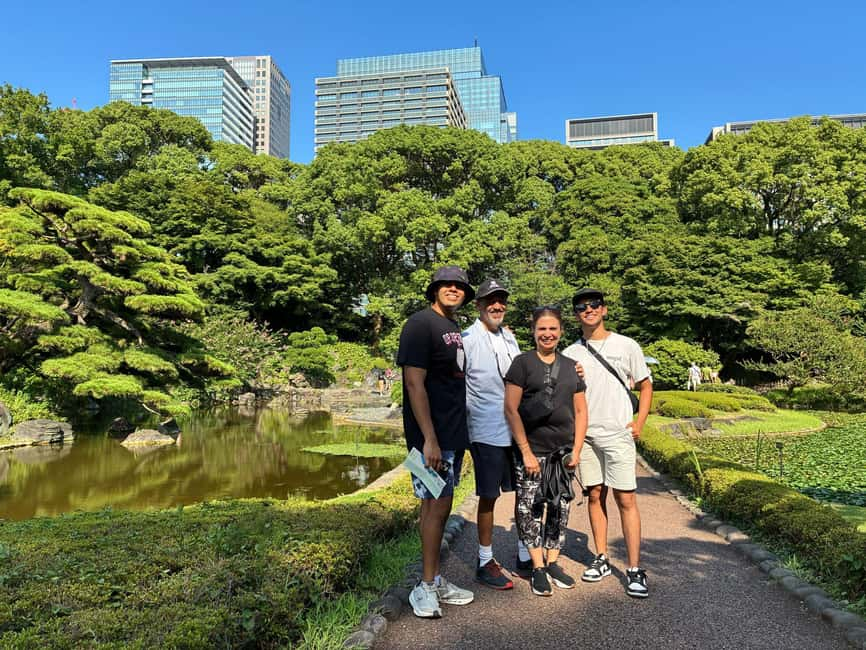
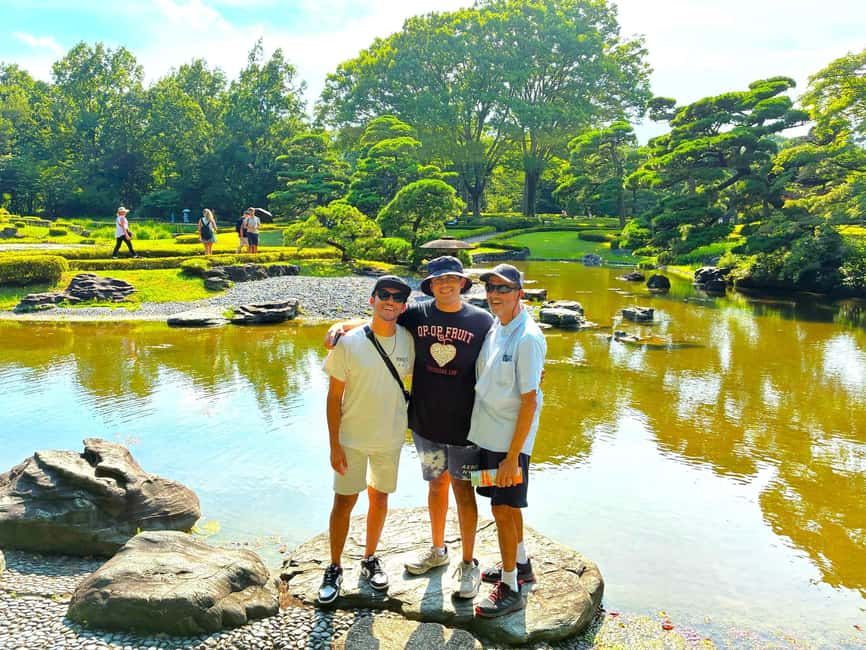
Ninomaru Garden is the gentlest part of the experience. After the defensive gates, guardhouses, and castle ruins, the garden gives you room to slow down. Its paths, plantings, pond, and koi offer a calmer picture of the grounds.
The garden is not simply a pretty ending. It shows how the castle site served more than military and political purposes. Gardens offered space for quiet, ceremony, and controlled beauty within a heavily defended compound.
You get about fifteen minutes here, followed by another fifteen minutes in the Imperial Palace East Gardens before returning to the Wadakura rest area. That timing is enough to enjoy the setting, though you will not have hours for an unhurried garden visit.
I especially like this part for visitors who want a break from Tokyo’s noise. The koi pond gives you an easy focal point, and the garden feels more restful than the formal gate areas. Still, the tour remains guided, so it is not designed as a long personal meditation or photography session.
What the $37 price really buys you
At $37 per person, this is not a bargain-priced stroll, but it can be fair value. Admission to Edo Castle and the Imperial Palace East Garden is included, along with a live English-speaking guide and a commemorative photo opportunity. The activity also lasts two hours, which is long enough to cover the major sites without taking over your day.
The value rests mostly on the guide. Mari has been praised for teaching a great deal, while Isao has been described as friendly, patient, and willing to answer questions. Another guide gave detailed historical explanations and allowed extra time for the subject. Those are exactly the qualities you want here because the ruins do not explain themselves.
There is a clear risk. One guest felt the activity was little more than a park walk and thought it could be done independently. That criticism is fair if your guide says very little. The grounds are public, and you can explore them without booking a tour.
So ask yourself what you need. If you enjoy reading signs, checking maps, and researching Edo Castle on your own, the admission and guide fee may not feel essential. If you want the gates, guardhouses, and castle platform explained in plain English, the extra cost makes more sense.
The overall rating is 4.4 from 13 reviews, with several strong scores and a few low ones. That spread tells you to keep expectations realistic. The route is solid. The guide is the variable.
Who will enjoy this two-hour walk
This experience suits first-time visitors to Tokyo who want a short historical activity near the Imperial Palace. It is also useful for anyone interested in samurai-era government, Japanese castle design, or the transition from shogunal rule to the imperial period.
You will get the most from it if you ask questions. Ask about the gates, the guard posts, the Honmaru area, and how the garden relates to the castle. An engaged guide can respond well, and the supplied information specifically notes that Isao answered questions patiently.
The tour is offered in English, with private or small-group options available. A smaller group may be preferable if you want to ask several questions or keep the pace comfortable. The activity does not include hotel pickup, food, or drinks, so plan your route to and from Wadakura separately.
This is not suitable for children under six, people with mobility impairments, or wheelchair users. You should be comfortable walking for two hours and moving through outdoor paths and historic grounds. Bring water, a camera, and comfortable shoes.
Should you book the Edo Castle tour?
Book it if you want the former castle grounds explained rather than simply photographed. The best parts are the Otemon Gate, the defensive guardhouses, the Honmaru site, the Tenshu-dai view, and the peaceful Ninomaru Garden. Together, they give you a clear sense of how Edo Castle worked and why the site still matters.
Skip it if you mainly want to enter the Imperial Palace buildings, see lavish interiors, or explore entirely at your own pace. You will remain outside the palace’s inner grounds, and the experience depends strongly on how much your guide contributes.
For most first visits, I think the tour is a sensible two-hour introduction. Just book it for the history, not for palace access, and arrive ready to walk. If you are assigned a guide with the warmth and patience shown by Mari or Isao, the $37 fee should feel well spent.
FAQ
Where does the tour meet?
Meet outside the Wadakura Free Rest Area, in front of the entrance. The guide will be holding a yellow sign.
How long does the tour last?
The tour lasts two hours and returns to the Wadakura Free Rest Area.
Is the tour conducted in English?
Yes. The live tour guide language is English.
Does the tour enter the Imperial Palace buildings?
No. The tour does not enter the palace buildings or the inner grounds of the Imperial Palace. It focuses on the public gardens and the former Edo Castle ruins.
What is included in the price?
The price includes a live tour guide, admission to Edo Castle and the Imperial Palace, and a commemorative photo opportunity.
What should I bring?
Bring comfortable shoes, water, and a camera. Flash photography is not allowed.
Is the tour suitable for wheelchair users?
No. The activity is not suitable for wheelchair users, people with mobility impairments, or children under six years old.
More Royal Palace Tours in Tokyo
- Tokyo Castle & Imperial PalaceーShogun Walking Tour
★ 4.7 · 1,068 reviews - Tokyo Castle & Imperial PalaceーShogun Walking Tour
★ 5.0 · 724 reviews - Tokyo: Imperial Palace, the history of Japan (ENGLISH GUIDE)
★ 5.0 · 77 reviews - Full Tokyo: Meiji Shrine, Imperial Palace, Asakusa & Skytree
★ 4.7 · 16 reviews
More Palace Gardens and Grounds in Tokyo
- Tokyo: Edo Castle & East Garden of the Imperial Palace Tour
★ 4.7 · 112 reviews - Tokyo: Pvt. Tour – Edo Castle & Imperial Palace East Gardens
★ 4.8 · 63 reviews - Tokyo: Imperial Palace East Gardens and Tokyo Station Tour
★ 5.0 · 16 reviews - Paris: Versailles Palace and Gardens Full Access Ticket
★ 4.6 · 41,579 reviews
Newly added in Tokyo
- Tokyo walking tour around Imperial Palace and Tokyo Station★ 5.0 · 3 reviews
- Tokyo: Imperial Palace, the history of Japan (ENGLISH GUIDE)★ 5.0 · 77 reviews
- Tokyo: Imperial Palace with Nostalgic Alley Kagurazaka tour★ 4.3 · 8 reviews
- Tokyo: Pvt. Tour – Edo Castle & Imperial Palace East Gardens★ 4.8 · 63 reviews
- Tokyo: Edo Castle and Imperial Palace Guided Walking Tour★ 5.0 · 6 reviews
- Tokyo: Imperial Palace East Gardens and Tokyo Station Tour★ 5.0 · 16 reviews
- Imperial Palace Tour: Discover Samurai History with a Guide★ 5.0 · 12 reviews
- Full Tokyo: Meiji Shrine, Imperial Palace, Asakusa & Skytree★ 4.7 · 16 reviews
Palace Gardens and Grounds, compared.

Versailles Palace and Gardens Full Access Ticket
Read our review →
Skip-the-Line Tour of Palace and Gardens Access
Read our review →
Schönbrunn Palace & Gardens Skip-the-Line Tour
Read our review →
Alhambra & Gardens Tour w/Nasrid Palaces Option
Read our review →
Versailles Palace & Gardens with Transportation
Read our review →
Skip-the-Line Schönbrunn Palace & Gardens Tour
Read our review →
Versailles Palace Guided Tour & Gardens Access
Read our review →
Versailles Palace and Gardens Tour from Paris
Read our review →Browse the lists this tour appears in